Showing posts with label AbinanteAndNola. Show all posts

Wednesday, January 29, 2020

This Train Ain't Bound for Glory

Model railroads are most fun when there’s action, and that means we want to model prototypes with lots of trains moving around. I chose the Vasona Branch over other SP branches because I assumed the canneries and dried fruit packing houses along the tracks could generate that action. However, I also wanted to include the photogenic locations in the Santa Cruz mountains: redwoods, oak, chaparral, and creeks in narrow canyons. I knew that industry was sparse up in Los Gatos Canyon, but just how sparse?

There aren’t a lot of sources to tell us how busy the railroad was. Maybe we’ll find a quote in a newspaper about last year’s revenue, or maybe we’ll find some railroad paperwork or photos that suggest train length. But that sort of information is rare; I’ve never had that sort of information for the Vasona Branch, but I’ve always been curious.

Luckily, there is one potential source. When railroads wanted to shut down a branch line, they’d need to ask permission from the Interstate Commerce Commission to make sure they weren’t leaving customers in the lurch. The ICC decisions on abandonments give us at least a small view into an under-performing branch.

I’d always been curious about the abandonment proceedings, but assumed the details would be in a dusty book in a university library’s off-site storage. I’d asked around when I was visiting the California State Railroad Museum last week, but the likely books were stored off-site. Some poking around showed that some local libraries might also have some of the ICC decisions, but none of the places were easy to access. I knew rough dates of abandonments, and web sites like abandonedrails.com even provided the ICC “docket number” to help with searches - the abandonment of the Los Gatos - Olympia portion of the line in 1940 was ICC docket #12815.

It’s also the 21st century, so there’s a good chance some of those documents are on-line. So I tried a few searches with different keywords in different permutations: “interstate commerce commission”, “abandonment”, “los gatos”, “South Pacific Coast”.

Pay dirt. The abandonment decisions for SP’s Boulder Creek branch (1933), Le Franc to New Almaden (1933 also), Los Gatos to Olympia (1940), and Campbell to Le Franc all turned out to be on-line, with links below. None of these are particularly compelling reading: no stories of murders, or heroic rescues, or amusing encounters with grizzly bears, but just some dry stories: “This railroad no longer has a reason for being there, the folks living nearby don’t need it, and the railroad doesn’t want to run it.” They’re also not full of railfan facts such as locomotives and engineers. However, they still give us a sense of what the railroad was like.

From the Southern Pacific Company Abandonment of theSanta Cruz branch from Los Gatos to Olympia:

“The line proposed to be abandoned is an intermediate segment of the branch connecting San Jose… with Santa Cruz. It was built by the South Pacific Railroad in 1870-1880 and acquired by the applicant in 1937. The main track is laid with 90 pound rail. The aggregate curvature is about 3,598 degrees, with a total length exceeding 8 miles. There are approximately 13,137 feet of timber-lined and masonry-lined tunnels… Motive power is limited to the consolidated type of locomotive…. the line serves an area mainly devoted to summer homes and resorts; there are no industries except for a limited amount of fruit growing, which is not dependent on the railroad for transportation.”

But then we start getting some of the color. “As protection against embankment slides and washouts, a pilot was sent ahead of the early morning train.” As model railroaders, having a pilot train running to watch for redwoods across the track would be quite the thing for operation. Saturday excursion runs generated most of the passenger numbers, so I should run more Sunshine Specials to Santa Cruz.

And then there’s the traffic numbers. I knew that the Santa Cruz Mountains were quiet in the 1930’s, but oh how quiet! There were only six carloads of outgoing freight between 1935 and 1939. Each year, there were only 40-70 cars inbound (except for 1939, when 392 carloads came in for Highway 17 construction.) Most of the traffic was through service: thousands of passengers, mostly for the Sunshine Special excursions. The line also carried 500-1500 carloads of sand from Olympia and “oiled crushed rock” (aka asphaltic rock) from near Davenport each year. Even with the mountainous route, shipping via Los Gatos Canyon was faster and less expensive than going the long way through Watsonville and Gilroy. The Southern Pacific admitted the costs were higher on the new route, but they'd be able to handle more cars per train. The shippers were disappointed at the loss of the short route to San Francisco, but resigned to pay an extra 0.25 cents to 1.5 cents per hundred pounds to ship their product via Watsonville. That’s all model railroad scale: about five loaded cars a day across the railroad, and one car a day ending up on the railroad.

The reports also list population, highlighting how much the Santa Cruz mountains had depopulated. Only around 1300 people were living along the line in 1939, with 500 at Alma, 150 at Aldercroft Heights, 40 at Call of the Wild, 50 at Wrights, 35 at Laurel, 196 at Glenwood, and a huge 240 at Zayante. The numbers are probably larger now, but the land’s still pretty empty.

If you go and compare those freight numbers to San Jose, it’s easy to see why the SP dumped the Los Gatos canyon line. Compare with San Jose proper. A 1940 labor law case argued that several of the dried fruit packers tried to sponsor their own union to avoid the Longshoremen’s Union getting into their business. In between stories of companies directing favored employees to organize “the right way”, there’s details about fruit volume. J.S. Roberts, on my layout, generated 1,750 tons of fruit in 1939- as much as the Los Gatos - Olympia section carried in a full year. Abinante and Nola and Hamlin Fruit generated similar traffic. Sunsweet and Del Monte would have generated 300 cars a year each in dried fruit from San Jose. It’s not hard to see how SP made its money.

For me as the modeler, these facts stress how I should keep the Santa Cruz Mountains quiet: occasional freights full of sand-laden gondola, but otherwise no sizable industries generating traffic, and a bunch of rusty sidings that may not see a train again.

Oh, and I need to model that pilot train checking the line.

Raw numbers for the Los Gatos - Olympia service:

Passenger Traffic: 


YearLocal PassengersThrough Passengers
1935815,482
19361204,842
19371294410
19381354427
1939263389

Freight Traffic:

YearLocalLCLBridge Traffic
193539 carloads / 1984 tons20 tons14 carloads / 229 tons
193631 carloads / 1557 tons 8 tons0 tons
193769 carloads / 3758 tons 22 tons416 carloads / 21,075 tons
193836 carloads / 1451 tons26 tons01,133 carloads / 64,426 tons
1939392 carloads / 21225 tons37 tons1,517 carloads / 92, 554 tons

Only 6 carloads of freight originated on the line from 1935-1939. Six.

That was fun; let’s check another!

Here’s the abandonment report for theBoulder Creek to Felton branch, torn up in 1933. “The marketable timber supply in the territory has become exhausted, there is no other manufacturing industry in the territory, farming is of no importance.” Rock and stone were the main freight being shipped, but only around 100 loaded cars or so were coming off the branch. “The only inbound carload traffic of regular nature is an occasional car of coal.” The report lists that service had declined to a weekly freight, with cars, buses, and trucks taking away business that had been for the railroad.

Or the New Almaden branch. The New Almaden mines had been shut down for years; the only traffic from the line between 1931 and 1933 was “137 tons of tomato juice”. “ The weekly mixed freight just encouraged the locals to jump in the car to get around.

Or the Le Franc branch: surrounded by orchards and vineyards, but the locals all deliver their produce by truck. From 1933-1936, the SP handled less than twenty carloads a year, and handled it all with a yard locomotive.

Again, none of these documents contain essential facts for our model railroads, but they do tell a bit about how the railroad declined, and who remained to use it during its last years. When visitors come by, we can point at a tank car, look sad, and say “137 tons of tomato juice - that’s the only thing that railroad shipped in its last year.”

Pro tips for finding similar documents: try several searches, and poke through a couple pages of search results. Use quotes around groups of words such as “Interstate Commerce Commission”. If you find a book with other railroad-related legal reports, check the index or start using keywords, and you might find some interesting gems. Abandonment reports sometimes turn up in the “Finance Reports” volume, though that wasn't true for all the cases here. If you decide not to practice your Google searching skills, check for a university library with ICC reports, or visit a county law library that has access to HeimOnline - that database apparently has all the government publications. Santa Clara County's law library provides free access if you visit.

Wednesday, August 19, 2015

How Big Was the Heating Oil Tank at J. S. Roberts?

"You don't need to know how many cars could fit on the team track at the San Jose Western Pacific freight depot to build your layout. The answer is "three", by the way."
--Byron Henderson

Not every model railroader is interested in history, but there's enough so that some potential model railroad builders get stuck trying to learn every possible detail about their prototype before they ever start building. Byron's quote highlights that we don't need all those details to have fun modeling.

But his quote also highlights how obsessive some of us can get learning about particular places. I'm guilty of that; to build my model of the Vasona Branch, I've done way more research than I really need. One particular source of my obsession has been the packing house at 740 West San Carlos Street, once occupied by J.S. Roberts in the 1930's, but occupied by Abinante and Nola in the late 1940's. I've written about Abinante and Nola many times in the past, and about working on the scene as it would have looked in the 1930's.

But, hey, how could I model that packing house without knowing everything about it? What about their oil tank used for supplying steam to the dried fruit packing plant. Was it 6,000 gallons and filled by the local oil dealer, or bigger, and supplied by rail?

I can answer that sort of question now. Heck, I can even tell you what that tank looked like. You see, I went off for lunch at Paradiso's Deli on Auzerais St., just behind the former Del Monte cannery. After some tasty ravioli and meatball, I wandered off along the Los Gatos Creek trail for sightseeing, and saw a backhoe digging off on the other side of the railroad tracks.

1902-era redwood heating oil tank being dug up.

What were they digging up? Turns out they did an environmental survey on the property at 740 West San Carlos, and discovered that the old oil tank for the packing house had never been removed. Yesterday, they'd exposed it, and found it still had 9,000 gallons of heating oil in it, and pumped out the thickened oil. Today, they were pulling up the tank to check underneath for spills. Odds are the tank was placed in the ground in 1903 when the packing house was built for Ernst Luehning and his San Jose dried fruit outpost. It was in really good shape for a hundred year old *redwood* tank that had been holding something similar to diesel fuel for all these years. The joints were still tight on the tank, and was little sign of fuel leaking through.

More importantly, the Sanborn map lied; it wasn't a 6,000 gallon tank, but closer to 12,000 gallons - probably just the size to deserve a carload of heating oil a few times a year.

Now, I'm not a stranger to the idea of shoving oil in the ground - when we lived (briefly) on the east coast, we lived in two houses with heating oil; in both cases, we had to remember to call the oil company to dump a thousand gallons of oil in our front yard so we didn't freeze to death. In our last house, we didn't quite trust the landlord to compensate us for oil we left in the tank on moving, so we tried to stretch the tank for the whole season... and ran out just before a huge snowstorm hit. Ugh. After that mistake, I really can't imagine anyone moving out of the packing house without taking those 9,000 gallons with them. But I guess landlords were much nicer in San Jose back then.

If you're ever over to see the model railroad, look over just to the right of the packing house, and with luck I'll have added some piping and vents for a certain 12,000 gallon oil tank that I know occupies exactly that spot on the model railroad.

And if you're one of those folks doing the environmental impact surveys, try aiming a couple hundred feet west. The Zicovich Winery was out there in the 1890's, and with some luck you might find some barrels of wine that survived the Great San Carlos Street Fire of 1899. Much more tasty than half-century old oil.

Photo of tank being dug out of lot at 740 West San Carlos taken by me, August 19, 2015. Thanks to the crew doing the removal for talking with me about the fun of discovering an removing the old tank. Thanks to the crew doing the digging for chatting with the strange obsessive model railroader about their site.

Friday, June 26, 2015

Don't Trust Robert's Advice on 3D Printed Buildings

In the past, I've declared that 3d printing isn't great for buildings. Most buildings are easy to make using sheet styrene or sheet wood - I can probably build them faster than I could draw them on the computer. I only need one copy of a particular building, so the ability to print multiple copies isn't so interesting. Buildings tend to be large; they're either slow to print, or won't fit at all in the 3d printer. I'll admit I've used the 3d printer to make details (such as the architectural details for the Market Street station, or the freight doors I borrowed from the Guggenhime packing house. But buildings? Not worth the trouble.

Well, actually, sometimes the 3d printer can help with buildings, and two recent projects highlight when the printer might come in handy.

J. S. Roberts and clerestory windows Early 20th century buildings often used clerestory windows - raised sections of roof with small windows - as a way to bring light into the center of a building. We usually think of this with sawtooth roof factories, but you'd also see this in frame structures. The J. S. Roberts packing house off San Carlos Street got light into the fruit sorting area on the third floor with a raised roof and some small windows, all above the barn-like building's normal roof line.

J.S. Roberts clerestory windows

Clerestory windows like this are a pain to scratchbuild. There's not a lot of good, tiny window castings if you're trying to model a strip of two foot high windows. Because the clerestory roof is often only raised a couple feet, building the walls around the window can be difficult. If the clerestory is on a peaked roof, then I've also got to cut the ends to match the roof slope precisely. The last time I did a model like this, I used some 3d printed blocks to form the clerestory section, but still had to cut the lapped siding sheet to fit. For that model (the Earl Fruit Company packing house on Ryland St.), I wasn't completely happy with the overall clerestory look (too few windows, clerestory section too tall), but I decided it would do.

When I completed the main section of the J.S. Roberts packing house, I knew I needed to make another clerestory roof to finish the project. However, the 1930's photos I'd seen showed a very short space between the two roofs. I couldn't think of any commercial windows that would work, and I knew the whole assembly would be tedious to build.

Clerestory 3d model

Roof and access hatch

Instead, I cheated - I sketched the whole clerestory roof - siding, windows and all - as a single piece. I didn't have to worry about cutting the angles against the roof (as long as I measured the angle correctly.) I could size the windows to exactly match the space. I did have to draw out the location of *every single board* for the siding - tedious, but doable on this relatively small model. The result was too big for the printer, so I split it in two, printed two copies, and glued the pieces together to make a completed clerestory assembly. After painting and attaching corrugated siding for a roof, I was done. The windows, although solid, got some black gloss paint to make it look like there really was glass in those panes. The result was just right - a roofline that matches the prototype and I didnt have to cut any fussy angles.

In fact, I was happy enough with the result that I did another 3d print for the access hatch on the roof. Again, by 3d printing it, I didn't have to worry about cutting the correct angle into plastic siding, and didn't have to worry about fabricating a tiny box perfectly square.

Campbell passenger shelter for the Peninsular Railway

The Sourisseau Academy, one of the local history organizations in San Jose, posted a picture recently of downtown Campbell in the 1920's. The photo, showing the area around the railroad tracks and Campbell Ave., reminded me that the former Peninsular Railway, an interurban line, used to go from downtown San Jose to downtown Los Gatos via Campbell. The tracks cut through the new suburbs of Willow Glen and turned here and there through orchards. Just before the tracks reached downtown Cambpbell, they curved off Campbell Ave. and onto Railway Ave to pass next to the old S.P. depot. The Sourisseau's photo shows Campbell Ave. at Railway Ave. - the curve of the interurban tracks, the overgrown mess of the SP's former garden at the intersection, and a small passenger shelter at the intersection which must have been handy both in the rain and on really hot days in summer. (The photo is visible in the Sourisseau February 2015 video, showing the interurban tracks turning south onto Railway Ave.)

Now, the passenger shelter wasn't much - a bench for a couple people, simple siding, and some minor architectural details to please the town burghers. It's also exactly the sort of model that's easy to make in styrene with a couple hours work. I was still curious whether I could make one in 3d, and did some quick sketches.

Applying the siding was the annoying part; rather than just pulling some lapped siding sheet out of a drawer, I had to draw each board: correct spacing, correct overlap at the bottom, etc. The rest was pretty trivial, with the hardest part being the choice of how to print the model. (I chose to print it upside down, with the roof having the bad surface where the model attached to the 3d printer.) Some filing, and some Campbell shingles completed the model. It's not much, but it showed me that I could create small structures quickly. More importantly, I got to play around a bit with the design and experiment with the decorative eave ends. For my layout, 3d printing the shelter is a bit of overkill, but if I needed three or four, it might have been a suitable project for 3d printing.

I still think 3d printing isn't particularly useful for 3d structure models, but these two projects reminded me that 3d printing could still be handy either for work that would be challenging to do by hand, or where I wanted to experiment with details or shapes.

Monday, July 14, 2014

3D Printing Stories: Flats of Drying Apricots

[Sorry, history buffs - feel free to skip all the 3d printing and model building articles coming up.]

Here's the latest project for the 3d printer: stacks of drying flats.

The new version of the "Abinante and Nola Packing House" is getting finished. The building is now labelled as J.S. Roberts, the actual occupant in the mid 1930's. I've got the rough building done, but there's still some details... like a roof... to finish. But it's looking finished.

The J.S. Roberts packing house had one unusual feature: a separate addition contained a "sulfur box" - a sealed box where apricots could be smoked in burning sulfur fumes to preserve the fruit and keep the bright orange color. Many farm drying yards had a makeshift sulfur box. However, our packing house had the sulfur box on the third floor, right next to where the fruit would be sorted and graded. That makes some sense - the dried fruit would be brought to the packing house in sacks, and carried to the top floor for sorting and grading. If it met our packer's standards, it was dropped into bins on the second floor, and pulled out on the first floor for boxing. Having the sulfur box at the top meant that it was queasy to unload.

Now, having that third floor addition for the sulfur box is kind of interesting - it's 20 feet off the ground, and probably stuck out because of the different construction and exterior look. I took some creative license, and decided having burning anything close to the main building would be inappropriate, so I put the sulfur boxes on the far side of a small deck off the second floor. And if I've made the sulfur boxes visible to the outside, I'll also need to show the fruit going in.

That means I need drying flats - the real sulfur boxes would have taken stacks of flats each holding a layer of apricots. Drying flats are useful for other scenes on the railroad. In farm drying yards, women in the cutting shed would have halved apricots and put them on the flats; stacks would then have been rolled on small carts out into the drying yard to be laid out for drying in the sun. I've made a few drying flats by hand out of card stock and 1x4 scale lumber, but those pieces are tedious, small and fiddly. Doing a stack of 15 would be even worse. Luckily, a 3d printer doesn't know about tedious.

The drying flat stacks are about 3/8 inch wide, one inch tall, and one inch deep. The center of the model is hollow, but the individual flats are actually separate on each end. These were painted with a weathered black, then washed with Floquil grime for a translucent, white look of weathered wood. I made stacks in several different heights: five flats, 12 flats, and 15 flats. Printing some individual flats would also be fun, but I'll need to figure out how to set up the prints.

I did the 3d design for these in SketchUp, which is wonderful for rectangular designs like these. My first designs were too thin; I'd started with a one inch lumber border around each frame, but the printer needed walls to be more substantial than 0.010 inch. The image from SketchUp shows how the side rails were two scale inches wide except for the top frame. Each flat goes back 1/8", with the bulk of the model hollow to save on resin. The fruit isn't very realistic, but it does add a bit of detail.

I'm not the only one making industry-specific details on a 3d printer. Ken Harstine has been selling orchard ladders, field boxes, and fruit lugs at Shapeways for quite a while, and his models definitely inspired me to see what I can print.

Still to come: flatcars and lumber loads, straight from the 3d printer!

Wednesday, February 5, 2014

And That's Why You Stare At Old Photos

J.S. Roberts, 1934

The dried fruit packing house at the corner of San Carlos Street and the Los Gatos branch has always gotten a lot of attention on my layout. When I was first planning the layout, I saw the name Abinante and Nola on a 1950 Sanborn map, and decided then to leave space for a packing house with that name on the side. The current model of the plant, kitbashed from a Campbell Scale Models "Tower's Flowers" kit, was a decent model - large, and with plenty of loading doors - but didn't actually match the real building.

When I finally got serious about history, I also found out that the building wasn't occupied by Abinante and Nola during the time I model. I instead found out about Higgins-Hyde, and prune pools, and crafty dried fruit buyers during the 1930's, and J.S. Roberts taking over the business after Higgins got run out of town on a rail. One of the Abinante or Nola sons told me about how he remembered the plant as a big, dark barn, and also that it was his dad's favorite warehouse because its location on a dead-end section of San Carlos Street made it easy for farmers to drop off fruit... and how my model didn't really look anything like what he remembered.

And then, I found an actual picture of the plant, and confirmed that the model was very, very wrong. Since then, making a more accurate model has been pretty high on my to-do list.

Model being assembled

Building the Model: Fast forward a year or two, and I finally start on the improved model. Because the one picture I had of the building was so poor, I instead grabbed my favorite photo of the Guggenhime packing house in San Jose and used that as inspiration. After a few pencil sketches to plan, I pulled out the styrene sheet and started cutting. This was going to be a big model - maybe 14 inches by 8 inches, and six inches high. I'd had problems with similar models warping horribly, so this time I built the model on a plexiglas core to give it some additional rigidity. That worked - I pretty quickly had the four walls, and so I moved on to painting them using my favorite trick of gesso and india ink on weathered styrene to get the appropriate weathered look.

This weekend, after much of the painting was done, I finally squared up the model and glued together the basic block. That, of course, meant it was time to move on to adding details, and the only way to do that was stare at some real packing houses and steal the best bits from them all.

Guggenhime packing house, San Jose.

Here's that photo of the Guggenhime packing house that inspired this model, taken by local commercial photographer John Gordon back in the early 1930's. Like the J.S. Roberts packing house that this model represents, the Guggenhime packing house was a big barn-like structure, three stories high, and already looking weathered here in the 1930's. My first detail was going to be the loading dock doors - I'd planned on using plastic castings, but they wouldn't fit with the plexiglas walls behind the cut outs. Instead, I turned back to the Guggenhime photo and zoomed in on some of those loading dock doors for inspiration.

Here's a close-up of one of those doors, along with my notebook scribblings as I stared at the photo. The loading doors are obviously simple things - some siding nailed on a frame of 2x4's at best. The door hangers look an awfully lot like the tracks used for boxcar doors (I even went rummaging around in my scrap box looking for just those sorts of tracks without luck, so looks like I'll be visiting the model train store soon for reasonable parts.) I really like the angled sheet metal keeping rain off the door, the half-circle metal hangars holding the door up, the 2x12 holding the track away from the building, and the plain wooden blocks acting as door stops. Look at the scratches and gouges as well - the scratches at the height of a hand truck, perhaps, and the wear and dirt close to the ground, and that scratch just where the door would be when the door was fully opened. These are great details, and I ought to be able to use them in the model. And if you zoom in on the original photo at SJSU, you'll even see that funky "2" indicating the door number in a surprisingly artistic hand.

Zooming in on Door 1:When I started looking at that photo tonight, I was having a great time writing down all these little details in hopes I could add them to the model. I even zoomed in on those doorstops, and decided they were crude blocks of 2x4s - nice detail, and easy to model. And then I zoomed in on door one, and saw many of the same details... and then realized there was a strange box stuck on top of the doorstop, maybe eight inches high. Zooming in, you can even distinguish the lettering on the box front: "SWITCH LIST".

Now, when a railroad switch crew comes to your warehouse with a boxcar, they need to figure out where to place that car. If your loading dock can only hold one car, maybe there's not a lot of choice, but Guggenhime & Co. had at least six doors spread across three buildings here in San Jose, and if the prunes for Poughkeepsie are behind door number one, you'll have some very unhappy warehousemen if they need to cart those prunes down the dock to a New York Central car spotted at door number six. Now, the railroad crew has three ways they can figure out where to put that boxcar. They might go by convention - you always want the boxcars on the near end of the track, and the tank cars over by the piping. They might rely on hearing your preferences, getting off the locomotive when they arrive and searching for the foreman to tell them what to do. And if it's the middle of the night and no one's there to tell them what to do, you might leave them a note.

The Switch List box is likely to be the place where the manager of the packing house would leave notes about where to put the different cars. He would have had his phone call with the agent or car department to find out that the empties he needs (or the cars he's waiting for) are arriving tonight, he would have known what cargos would go in each, and he could quickly scribble down what he needs. The Northern Pacific boxcar full of box shook goes to door six. The two cars for the East Coast go to doors 1 and 2. The SP car getting bags of prunes for a steamship out of San Francisco to Europe goes at door four. He pencils that in, folds the note, and puts it in the box. Late that night, the train crew rolls in with the cars for Guggenhime, stops, pulls out the instructions, curses a bit because they've got the cars in a completely different order, and starts their switching. The next morning, the manager comes in, checks his cars, and starts the crews loading and unloading them. (If it's a weekend, we might see something more like Vince Nola's memories of driving by the warehouse with his dad on Sunday night to make sure the SP had placed the cars they'd promised would be there by Monday morning.)

If an army marches on its stomach, the Switch List box reminds us that a railroad marched on a lot of paper, whether for internal consumption, sharing official correspondence with shippers, or leaving helpful notes to a crew about where a boxcar should be placed. Tony Thompson has talked about the equivalent for a station agent - the bill box used to trade the waybills (official billing papers) and switching instructions between station agents and the crews that might be visiting the town when the station was closed. Guggenhime's switch list box was very unlikely to have official paperwork because the railroads held onto that tightly for billing purposes, but the switchlist box seems just right for unofficial instructions that needed to survive a winter rainstorm. My model for J.S. Roberts will only be a third the size of Guggenhime and won't need the bill box to tell where cars should be placed, but I suspect my model will still have the bill box sitting up on top of one of those 2x4s.

[Guggenghime packing house photo from the John C. Gordon photo collection at San Jose State University. J.S. Roberts photo taken from the edge of another John C. Gordon panorama of the San Carlos Street viaduct, also in San Jose State's collection.

If you've got better ideas about how the switchlist box was used, leave a comment below or drop me a note. I'm guessing at a lot of this, and I'd love either some confirmation or suggestions about how to use a switchlist box like feature to make switching more realistic on my layout.]

Saturday, May 11, 2013

Trains Rolling Over, and Rosenberg Brothers Burns

I really need to model the 1900's. For one thing, I could make really bad trackwork and still be prototypical. Not only do trains roll over on the old narrow gauge line, but the November 10, 1906 San Jose Evening News also mentions that train #36's engine rolled over the previous day near the broad gauge depot (Market Street). Because the article was buried on page three, I suspect engines rolling over wasn't that uncommon an experience.

Up on the front page, you'll find the story that dragged me to this particular issue: the Rosenberg Brothers packing house burned overnight. As the Evening News put it:

Stewed prunes are a drug on the market today, although the supply is said to be a little overdone. Out on Ryland street adjoining the Southern Pacific tracks there are several thousand tons of thoroughly cooked fruit, enough to supply the United States Army for a month to come.
The prunes were stored in the warehouse of the Rosenberg Brothers' company awaiting shipment to the eastern markets. Early this morning, the warehouse took fire and today there is nothing left but a half block of cinders and ashes and many tons of cooked fruit.
FIRE SPREAD FAST
The fire broke out at 1:30 am in the engine room of the packing house, and spread with great rapidity until the whole interior of the building was a mass of flames. When discovered the fire had gained great headway and it was impossible to save the building for destruction.
FOUGHT FIRE BACK
The burned packing house adjoins the plant of the Inderrieden Packing Company and the firemen devoted their energies to preventing the spread of the flames in this direction. After a hard battle the fire was driven back from the Inderridden plant and the loss was confined to the Rosenberg Brothers' packing house.
A train of Southern Pacific freight cars standing upon the track adjoining the warehouse took fire before they could be hauled away and ten loaded cars were burned. A number of small dwellings on the north side of Ryland street were scorched by the extreme heat, but were saved from destruction by the chemical engine.
... It was first feared that George Gonzales, the night watchman employed at the plant, had been burned in the building, but later it was found that he was safe at home where he has been confined for several days by illness.
The plant was in full operation at present and employed a large force of girls and men. It is estimated that there were fully fifty cars of dried prunes, peaches, apricots, and pears in the building and the loss will total $100,000.
MANAGER AWAY
Rosenberg Brothers are big dried fruit packers with headquarters in San Francisco and branches in all leading fruit sections. The local manager is George Hyde. Mr Hyde was in San Francisco when the fire was discovered, having gone there on Friday.
The photo shows the Rosenberg plant a few months earlier, captured by George Lawrence's aerial photo of San Jose. You can see the line of buildings on Ryland Street, helpfully annotated by their owners in whitewash as part of the aerial photo celebration. Abinante and Nola will be in Inderrieden's plant in 1945. You can even see Earl Fruit's plant at the bottom of the photo, as well as the huge expanse of the SP freight house in the middle of the yard.

Interestingly, Rosenberg Brothers was a newcomer to San Jose, only appearing in the city directories in 1906. Time to look through old papers to see hints of what brought them to town.

And yes, the manager of the burned plant, George Hyde, is the same George Hyde that will be building a cannery in Campbell in a few years. Bet he made sure there was a substitute night watchman on hand when the night watchman got sick. George had only been doing the job for a year; the 1905 San Jose City Directory listed him as an orchardist out in Cupertino in 1905. He was still manager of the Rosenberg Brothers plant in 1907, but went back to the orchards in 1908. He'll go back into management in 1910 when he and E. E. Thomas manage their own dried fruit company, then take over the former Campbell Fruit Growers Union in Campbell.

Rosenberg moved their operation to San Carlos St. "near the creek" for the 1907 season, then to the former Santa Clara Valley Fruit Exchange plant on the northwest corner of Sunol and Auzerais Sts, where they stayed from 1908 through 1915. That year, the plant the plant was taken by arson, and Rosenberg moved to hopefully less inflammatory Santa Clara.

Also in Saturday's paper:

  • Redding man tries to hold up italian restaurant. John Leishman was refused breakfast because it was too late, so rather than ask "pelase?" he pulled out a gun.
  • Updates on the gas-pipe thug murders.
  • Maude Adams, the Debbie Reynolds of her time, turns 34.

Monday, March 11, 2013

Ha Ha! You Fell Victim to One of the Classic Blunders!

Everyone remembers the Princess Bride, right? And Vizzini's famous gloat?
Ha ha! You fool! You fell victim to one of the classic blunders - The most famous of which is "never get involved in a land war in Asia" - but only slightly less well-known is this: "Never go against a Sicilian when death is on the line!"
And of course, there's also the slightly less-known classic blunder: "Never try to break a prune pool when every prune grower in the Santa Clara Valley is trying desperately to stay solvent."

We've heard previously how the Higgins-Hyde packing company, based out of that packing house at San Carlos St. and the narrow gauge line, tried just that and managed to get pretty much every prune grower in the Valley out in force with pitchforks and torches, and encouraged the Sacramento politicians to demonize them for misstatements. Good times, good times.

When I first wrote about Higgins-Hyde, all I knew was that they had occupied the packing house I've previously described as Abinante and Nola around 1930 or 1931, and that they'd pissed off pretty much the whole Valley in 1932. I also showed how their chattel mortgages - loans to growers against the upcoming prune crops - show up in county records, giving us a chance to both understand what farm equipment the growers had as collateral, as well as the agreements that started the anger towards the company.

Luckily, there's a bit more available with some more poking around at the Clerk/Recorder's office, census records, and city directories. If you're into that sort of thing.

The Higgins-Hyde Packing Company appears around 1929, leasing the former Pacific Fruit Products / Sunsweet packing house right at the railroad tracks and West San Carlos St. The principals are Albert A. Higgins and Warren Hyde. As we saw previously, J.S. (Jack) Roberts, a salesman and fruit buyer, was a vice president, and Jacks's name often appeared on the fruit contracts.

Albert seems like a newcomer to San Jose, born in 1890 in New York. I'm not sure where he's come from; there's an Albert A. Higgins in San Francisco in 1928, an A. A. Higgins in Los Altos listed as a rancher at the same time, and an Albert A. Higgins, fruit merchant in Los Angeles in 1920, but I'm not sure which would be our man. He's newly married to Edith (Bea) Rea (he's 40, she's 23), and living with her parents on South 13th St. in San Jose.

His father-in-law, Edwin Rea, is worth an aside; a well-known San Jose lawyer, he's remembered these days primarily for defending David Lamson in his murder trial, and for getting in a fist-fight with the district attorney during that trial. Justice may be blind, but those lawyers have enough eyesight to know how to connect with a strong right hook.

Warren Hyde, however, was a very well-known and respected local citizen: an early orchardist in the Saratoga area, and a former Sunsweet director during some organization troubles back in 1922. Warren Hyde and George A. Hyde appear to have had adjoining properties out by Prospect and Quito Road at various times, making me think they might be related, or even brothers.

The building and lot at 750 West San Carlos St. were owned by H. H. Kooser and his wife at the time of Higgins-Hyde's occupancy. We know about the Koosers thanks to the legal documents associated with the building of the San Carlos St. Viaduct in late 1934. The re-routing of the road required selling a small strip of land and removal of a garage and scale, and the sale agreement included $200 for Higgins-Hyde as compensation for these changes (5/29/1933, book 652, page 386). (The viaduct was allowed by the California Railroad Commission decision 20559, if you're into that sort of thing.)

Higgins-Hyde is listed in the 1929, 1930, 1931, and 1932 San Jose city directories, hinting that they'd been around for at least a few years before the big kerfuffle with the prune pool in the dark days of summer, 1932. There were at least six chattel mortgages filed in 1932 with Higgins-Hyde: the Leo, DiSalvo, Oliva, Galvin, Greco, Rose, and Lester orchards all borrowed against a crop they were planning to sell to Higgins-Hyde that year. But once Higgins-Hyde challenged the Prune Pool and lost, they released all their growers from their contracts so they could join the prune pool. Higgins-Hyde probably lost their chance for a crop to sell over the winter of '32. At that point, having a packing house and storage space wasn't terribly useful, so Higgins-Hyde leased their packing house on July 19, 1932 to the Lawrence Warehouse Company, much as Hyde had done a few years earlier.

Higgins-Hyde could only hope for the 1933 year to be better, but it wasn't. In May, they cancelled their lease of the Hyde Cannery as storage space (5/8/1933, book 683, pg 374). On May 27, they cancel Lawrence Warehouse's lease on the 750 West San Carlos St. plant. They also appear to have started wrapping up the company in bankruptcy court. On May 29, Albert and Bea transfer orchard land in Saratoga to T. J. Miller, the trustee in bankruptcy for the company; the bankruptcy case opens for real in San Francisco on June 3. And then it's all over, except for unwinding all the various deals. It doesn't sound happy, but there's probably some stories there.

Early the next year, during that unwinding, T. J. Miller finds that Higgins-Hyde may have made the classic legal blunder: Never annoy people who might be jurors on your trial. The May 9, 1934 San Jose News has a little blurb under the title "Packing Firm Trustee Loses $2578 Prune Suit":

T. J. Miller, trustee of the Higgins-Hyde Packing Company, lost his $2578 action involving a contract for the purchase of 800 tons of prunes against Nathan L. and William Lester, growers, in Superior Judge William F. James' court yesterday when a jury awarded judgement in favor of the defendants.
I can't imagine the locals were friendly to the company that tried to break the Prune Pool, regardless of how good the contract was. I also have no idea whether this was one of the lingering contracts left over from the no-good-very-bad summer of 1932.

Analysis

Warren Hyde's connection makes me wonder if the creation of Higgins-Hyde has anything to do with the demise of George E. Hyde Packing in Campbell. The reports that the company started fading in 1928 might suggest that Warren had been selling through his brother, but the looming demise of the Hyde Cannery and dried fruit packing meant that he needed a better place to sell his crop. I'll need to keep an eye out for more hints about the history of Higgins-Hyde.

Now, all this corporate information is quite fun for those of us with some obsessive-compulsive tendencies, but it really does have an application to model railroading. For, after all, I've always been uncertain about exactly what business should exist at the site where I've now got Abinante and Nola. Now, I can lay out all the options:
  • Before 1928: unsure.
  • 1928 - summer 1932: active packing plant run by Higgins-Hyde.
  • Summer 1932 - Summer 1933: Higgins-Hyde painted on the building, but used by Lawrence Warehouse.
  • Summer 1933 - Summer 1934: Higgins-Hyde painted on building, but probably empty.
  • May, 1934: San Carlos St. viaduct is being built.
  • Late 1934: San Carlos St. viaduct is completed.
  • Late 1934: Active plant run by J.S. Roberts. John C. Gordon takes photo of completed viaduct with old bridge still around, and J.S. Roberts painted on the packing house.
  • Pre-1935: Bypass line around San Jose built. Old San Carlos St. bridge removed as seen in unpublished John C. Gordon photo.
So that's it: if I'm modeling before 1928, I need to do more research. If I'm modeling before summer 1934, I can put Higgins-Hyde on my layout, but I can't have the San Carlos St. viaduct. If I'm modeling after Summer 1934, I'll want both the viaduct and J.S. Roberts.

There's only one problem: I spent last week ripping out the track around the San Carlos St. viaduct to get rid of some frequent derailments. As part of getting the track running again, I redid the scenery at the same time to include Los Gatos Creek and the former site of the old San Carlos St. bridge. It looks like I've just post-dated my layout to late 1934... or at least one corner of the layout to that year. Doing so means that the Hyde Cannery shouldn't be running and the Hunts Cannery in Los Gatos needs to be abandoned, which either I've just lost two key industries... or I've just arranged my model railroad so that half the layout will be set in 1928, and half in 1934. I should put a tricked-out DeLorean on the road between San Jose and Campbell just so folks understand why they're moving six years when turning round that corner. Oh, what a tangled mess I've gotten myself into...

[Photo still taken from the movie The Princess Bride. If you haven't seen it yet, you've missed something amazing. Go watch it. J.S. Roberts photo from a John C. Gordon collection panorama at San Jose State.]

Thursday, February 14, 2013

Exciting Times at the Recorder's Office with Chattel Mortgages

For various reasons, I've been down by the County offices at lunchtime lately, and decided this would be a great time to poke around in the Santa Clara County Clerk/Recorder records. In California, the county recorder stores critical legal records: births, deaths, deeds, mortgages, subdivision maps, and the like, going all the way back to the 1850's. I'd always been a bit curious about land ownership, so I thought it might be fun to poke around on properties, both our current house as well as some of the canneries and packing houses I've been following.

I'll give the results of some of that research another day, but for now I'll highlight one tidbit of information I found, and I'll tell a little about what's good and bad about searching legal records.

Higgins-Hyde Lends Some Money

Now, land records alone aren't very interesting for the model railroader. They're not necessarily good for tracking down industries in a particular area, for land is often leased to businesses. The personal records - births, marriages, and deaths - can be found easier through ancestry.com or other genealogy sites without the trip downtown, and the legal records usually have much less color than, say, census records.

But that doesn't mean there aren't gems to discover. While tracking down the ownership of the "Abinante and Nola" packing house at 740 West San Carlos St., I got stuck trying to find the owner of the property before around 1950. After some failed searches, I decided to check in the 1930's records for mention of the occupant at the time, the infamous Higgins-Hyde Packing Co. I didn't find any deeds on my search, but I did turn up a couple agreements between Higgins-Hyde and local orchardists called "chattel mortgages".

A chattel mortgage is an agreement to borrow money on "movable personal property". In these cases, Higgins-Hyde lent money at the start of the year to orchardists to help them with the year's crop and also provided a minimum price for the crop. The orchardists mortgaged the crops of prunes on some or all of their land and perhaps some of their equipment, and in return got the cash immediately. The orchardists promised to properly care for, harvest, and prepare the crop for market, and use the proceeds of the sale to pay back Higgins-Hyde. If the sale price of the fruit was greater than the borrowed amount, the orchardists kept it. Higgins-Hyde kept the right to go and grab the fruit if the orchardists failed to maintain the orchard or protect the crop, and would also grab any additional collateral if the orchardists didn't cough up the prunes.

Here's one of Higgins-Hyde's agreements with Fred and June Lester, well-known Willow Glen residents, from mid-August 1932. (Just to be precise, this mortgage was filed 8/17/1932, recorder's book 620, pg 294). This agreement, adding another $400 to an existing $4100 debt due in November of 2012, was signed just before Higgins-Hyde was savaged in the press for trying to undercut the Prune Pool.

And the agreement gives us a few hints about some of the Lester's orchard lands. The Lesters were best known for farmland south of downtown San Jose. Like a lot of orchardists, it appears they also owned and leased land in other parts of the Valley to expand their business or diversify their crop. This agreement covers two of these orchards not on the family ranch: a quarter quarter section of land (40 acres) at Bascom and Hamilton Avenues (now the site of a Whole Foods and large strip mall), and another 60 acres on White Road near Penitencia Creek in the Berryessa District of San Jose.

The Lesters also pledged a car (Studebaker) and tractor (50 h.p. Best Tractor. That Best tractor would be a nice detail for one of my orchards, for Best was a Bay Area company that produced continuous tread tractors that wouldn't compress the Santa Clara Valley's soft orchard soil. Best later meddled with Holt to form Caterpillar.

Note to self: buy more Studebaker models. Campbell sounds like it was more a Studebaker town than a Ford town.

The Lesters must've been a bit desperate for money after the low prices of the previous seasons; the agreement shows they borrowed $1500 in December 1931, then $2000 in March 1932, then $635 in April, and the final $400 in July, all payable in November.

There were at least three other similar mortgages filed the same year - the Leos on Latimer Ave. in Campbell, the Avilas off Monterey Road, and Gwins in San Martin. There also might have been separate contracts to sell the fruit at a fixed price to the company, but those wouldn't have gotten officially filed because they were simple contracts and not pledging ownership of specific assets.

One last note on the chattel mortgage: note that the Vice President of Higgins-Hyde at the time was Jack Roberts, probably the J.S. Roberts that occupied the site after Higgins-Hyde. Looks like Higgins-Hyde didn't skulk off into the night, but instead changed their name and kept packing after the Infamous Prune Pool Caper.

Searching at the Recorder's Office

I've only done a few searches at the Recorder's office, but here's some advice based on that experience.
  • Searching legal records is painful; they're not available online, so you need to be in the Recorder's office to see any of the actual deeds and mortgages. Indexes are awkward. Do as much research as you can about potential landowners and sale dates (to a likely year or month) before going to the Recorders office. Census records, city directories, and personal interviews can help you narrow searches before you start.
  • Deed searches require using an index book to find the "book" and "page" of a recorded instrument, then going to that "book" to see the actual record. For post-1980 records, the index is a computerized database, so it's easy to search for a particular owner. For the 1970's, you leaf through microfilmed computer-printed indices (luckily sorted alphabetically).

    Before that, the indexes are no longer alphabetical. Instead, you find the index book for a year or set of years. Each book is grouped by the first couple letters of last name and sorted by date. For Higgins-Hyde, you'd find the "H-J index book" as a set of images to browse. You'd then look through that book to find the section containing records involving people with the last name starting with "Hi-Hu" prefixes, then you'd read through that section in date order looking for any index entries referring to Higgins-Hyde. You'd then have a book and page for the actual document, and so you'd go to a separate database to actually see the deed. Finding the Higgins-Hyde documents in the 1932-1939 index required some back-and-forth to find the Hi-Hu section, then required scanning all fifty or hundred pages in the "Hi-Hu" section looking for mention of Higgins-Hyde.

    At least in the 1960's, the date-sorted by name prefix indexes are typed. Before then, you're getting into handwritten indices. The 1930's indexes can be clear or hard-to-read depending on the handwriting of the recorder. Luckily, the actual documents are typewritten so the legalese is easy to read. As you go earlier, you'll start finding cases where the legal documents are handwritten, and you'll find reading legal descriptions of properties to be a chore. Let's hope the folks who have been computerizing the census records might turn their handwriting skills to mortgages.

  • Viewing documents can be very, very awkward. In some counties (such as Alameda County), all the non-modern records and indexes are on microfilm, requiring some work each time you need to change media. In Santa Clara county, the indexes and actual records are all on computer, but the user interfaces for viewing the documents can be clunky and often only allow a single window at a time.
  • Common names or similar corporation names can make searching ten times worse. Trying to search for records involving a prolific real estate investor, a title company, or subdivision builder could result in a couple entries a day or hundreds over a year. The indexes often contain the "grantor" and "grantee", so you might get hints about which records might be interesting, but you'd then need to dash to the actual records to decide if the one you're looking for.

    I learned to do my searches on the least-common name in a grantor-grantee pair. To find more on the Lester's interactions with Higgins-Hyde, it might be easier to look through the "Le" section of the grantee index for Lester rather than the "Hi" section for Higgins-Hyde.

  • Legal records are a big business, so prices are set for the legal and real estate folks searching records. Unofficial copies can be $10/document (plus a per-page charge) in Santa Clara County. Using a smart phone to capture screen images might be an easier way to save a bunch of interesting records.
  • Tracing ownership can be tedious. Generally, tracing the ownership of a particular piece of land means finding when the current owner bought the land, then searching backwards through the years to find when the previous owner bought, and repeating. If you know that Joe bought the land in 1980 from Jim, you'd have to then search backwards from 1980 looking for all records on Jim to find his purchase. Knowing that Jim bought some time around 1960 avoids a lot of tedious searching. You might even be able to search from two directions, going forward from a first owner rather than back from a last owner.
It's worth mentioning I also used the visits to the Recorder's office for non-model-railroad purposes. I managed to track down all the owners of our otherwise commonplace house all the way back to its construction. It turns out every owner has had some connection to high-tech: first a former Hughes engineer at IBM, then a Lockheed aeronautical engineer, a GE nuclear engineer, Sun/IBM family, and our Apple/IBM/Google family. That almost explains the unsafe electrical splices we found buried in the roof when we re-roofed in 2000.

There's other interesting facts in the Recorder's dusty files - a strangely cheap purchase of a warehouse from the SP by Abinante and Nola, notice of the sale of the George Hyde cannery on the courthouse steps in 1932, and a full accounting of the assets of the Ainsley Cannery during a corporate reorganization. Those can all wait till another day.

[Photo: Recorder's Office, San Diego County, 1962. From San Diego History.

Sunday, January 27, 2013

Open Houses: It's Like Opening Night, Repeated Over and Over

Whew, another Bay Area Layout Design and Operations meet has happened, and once again it's been a great weekend. Great talks, great conversations, and a full set of layout tours and operating sessions. Seth and Chris's description of using RFID tags to automatically make switchlists for trains showed that a long-desired bit of technology is ready for model railroading prime time. Tom Knapp described his latest Nn3 layout based on the Pacific Coast Railway in San Luis Obispo, and his lightweight modules made from 1x1 oak frames and 1" styrafoam definitely started me considering a couple module and shelf layout ideas. I missed some of the later talks as part of helping with layout design consulting, but got to talk with some fun modelers planning some neat shelf layouts and Bay Area prototypes - the advising experience was as much fun for me as I suspect it was for the designers. If you didn't make it this year, make your plans to visit San Francisco next January!

The weekend was also a bit of a whirlwind for me; I had the Vasona Branch layout open on Saturday night, and then hosted an operating session Sunday afternoon, and it was all dizzying, tiring, and fun in so many ways.

Making the layout presentable's always a struggle. There's the prep of clearing out the stuff that normally lives in the garage, the cleaning and cobweb patrol, and the effort of testing the layout to make sure it's running ok... which is a big challenge if it's been months since I last hosted. This year was a little worse than usual; although I'd been doing prep for the last few days, a bunch of gremlins must've crept in during the last few nights. A couple switches started sticking and shorting out the power supply when thrown. Well-behaved cars seemed to be derailing more often. Worst of all, one of the key switches on the layout started tossing cars off last night.

That last story is worth some detail. Normally, I'll test the layout by running a partial operating session on my own and watch for parts of the layout that misbehave. I'd done a bit of that this time, but perhaps not enough. I've also learned that it's hard to be a talkative host and run trains, so I'll usually catch an unsuspecting visitor, give him a throttle, and ask him to switch some industries while I say hello to visitors.

Last night, the poor guest took out one of the cannery jobs, and started pushing and pulling twelve cars over the spur leading to Del Monte Plant #51, the dried fruit plant in West San Jose. It seemed like every car was derailing on that switch, and each time there'd be a spark and the short circuit alarm would beep. He'd re-rail, go to do another switch, and there's be another car on the ground, another spark, and another beep. He later said he still enjoyed the job, but I was embarrassed with how badly the layout was operating - more than a few cars derailing during a session takes away any feeling of actually being a railroader.

I spent a good part of Saturday night and Sunday morning trying to diagnose what was going on. I coupled up all a good twenty cars, and ran them back and forward over that switch over and over, and cars were derailing constantly. Forward, back, derail, curse. Forward, back, derail, curse. I tried adjusting the track, I tried pulling out badly-behaving cars, I tried reasoning with the badly-behaving switch. Nothing.

Helpful hint: if you want to have a large, operating layout, it'll help if you're also willing to stand in a cold garage for hours on a wintry Saturday night running trains back and forth over a single stretch of track. Stock up on the curse words too.

With a couple hours before showtime, I was seriously considering extreme methods: pulling up the switch and replacing it with a length of flex track. I even marked the section to cut and had started curving the replacement track. Luckily, I reconsidered my odds of having a working railroad by 1:30, and decided I wasn't that brave. Instead, I pulled out the several of the worst behaving cars, replaced the trucks on a couple, and did some careful shimming, and got the failure rate down to every few trains or so. Whatever I did must have helped; the switch did decently all afternoon, and what failures it had were no worse than some of the hiccups around the layout. I'm still curious why the trucks were the problem for a couple of the cars; it looks like the springs in a couple trucks weren't keeping the sideframes level. Pitting on other wheels might have let bits of metal that could cause a wheel to climb a rail. For the rest... well, that's a mystery.

That switch (and the scenery around it) are still destined for some Serious Attention, though. I suspect a sharper-than-usual curve and slight downgrade just before the offending curved turnout is part of the problem, so some extra care at keeping vertical curves and grades gradual mught help. My current thought is to rip out the scenery and track there, do a better job of laying the track, and then redo the scenery and structures. Luckily, that switch is in front of the Abinante and Nola packing house which I learned was completely unlike the actual location. Now that I've got that 1934 photo of the J.S. Roberts packing house that I found down at the San Jose library, I've got a ton of great, photogenic detail to try to incorporate into the layout. Stay tuned for progress reports.

Even with the Mystery of the Derailing Boxcars, the weekend was still amazingly fun. The open house and operating session over the weekend brought some interesting folks by; the pictures of the operating session show their smiling (and occasionally pensive) faces. This open house also brought some folks interested in San Jose history, so I had some great conversations about about the layout. I heard about the fun of stacking cans at the Del Monte cannery, and how my Plant 51 model matched memories of taking the Daylight from San Jose to visit Grandma in San Francisco.

Thanks to all the folks who stopped by, stay tuned for maintenance progress, and I'll see the rest of you at the Layout Design and Operations meet next year!

[Photos: operating session on Sunday. I managed to shoehorn six operators onto the layout this time, including one new operator who I hope will become a regular on some of the local layouts. I also got enough questions about operating that I really need to think about getting back to regular operations...]

Wednesday, December 19, 2012

Abinante and Nola In Flames

I've written a lot on Abinante and Nola, the dried fruit packer that operated across the tracks from the Del Monte cannery in the 1950's. Their name is still on the building on my layout even though the company didn't even exist in the early 1930's when my layout is set. Still, they're a favorite packer for me, so I keep an eye out for details about them when I'm doing online searches.

A recent newspaper search turned up the story of the loss of their first plant out on Stevens Creek Road towards Cupertino. I'd heard from the family that the plant had burned down some time in the 1940's, and the San Jose Evening News on May 20, 1940 confirms this - the plant went up in flames that morning. Photos in the paper show the boiler and metal wheels of carts for carrying dried fruit flats as the only survivors.

Fire of unknown origin destroyed the Abinante & Nola dried fruit packing plant on Stevens Creek Road and a large stock of dried punes stored in the building early this morning. Loss was not immediately estimated, but is expected to total several thousand dollars.
Discovered by passing motorists, the fire had swept through the entire plant and efforts of volunteers to save the burning building were unsuccessful. The blaze occurred outside the limits of any fire fighting district, but the Burbank fire district men and apparatus, led by Chief Jack Suratt, responded and saved adjacent buildings.
The Abinante & Nola plant, operated by Sam Abinante and Frank Nola, was formerly known as the West Side Fruit Company and was one of the oldest packing plants in the county.
I'd always suspected Abinante and Nola had occupied the West Side Fruit Growers Association property, but this confirms it. It's irrelevant for the model railroad, of course, but tying the story together is just as much fun!

Tuesday, May 1, 2012

Abinante and Nola site, 1970.

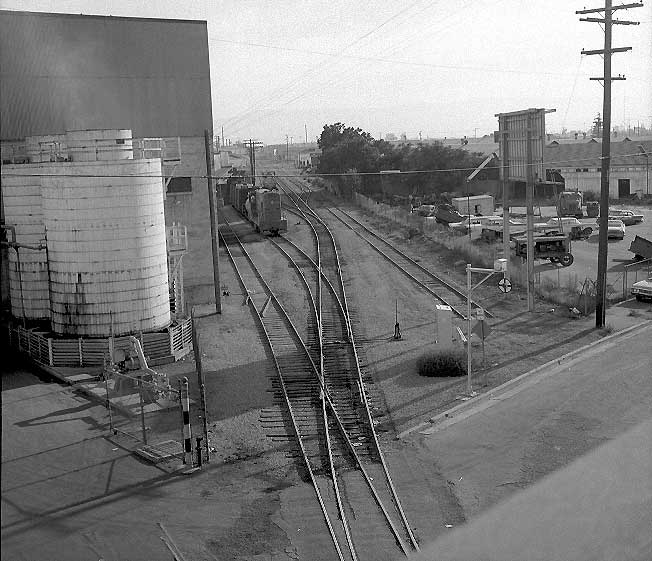
As I've mentioned before, 740 / 750 West San Carlos Street, just at the SP's Los Gatos branch, had a number of occupants - Pacific Fruit Products in 1915, Higgins-Hyde in the early 1930's, J.S. Roberts a bit later, and Abinante and Nola after World War II. The J.S. Roberts photo's the best one of the barn-like site which ought to resemble Del Monte's Sunnyvale plant a bit.

I've known there's some other photos of the site out there. The Dome of Foam, one of my favorite SP/San Jose sites, fixed a broken link to a photo recently, so now it's possible to see the Abinante and Nola site as it looked in 1968. Check out the Dome of Foam's page on the Diridon Station depot goat for more photos of the industries around San Jose's Diridon Station and the caption for the original photo.

The photo of the site is worth some extra examination. The buildings to the left are the Del Monte cannery (as taken from the San Carlos St. bridge. Abinante and Nola was on the empty lot to the right of the photo, with its four car spur still in place. The Dome of Foam caption says the siding was used for commute car storage in the 1960's.

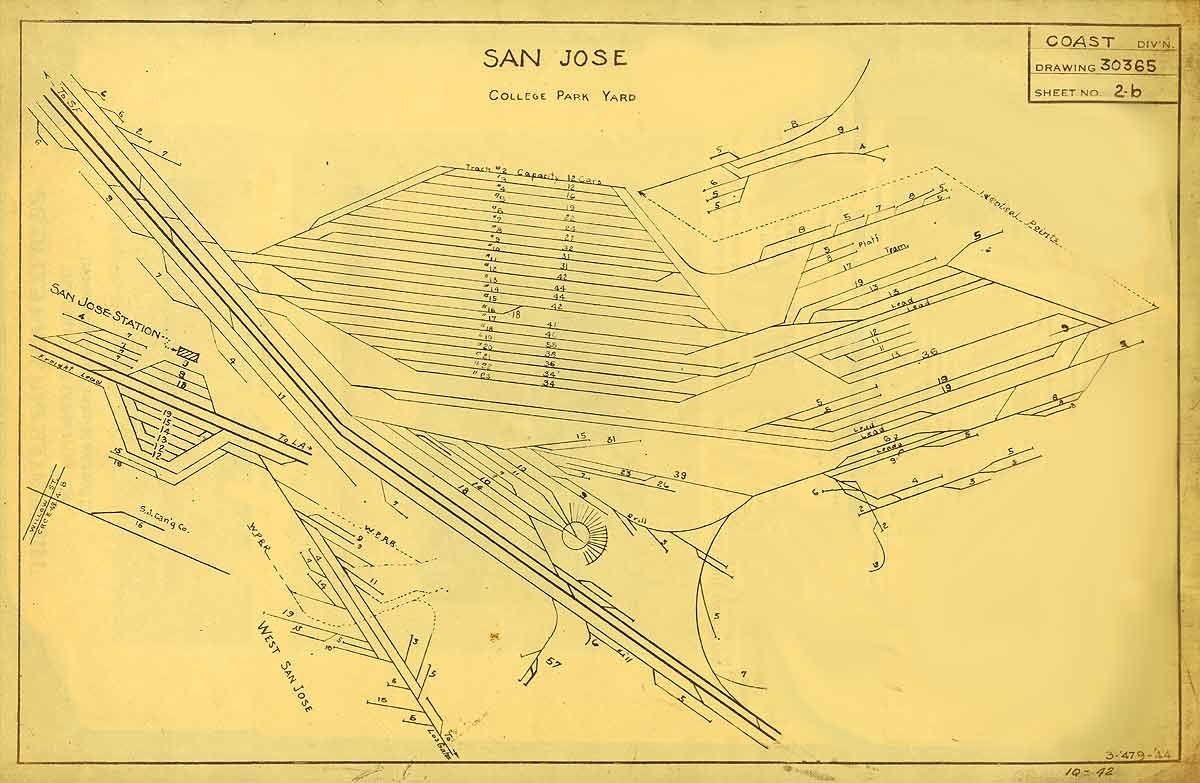
Further up the track, and sharing the same spur was the former Santa Clara Mill and Lumber yard was on the right (though it was Cheim Lumber by the mid-1930's). The two tracks to the left were part of the Del Monte cannery's trackage, as seen on the Dome of Foam's track standing room space map - look at the bottom of the page for the West San Jose trackage and the nine and three car spurs at the north end of the cannery trackage.

The warehouses behind the triangular empty lot were warehouses for a billboard company that took over part of the lumber yard's space in the 1930's. I'm surprised at all the trees in the near-foreground; there's no trees in 1948, and only slight trees in 1956 after the packing house was torn down.

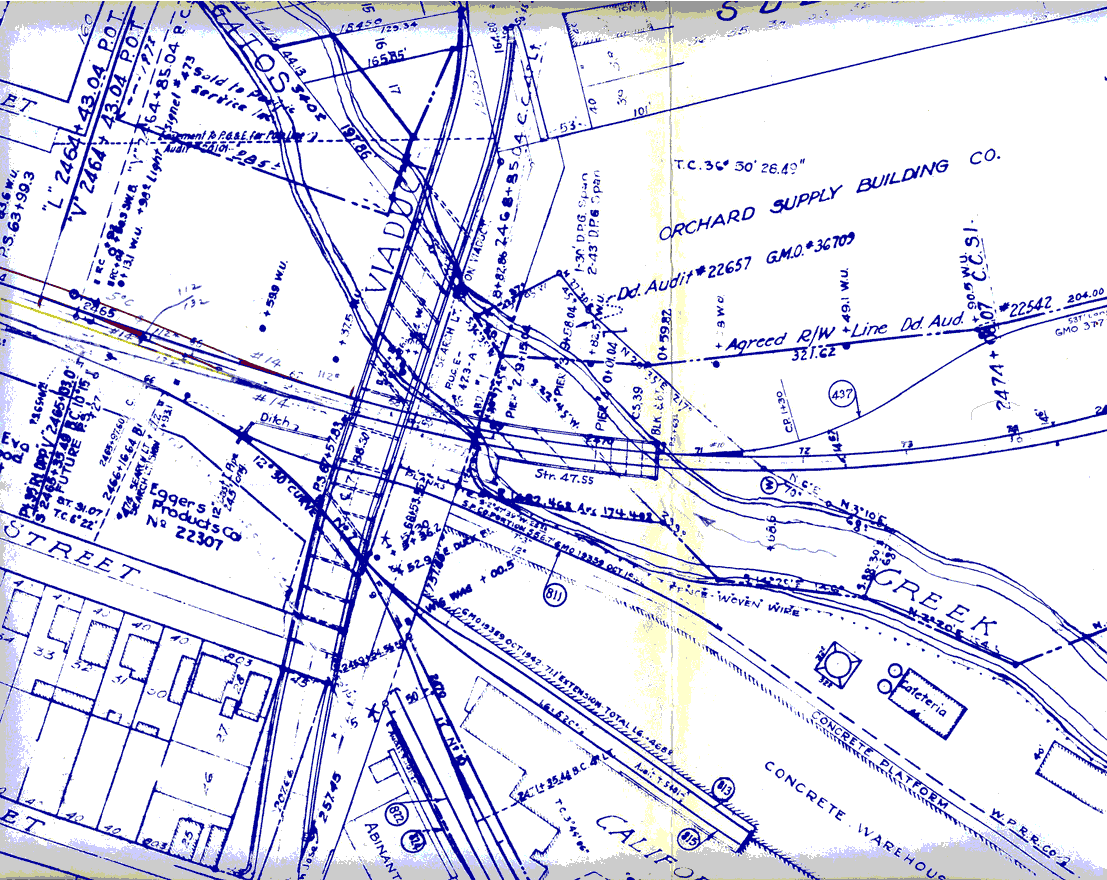
A recent Dome of Foam update also included images from this railroad valuation map, showing some planned improvements to the trackage in 1965. This map has a bunch of interesting details - the cafeteria at the Del Monte Cannery, Abinante still in existence, and the original San Carlos St. route (including the bridge across Los Gatos Creek!) See the Cahill realignment page for more details about the planned 1965 trackage changes and some more fragments from that nice valuation map.

None of this matters particularly much for me as a 1932 modeler; it's partially interesting if I were ever to have more modern operations on the layout, but the photo does hint at the flat and plain look of the area around West San Jose. This ain't dramatic scenery culture, and that's ok.

[Photo from E. O. Gibson's Dome of Foam. It's his photo originally; I've cribbed it because it's just too cool a picture not to share. Go read his pages. Send him money and a Britney Spears CD.]

Saturday, December 10, 2011

Ryland Street in 1976

If you've got to say one thing for progress around here, it's pretty hard to find undeveloped dirt lots around San Jose these days. Case in point:
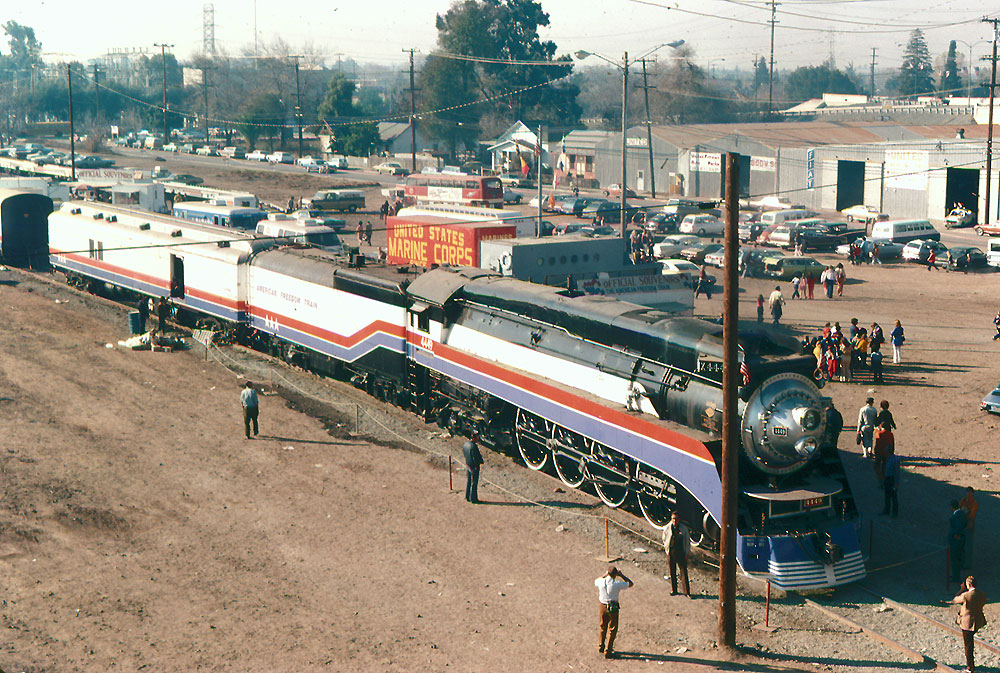
E. O. Gibson's 1976 photo of the Freedom Train in San Jose. It's billed as "sitting on display at the site of SP's former San Pedro St. [freight] station", though it might be better billed as "sitting on the site of several old packing houses on the north side of the old yard after they'd bulldozed everything interesting away." The street in the background is Ryland St., and Google Maps shows that the warehouses and little houses are still there. The dirt field is now condos, and Abinante and Nola's plant on Ryland St. was located about where that British bus is parked.

But those houses along the street have cleaned up nicely in the intervening years, at least as seen from Street View.

Just try finding that much undeveloped dirt around San Jose today. It's hard to believe that this pre-1930 photo would have been taken at the same location.

That 1976 photo, by the way, is from one of my favorite railroad sites, the Dome of Foam. Snarky humor, lots of San Jose content, and a serious dose of train order minutiae make it worth an afternoon of reading.

Tuesday, October 18, 2011

The *Definitive* History of Abinante and Nola

Just when I thought I was done, I got contacted by one of Frank Nola's son who filled in even more details on Abinante and Nola. The result is a more complete, more detailed history of Abinante and Nola, along with photos and excerpts of Sanborn maps showing the various packing plants they occupied.

And one more thing... many packing plants list "shook storage" where the boxes waiting to be assembled would be stored. This California Railroad Commission case explains why you shouldn't just dump the materials for boxes on the end of your spur, and assume the railroad will switch you twice a day.

Tuesday, September 27, 2011

Photo of Another Abinante and Nola site

Another photo in the Gordon Collection captured a glimpse of another Abinante and Nola plant site. This time, a photo of Albers Brothers Milling on Ryland St. shows the back side of the packing sheds on the north side of the tracks near the San Jose Market Street station.

Here's the full photo if you want to see what other details you can find.

In the full photo, Albers Bros. Milling is at the corner of San Pedro and Ryland (either 100 Ryland St. or 395 N. San Pedro St, depending on the occupying company. Beyond that is 200 Ryland St. with the "FRUIT CO." sign - it probably holds Warren Dried Fruit right now, but about 1944, it'll become Abinante and Nola, and they'll redo the foundation as seen in the building permit. The larger building is Rosenberg Brothers, and past it is J. B. Inderridden as I mentioned in March. That posting in March showed the opposite side of these buildings, and the aerial view.

That corner looks a little different now; it's under the Coleman Ave. overpass.

This was a hard photo to track down; the Sanborn maps show that Albers was on the south side of the tracks, but the shadows and the weedy distance didn't match with the position of the San Jose Freight Depot just visible to the left of the building. Luckily, I realized those ventilators on the roof were uncommon, and matched the photos from the other side of the tracks.

By the way, this photo, like many of the photos I've found in the different libraries, is catalogued over on Lookback Maps so I can remember which photos I've found near a specific location. Why not mark where some of your favorite historical photos were taken?

Monday, September 26, 2011

Paydirt: Photo of Abinante and Nola Packing House!

All the research I've been doing on Abinante and Nola started with a single question: what did the packing house at 750 West San Carlos St. look like? Although aerial photos on Historic Aerials show a rough silhouette and Sanborn fire insurance maps show the floor plan, I've never found photos of the actual building.

Luckily, one of the rules of research is to keep looking till you do find something. When I did a recent search for "J. S. Roberts", the previous owner of the packing house, some new panorama photos from the 1930's turned up at San Jose State's John C. Gordon Collection. (The Gordon collection is a great set of photos for anyone interested in San Jose in the 1930's.) An image of the San Carlos St. viaduct shows one building for Del Monte Plant #3, a row of maintenance-of-way cars along the tracks, and the J.S. Roberts dried fruit plant. The photo is also from 1934 - pretty much my era.

Full photo here.
So let's compare the photo with the scene I actually built:
  • The packing house is large and barn-like with clapboard siding and a corrugated tin roof. It's definitely different from the model I built, and much plainer.
  • Hidden in the trees, you can just barely see the tiny boiler house made of corrugate steel, with what appears to be a tall smokestack twenty feet in the air. The boiler house looks like it's behind a worn, whitewashed fence,.
  • The railroad crossing on the former street is blocked off at the bridge; that fence is still there, as far as I know, but the bridge was removed long before. That line of parked cars behind the barrier would be a great detail in the scene. I'm not modeling Los Gatos Creek, but modeling at least part of the bridge and creek would be a great bit of detail for the scene. I don't have room for both sides of the creek, but I wish I could add the sign on the telephone pole just before the bridge: "BRIDGE UNSAFE: NO MORE THAN 6 TON EXCEPT RR R.T.WAY SPEED LIMIT 8 MILES".

    Also note the road on this side of the creek is bordered by the creek, and has the nice boardwalk and railing to protect the locals from falling. On the other side of the road, the Del Monte property has its own fence to protect folks from falling in the creek.
  • The bridge supports have an unusual shape, with the actual supports narrower than the bridge. Those might be a good project for the 3d printer. The last portion of the viaduct is solid - again details to get right in the model.
  • I'd forgotten the stairs from the viaduct - they're still there, and I assume were designed for workers the Del Monte workers - again a detail to reproduce.

    On the far side of the viaduct, there's a line of what appear to be maintenance of way cars with windows and steps. The static maintenance-of-way cars might be a nice addition to my scene, as the curve on that side of the viaduct is pretty bare.
  • There's telephone poles and wires everywhere, some power, and some (on the viaduct) for the trolleys and Peninsular Railway interurban line.
  • One surprise for me is that there's little sign of construction of the new mainline in this phot. The Park Ave. underpass is obviously in place off in the distance, but I don't see any track other than the Los Gatos branch in the scene. However, if I look at another photo of the viaduct, taken from a lower angle, I can see a great deal of construction activity hidden behind the viaduct - debris, a maintenance of way shed, and several boxcars.
By the way, the current mainline SP tracks will pass just in front of the solid viaduct support, between that barricade and the bridge. Google Earth shows the relationship of the tracks and the viaduct piers quite nicely. This photo from Google Street View (a few years old, considering that walls of the Del Monte cannery are still standing) shows how the scene has changed in the last 80 years.

This photo again shows why I like modeling real scenes. Much of the set dressing - the abandoned bridge, blocked street and line of parked cars; the plain packing house building, the stairway from the viaduct, the odd supports, and the row of maintenance-of-way cars - they are all details I would not have placed on my own.

Stay tuned for a future episode where I'll describe plans to redo the Abinante and Nola scene!