Showing posts with label Del Monte. Show all posts

Tuesday, October 21, 2014

Setting the Scene: How the People, the Equipment, and the Containers Describe an Industry

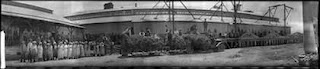
So here’s a fun photo from the John C. Gordon collection at San Jose State: a photo of the California Packing Corporation’s plant #21 at Milpitas. The photo probably dates from the twenties or early thirties, I expect, and gives a lot of detail about both the workforce and the plant.

Now, there’s a bunch of interesting bits worth examining in this photo.

The workforce looks like it’s half men and half women, with the men primarily in coveralls and women primarily in white. There’s no obvious management; there’s a couple guys who look cleaner than the others - one in a jacket, and a couple with shirts and pants - but you don’t see the guys in suits or the owners like you’ll often see in the photos of a cannery. The men mostly look anglo; although there’s a few faces that look Italian or Portuguese, most look anglo. The women, however, seem to go more for that southern European look - I’m seeing a lot of faces from old family photos here.

Next: what’s with those cranes, and what’s that wilted stuff that’s on the truck and its attached wagon? My initial guess was that it’s bringing in some sort of plant where processing the crop in the field is too labor-intensive. One possibility is that they’re some tiny crop - maybe peas. Or maybe they’re the tops of plants that went to seed. There’s mention that there were seed farms in Milpitas, so perhaps Del Monte was letting the plants flower, cutting them down, then threshing the seeds out in the plant here? The cranes might be used for bringing in the whole plant - the whole plant would be cut down in the field, brought here to the packing house. You can also see some sort of hoppers located in the wall along the right loading dock, with wheelbarrow-sized openings to pour something into.

While we’re at it, how about that truck and trailer, and those cool wooden wagon wheels?

And finally, if you look along the loading docks, you’ll see an interesting mix of containers. Towards the center of the photo, you’ll see a stack of what look like trays, and then, just to the left, you’ll see some shiny objects. That’s tin cans, fresh from the can factory. They’re stacked up, with wooden sheets separating each layer of cans. Although there’s a lot of cans there, the pile of the separating trays, off to the right is even more impressive, suggesting it’s been a busy canning season.

Now I’ve never thought much about how cans get to the cannery. I’ve heard my dad’s story of a summer spent at either the Hunts cannery in Hayward or the Del Monte plant in San Leandro grabbing cans out of boxcars with a long stick with metal fingers spaced out a can’s width apart. That was in the 1950’s. It looks like in these earlier times - or at this lower-volume cannery - the cans arrived in a more primitive way.

Then you’ll see lug boxes for bringing in the crop, and a sign above the door that I’m sure says “POSITIVELY NO SMOKING”, and some sacks of something. And finally, at the far left, some Del Monte product boxes, all labeled “SUGAR PEAS”.

And the mystery is solved. The Milpitas plant was canning sugar peas on this day. The pea plants got cut down in the field and pitchforked up onto wagons, then hauled to the cannery where the cranes tipped the wagons and their loads onto the loading dock. The hoppers are actually the input side of the viners, which would strip the pods from the vines and the peas from the pods. The peas would go in the lug boxes, then be carried into the cannery for cooking and canning. The cans are there on the dock ready to put into the machinery. When the product was canned, the result would go in the nice wooden crates at the left.

There’s even a video confirming this; Del Monte filmed the action at a pea cannery in 1939, and that’s on YouTube. The 8 minute mark shows the peas being harvested; the 10 minute mark shows the pea vines being tossed into the viner.

And we’re learning all that from just the stuff out on the loading docks.

Now, as a model railroader trying to detail cannery scenes, what we’ve learned from this photo really highlights how the clutter on a model helps a viewer understand what’s happening. Being able to see the raw material (the pea vines and cans), the finished products (cases of canned peas), and the workers hints at what’s going on here, and helps the photo - or the model - set a story.

Let’s Build Containers!

Normally, telling a story through those details on a model railroad either takes a lot of work or a fair amount of cash. Take sacks, for example. A prune packing house should be overrun will full sacks of prunes around September, for the local orchardists bring in their crop bagged. If you've got a prune packing house on your layout (and I've got three), then you need a lot of very tiny HO scale sacks of prunes. There's normally two solutions: make them, or buy them. I've made sacks from Fimo clay, but it's a slow process. You roll out a long string of clay, chop it into pieces, flatten it a bit, shape, and bake. (Interesting bit of trivia: Fimo polymer clay costs $3.59 for 50cc of material, or around seven cents a cubic centimeter. It makes the resin for the laser printer at fifteen cents a cubic centimeter seem pretty affordable.) Getting metal castings of filled sacks is possible - the military modelers love them for making foxholes and protected positions. But getting a ton of sacks involves spending real money.

Boxes and crates have the same problem - there's store-bought ones, but they tend to be in a few designs, and you'll never find more than a few for sale at a time. They're also hard to make by hand; either you make a lot of fiddly details and glue them together, or figure out a way to mock up entire stacks or rows of boxes with a printed image or some artfully placed scribe lines. Boxes are also hard to get right because of the precise shapes. The sacks can have mistakes and look mostly correct, but if your scribe lines don't make all the boxes the same size, then you've spoiled the illusion.

And then there's other containers that you can't buy. You've already seen my drying flats - a detail that's both impossible to buy commercially and a pain to build from scratch. Empty boxes (such as field lugs) aren't available as castings, though Ken Harstine sells some beautiful stacks of fruit lugs on Shapeways.

And all of this makes 3d printing a great solution for printing large numbers of detailed containers for a particular scene. The 3d printer is great for doing runs of lots of duplicate items to fill out a scene. Digital models make it easy to do variations - this stack is 6 boxes high, that one's seven, and the other has one slightly out of line.

And the best thing is that 3d printing is a great way for those little details you wouldn't necessarily see across the US, and thus aren't popular enough for the manufacturers. Remember those stacks of empty cans? I've never seen those on a store shelf before, but with some judicious 3d drawing, I can make some stacks for my own canneries.

Photo from the John C. Gordon panoramic photo collection at San Jose State University. They also have the regular John C. Gordon collection which has a bunch of commercial scenes from San Jose over the years.

Friday, December 13, 2013

Movie Night XV: "Golden Harvest" and "Out Of the Spirit of '49"

Tonight's movie is courtesy of the California Packing Corporation, filmed to celebrate 50 years of Del Monte. The film is actually a mix of 1960's documentary and a collection of promotional films from 1900 through the 1930's. It's a combination of a celebration of California and of the canneries; if you're looking for the cannery shots, you'll have to fast-forward past the missions and "rolling hills" shots, but there's some neat shots of Plant #7 (Emeryville), the correct way to prepare pears and apricots, the action on the asparagus canning line, and a great shot of a farmer checking his orchard next to his Model A. Bonus points for anyone who can name which plants are visible from 4:50 on... though be warned the shots make it very obvious how CalPak had a single architectural style.

There's also some shots from (I suspect) that Del Monte-sponsored silent film about the boy who wants to be a cannery superintendent. The melodrama isn't that exciting, but the huge paddle fans cooling the women and the boxes of fruit sure highlight what must have been a messy job! And where else will you see a close-up of removing the pit from a peach?

And the San Francisco fans will appreciate shots of the Alaska Packers Association pier in San Francisco pre-1916.

"Fifty-year old companies are a lot like fifty year old people - they like to reminisce."

(Full video here if the video above is cut off.)

And after you've watched that, check out Del Monte's 1940's dried fruit processing video. There's some neat shots of prune, apricot, and raisin processing along with some cannery shots. Check out the apricot drying yard action shots around the 7:00 mark, and tell me if you can identify the Del Monte plant at the 9:00 mark!

(Full video here)

[Both videos courtesy of archive.org / Prelinger Library's collection of commercial ephemera.]

Thursday, August 8, 2013

Movie Night XIII: Lost San Jose

Hey, I'm building a model of that stairwell on the San Carlos Street viaduct!

The video is from a San Jose Mercury article on Josh Marcotte and his "Lost San Jose" photos - check out his photos (online or in the gallery) for some highlights of earlier days.

I'll admit I'm a little miffed he hasn't taken a picture of those stairs that thousands of cannery workers trod, for the stairwell visible behind him was the quick way to the Del Monte cannery back in the day. To the left is the Los Gatos branch (with a modern-day trolley crossing as the video rolls.) To the right are the Caltrain tracks, and then Los Gatos Creek.

The world's changed an awful lot on the Los Gatos Creek side. Josh is standing on what used to be San Carlos Street; that changed in 1934, when the new viaduct was created, and the old bridge across the creek was closed off and torn out to make room for the Southern Pacific's new tracks. This great John C. Gordon collection photo shows the old San Carlos Street bridge before it was torn out and replaced with Southern Pacific's bypass around downtown San Jose. And none too soon, for a sign on a telephone pole warns "BRIDGE UNSAFE FOR MORE THAN 6 TONS", "SPEED LIMIT 8 MILES". Considering the rather cold faces on the kids next to the sign, I suspect they've spent their afternoon pulling out supports so the bridge would be even more unsafe....

Thursday, April 26, 2012

Road Trip: Sunnyvale!

Although I'm working madly to prepare for the ProRail operating session later this week, I deserve a bit of a break. Let's take an imaginary road trip all the way out to Sunnyvale to look at another dried fruit packing house - the Del Monte building on Murphy Street in Sunnyvale.

As we all remember from previous discussions, the key design features of a dried fruit packing house (at least in turn-of-the-century California) was:

  • build big and barn-like (because the packing house had to store the entire year's crop until it could be sold),
  • three stories tall to hold the gravity-fed storage bins, and
  • a (preferably non-carnivorous) powered elevator to get the crop up to the top floor for sorting and storage.

The Del Monte Building fits the model nicely. Built in 1904 and originally located at 185 Evelyn Ave. next to the railroad tracks, it was the sole Santa Clara Valley outpost of Madison and Bonner, a dried fruit packer with multiple plants out in the Fresno area. The plant's location hints that M&B was willing to take a big chance to branch out from the raisin market into the prune, peach, cherry, and apricot market of the Bay Area. In the typical breathless fashion of the news media at the time, the San Jose Herald (as quoted in the September 15, 1906 Pacific Rural Press) claims "Madison & Bonner have nearly completed enlarging the dried fruit packing house and are installing new machinery. This enterprise will be second to none in the county." As a San Jose booster, I seriously doubt that claim, but I'll assume they had a nice plant that might have hoped to be the equal of one of the San Jose and Campbell dried fruit packing houses some day. Maybe.

Madison and Bonner - James Madison and Charles G. Bonner, for there really were two flesh-and-blood men behind that title - only lasted to 1911 when the two principals decided to dissolve the company. Bonner took over the Fresno raisin plants, changed the signs to "Bonner Packing" and started billing the company in the trade rags as "successors to Madison and Bonner." The distant Sunnyvale plant went to J. K. Armsby, a large San Francisco-based packer. I don't know what Madison was left with, but I'm hoping he took off for Hawaii with the proceeds.

The J. K. Armsby company, then run by J.K.'s son, George Newell Armsby, had multiple plants around California and the West at the time of the purchase. In 1913, they listed their presence in Fresno, San Jose, Armona, Visalia, Sanger, Suisun, Marysville, Los Angeles, Gilroy, Yuba City, Stockton, Ventura, Sunnyvale, and even an outpost in Vancouver Washington. The 1916 list in an ad omits Sunnyvale, with no hint whether the plant was closed, or if the printer just ran out of room for another name.

But George wanted to run an even more massive organization, and in 1916, he headed east to New York, convinced a New York banker to lend him 16 million dollars, and headed back to purchase and merge five companies into his new California Packing Corporation, better known to us as Del Monte. Those five companies were:

  • his own J. K. Armsby company, with local plants in Sunnyvale, Gilroy, and San Jose,
  • Griffin and Skelley, who started out packing oranges in Riverside and moved on to raisins and prunes with a large plant in San Jose that became Del Monte #51,
  • Central California Canneries in San Jose (the Japantown cannery), Tulare, and (I'm sure) other places,
  • California Fruit Canners Association, itself a conglomerate merged from 18 canneries in 1899, including the San Francisco Plant #1 (the Cannery), the San Jose Fruit Packing Co. (which brought the large cannery on San Carlos St. in San Jose), Oakland Preserving Company, and others, and
  • the Alaska Packers Association.
Note that four out of five of those companies had a presence in San Jose, so it's not unfair to say that San Jose was pretty much a Del Monte town.

The Sunnyvale packing house served as a receiving station for Del Monte from 1916 to 1926. However, good roads and easy access to cars probably hinted to the bean counters at Del Monte that they didn't need as many receiving stations scattered over the countryside, and certainly didn't need the Sunnyvale location. The Planning Department for Sunnyvale says that Del Monte opened a new dried fruit packing house in San Jose in 1926 - Del Monte's Plant #51 on Bush St. just west of Diridon Station, and the former Griffin and Skelley plant. The new plant got rid of the need for the local receiving stations, and so the Sunnyvale receiving station was closed and mothballed as a warehouse.

Luckily, the Del Monte building got a second lease on life in 1930, turning into the Corporate Seed research lab for Del Monte. Del Monte only left it in 1986 - well after the rest of the valley had started growing silicon wafers instead of prunes. In 1993, it even lost its location next to the railroad tracks, but was moved onto the one block remnant of Sunnyvale's main shopping street, Murphy Ave, where it serves as the endcap for a small but fun downtown.

And with some luck, you might get invited to a wedding up on the third floor of the now-restored building, and you can think of all the prunes and apricots that got sorted up there when the decor was a trifle more rustic.

[Image of the Sunnyvale Del Monte building from Sunnyvale Historical Society. The building has its own web site for its banquet business.]

Tuesday, January 31, 2012

Life in Del Monte's Complaint Department

It's outside my era, but let's move away from the canning and dried fruit departments and see what life was like in Del Monte's complaints department in the 1980's.

Even if you don't like the article, at least there's a nice photo of China Basin Building east of the San Francisco train station. I hadn't realized that building had originally been built by Del Monte for importing bananas!