Showing posts with label open house. Show all posts

Saturday, January 4, 2025

Movie Night XXXI: Interurban Era visits the Vasona Branch!

I'd mentioned YouTuber Interurban Era visited in October; we caught some pictures of his Caltrain electric locomotive model in front of the Market Street Station. At the same time, he also captured some video of some of the Alta California rolling stock braving the Santa Cruz mountains. If you've wanted to see the whole layout on video (which I've wanted to do but never got around to), Miles did a great job showing off the layout, both as railroad scenes and showing the overall layout.

Pop some popcorn and watch his visit to the Vasona Branch here!

Wednesday, July 24, 2024

What makes a social group work?

Pat LaTorres greets the public at a garden model railroad exhibit at Bay Area Maker Faire 2016.

What’s it take to keep a group active over generations?

Recently in London, I visited the Museum of Freemasonry at the London Grand Lodge. The Freemasons are one of the oldest fraternal organizations in the western world, combining fellowship, charity, and a bit of mystery together to pull men and women together. Freemasonry starred as informal clubs in the 17th century. Several related groups pulled together for unified rules and rituals around 1717. By the 1760’s, several dozen lodges were active in different pubs and coffeehouses in London.

List of pubs hosting active freemason groups in 18th century London. From Museum of Freemasonry collection.

The “mason” in freemasonry is based on supposed attributes of medieval stonemasons - individualists who would journey around to work on major building projects. Medieval masons created guilds for training, and secret handshakes and processes to help masons share their level of skill when working far from where they may have trained. The projects they built were the most impressive building projects in Europe, and the masons had the sense of building for the ages as they constructed cathedrals and palaces across Europe. The Freemasons borrowed the metaphors and rituals from the medieval guilds. When men are all hopped up on caffeine and focused on bettering the world with talk of democracy, bettering selves, and breaking class levels, borrowing such metaphors of secret truths seems almost required.

As the British Empire expanded, freemasonry followed along, providing lodges that brought together all of the British expats and administrators - one of the few ways for men at different levels of society to interact. The museum highlighted an early 20th century British surveyor who knew wherever he went - Cyprus, the Middle East, New Zealand. Or London - there was always a lodge he could visit to make local acquaintances. In India, freemasonry allowed the levels of (British colonial) society to mix. The members also found it a comforting group even at the worst times - the Museum of Freemasonry included the meeting notes from Masonic gatherings at Changi prison in Singapore during the Japanese World War II occupation.

Initiation well, Quinta da Regaleira.

There was also all the fun ritual and secrecy as masons claimed they were passing on secrets from past ages. Some groups took this more seriously than others. One of Portugal’s elites, Carvalho Monteiro, was so dedicated to his Masonic fun that he built elaborate features in his gardens just for Masonic initiation rituals. He built caves and a deep well with a spiral staircase leading down into the depths. The lodge would send the initiates into a cave at the top end of the garden and expect them to find the correct passage to climb the well stairs "into the light." To be honest, if I had a big garden and a ton of money, I’d probably want to build a big occult fraternal society clubhouse in my backyard too.

The London Grand Temple highlights that pride and popularity of the organization. The London art deco grand temple with its two thousand seat auditorium is a beautiful and visible symbol of the organization. San Francisco’s Scottish Rite Temple out on 19th Avenue was a similar reminder. West coast model railroaders and rail fans likely have positive impressions of the Scottish Rite temple in Stockton where the Winterrail multimedia shows were held.

Main auditorium, Freemason's Hall, London.

Freemasonry has declined over the intervening years in numbers and influence. All fraternal societies have fallen out of favor as trends and preferences for how folks spend their time has changed. Freemasonry’s pseudo-historical self-improvement rituals might not be as attractive in this modern age. Their philosophy and attempts to improve the spiritual nature of their members veer awfully close to 1970s cults from my uninformed point of view. Freemasonry also has a very conservative bent. At the London Grand Lodge, the dress code was quite proper and old fashioned. Men in black three piece suits carrying briefcases with their mason’s apron and regalia may not be so interesting for more informal generations. Regardless, they’re still one of the oldest fraternal societies and still have an obvious following.

As much as friendship and gathering appeals to me, I’m likely not a good Masonic candidate - too informal, and too much of a Generation-X cynical bent. I’d pursue E Clampus Vitus, but I’m not sure I can hold my drink sufficiently to make it in.

What’s this got to do with model railroading?

Looking through the museum, I saw reminders of our own concerns about the hobby, especially as members age and interests change. I see the differences in how each generation wants to show their modeling skill: model contests at meets vs. RPM meets with their show-and-tell feel, focus on individual models vs the layout as a whole, layouts focused on operation against round-and-round club layouts. Each of these tensions can separate modelers, limit the size of events, and sometimes cause tension and conflict. For model railroading, I’d hope we can find ways of keeping the communities together just for a larger hobby and more folks to socialize with. I also want the community to keep attracting and encourage the next generation so we have more folks to hang out with and learn from.

Like the fraternal societies, we worry about participation and expectations and uses of free time changes. Formal rituals - the weekly meeting on Friday nights, or expectation of the hobby as a “mens-only” operation limits who might be interested, or when folks have time available. (See also the comments about the decline of scheduled social acitivities. Church groups and bowling groups both have seen the decline. For bowling, league participation has dropped off even as bowling in general is still popular, hinting at changes at how we want to belong. Some in masonry just blame it all on the hippies and drugs which I suspect is not one of the challenges for model railroad socializing.

The fraternal societies also remind us of the need to jump on new trends and styles. For me, it was interesting to see how model railroading changed after the introduction lion of DCC - more focus on operations and operating weekends, the new sub-hobby of electronics and command control becoming a significant part of the community, etc. Here in the Bay Area, we’ve had the DCC lunch on Fridays which started as a place for a dozen folks interested in command control to meet up and share their latest projects. That group’s quieted down after COVID thanks to an aging-out of one cohort of members, less unexplored corners, and changes in who was working close by enough to meet up.

The masons opened their museum, I suspect, in order to be more visible to a younger generation and search for new members. It was a weird and interesting vibe - I got the sense they were proud of the museum and eager to encourage a new generation, but I also got the sense they weren’t completely ready to open themselves up to the world.

For a model railroad group, there’s times where I think we’re hiding ourselves in similar ways. In other ways, I think we’re much more willing to talk with the visitors from outside the community, share what we’re doing, and just share our excitement. Members at club open houses are willing to talk with the public, as are the folks at our local model railroad shows. We also see how similar groups can be public and friendly at events like the Maker Faires (plug: San Francisco Bay Area Maker Faire will be in Vallejo in October!). Adam Savage’s YouTube videos sharing his personal and commercial prop-making skills also shows as an excited and modern way to share the excitement of building for building’s sake - see his video on making a carrying box for his prop gun from the Blade Runner movie.)

Printing group, Maker Faire Bay Area, 2016.

Burning Man illuminated art, Maker Faire 2016.

I like model railroading. I enjoy having a hobby that lets me construct interesting things without needing to navigate city building code, market and coworker constraints at the day job, or be concerned about building things with some critical need. I like using the hobby as a chance to learn and better myself as I research local history, technology, and the scenery in the places I model. I like that the hobby lets me be social with a fun group of people and be part of informal and formal groups. I like that the hobby gives me a framework to help the community whether in restoring and operating real railroads, sharing local history, or encouraging kids to learn how to make and repair things. I like that the hobby would give me ways to work towards achievements if I wanted, but that I’m not required. We don’t have a secret handshake, but we’ve got a lot in common with the Masons. I’d just like to make sure we stay as something active, modern, and interesting for newcomers rather than something defined more by what we’ve been.

Monday, February 13, 2023

Bay Area PCR Layout Design and Operations Meet: Full video

Every year, the Bay Area has a model railroad meet dedicated to model railroad layout design and operations. As I've said many times, this is my favorite event. It's got a mix of interesting talks, layout tours, and chances for folks to participate in operating sessions on local layouts.

This year, as in previous years, TSG Multimedia handled simulcasting the show to remote participants, and shared the video on YouTube. If you're curious what sort of talks happen at a meet, check it out!

(Or view on YouTube.)

Sunday, January 1, 2023

Bay Area Layout Design and Operations Meet: February 3-5, 2023

My favorite model railroad event, the Bay Area Layout Design and Operations meet, is happening this year in Richmond, California, February 3-5, 2023. Like always, the meet's a mix of talks about design and operation, layout visits, and opportunities to try model railroad operations on layouts in the Bay Area. Friday will have a tour of the real Richmond Pacific industrial railroad. Saturday's talks will be at the Golden State Model Railroad Museum at Point Richmond. We'll get to tour layouts in the East Bay on Saturday night. Operating sessions at local model railroads will be on Sunday. Like last year, you can also attend virtually if you're not in the Bay Area or want to enjoy the presentations from your home.

Get more information at www.bayldops.com. You must get tickets in advance at EventBrite. In-person tickets include a boxed lunch. Virtual tickets give you access to watch the presentations and ask questions via a Zoom video conference. In-person tickets also include the Zoom link in case you decide not to go up to Richmond.

I love the Layout Design and Operations meet because it pulls together a fun group of folks: interested in modeling specific locations, railroad history, imitating the real railroads' operating practices, and just interested in understanding what the real railroads were about. It's also a great meet if you're curious about any of these topics. The invites to operate on local model railroads got me interested in model railroad operations, and helped me understand the differences between running trains on my own versus working with a dozen other people to get trains moving on a large layout. Like past years, we'll also offer layout design and operations consulting. If you're considering a new layout, or thinking about operations on an existing layout, you can sign up for time to talk with others about what you're building and what options you might consider.

I'm planning to have the Vasona Branch open for a Sunday operating session, so if you're interested in visiting and joining in, sign up for the meet and put the Vasona Branch down as one of your choices for an ops session!

Hope to see you there!

Monday, July 5, 2021

Visiting the Vasona Branch: NMRA 2021 "Rails By the Bay"

Virtual visitors for the NMRA 2021 “Rails by the Bay”: Welcome to the Vasona Branch!

Thanks to the challenges of organizing a national convention during a pandemic, the National Model Railroad Association’s annual in-person convention in Santa Clara was cancelled. However, the local Pacific Coast Region has arranged an all-virtual convention, Rails By the Bay" this week, July 6-10, 2021. Sign up to attend (just $49!), watch presentations, ask questions of the presenters, hang out in the meeting rooms, and continue to watch clinics until August 7.

The Vasona Branch layout is one of the layouts on the “virtual tour”. For all you virtual visitors, here’s a quick good-parts summary of the layout. If you've got questions, ask in the comments below!

Check out the NMRA Magazine's November 2020 issue for a summary of the layout. (More on prep for the article and Dan and Doug's photographs of the layout.)

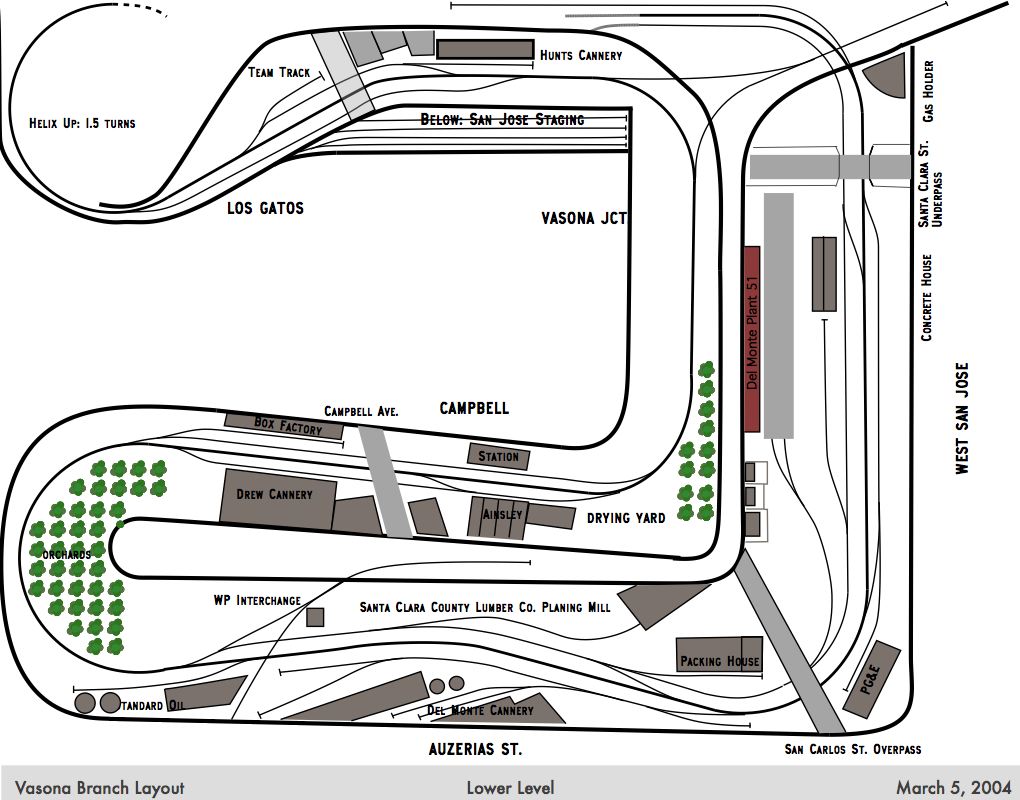
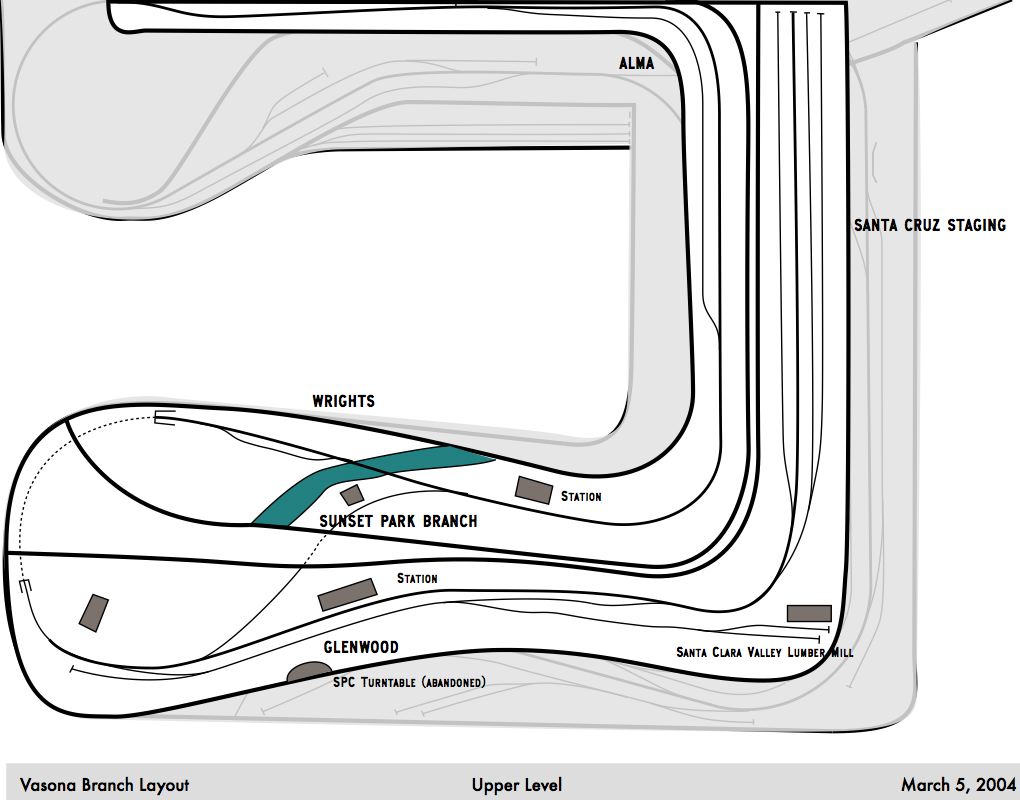
Layout plans: Lower deck, Upper deck.

Watch videos of the layout:


I’ve also written lots on the history of the real branch on my Vasona Branch blog. Some sample articles include:
I’ve used 3d printers to make lots of freight cars and passenger cars for the layout:
The Vasona Branch models the real crossing with the Western Pacific Railroad, and uses a real interlocking machine from Australia’s Modratec to control the crossing.
The Vasona Branch is an layout designed for operations; I invite two two-man crews operating layout for four hour operating sessions. I use my own switchlist generator for deciding which cars to move; trains move via yard limits and informal train orders.

Wednesday, August 19, 2020

Bring in the Photographers!

Full disclosure: all photos here are mine documenting the weekend, not the shots the pro guys made.

Well, that was an interesting weekend. As part of preparations for the NMRA 2021 National Convention, Rails by the Bay, I got a chance to get my layout photographed for articles about the convention. Model railroading’s a lone wolf hobby for me, so I’ve never had anyone else doing serious photos of the layout. I instead got to sit and see how others thought of my layout, and how they worked to get great photos. I also changed a bit how I think about the layout as a result.

So let’s talk about aiming for good photos in terms of planning, preparation, and the photos.

If model railroading taught me anything, it taught me project management. Building a model railroad always involves a long effort to build something significant: deciding what to build, sequencing all the work, rolling with the voluntary and involuntary changes, and ending up with a completed model railroad. I found out about the photo sessions at the beginning of the year, and realized I had some time to finish a couple scenes that had been lingering. I used my usual tricks for deciding what to figure out what to do: fix what annoyed me the most, and fix what I was in the mood for.

Two projects won. First, long suffering Glenwood’s scenery finally got redone. I’ve written a bit about that previously, but to recap: it has the potential for an eye catching scene, the prototypical curve makes it easy to stage reproductions of historical photos, and who doesn’t like model trains in mountain scenery? I’d first ripped out the old scenery and fixed some notoriously unreliable trackage near and in the summit tunnel. I redid the hills and Glenwood Highway to better match the terrain. I then covered the area in trees. Normally, I try to build trees from Woodland Scenics kits, but this time I bought from Grand Central Gems at a recent train show, and had a redwood forest ready in days. I ballasted track, detailed the former turntable pit, and built a quick reproduction of the Glenwood station from styrene. (I’ll talk more about the station another time.). Glenwood needed a water tank, so I quickly grabbed one of the venerable Atlas kits and put it into service.

By the time the scene was done, COVID-19 had hit and the original deadline for the work - the Prorail operating event had been cancelled. We rescheduled the photoshoot for August, which gave me motivation for another project. This time, I decided to go after downtown Campbell. The Campbell scene’s always been a focal point for the layout, but the scenery and structures have been half-done for years. I’d built the station model years ago and scenicked the station side of the tracks. However, the opposite side of the tracks was still temporary buildings and little scenery. That included downtown Campbell, Sunsweet, the Hyde Cannery, and Ainsley cannery. This area provided some great scenes - space to photograph long trains, switching action, and lots of canneries. I started on a big push a couple months back to redo everything. For downtown Campbell, I redid the road and building bases, and started trying to pull all together.

I’d already done four of the five buildings for the downtown Campbell Ave., but had held off on the most impressive of the group - the Growers National Bank building that had been downgraded to the local movie theater by the 1930’s. (The building still exists in 2020, though I think they're still fighting about whether to allow it to become a night club.) I’d made a couple attempts at starting the bank, finding a suitably regal plastic model, but the space on the layout was tiny - only about twenty feet wide - and the model wouldn’t fit. Unable to do things perfectly, I just gave up and decided I’d do the model another day.

That day finally came as I cleaned up Campbell Ave. I tossed out my ideas of a "perfect" model and decided to just start building and see what turned up. Like the Dutch signal box, I finally got annoyed enough to just start building. Like that model, I used styrene sheet primarily. Again, large dimension styrene rod worked really well - the 2 foot inset for the doorway was simply 0.250 styrene bar, simplifying the construction. A leftover door and window served for entry. I used brick sheet for the walls; the detail along the roofline were strips of board-and-batten siding standing in for carved stone. I crafted the theater sign from styrene sheet. I would have liked to 3d print it to get the lettering perfect, but my older SketchUp software doesn’t seem to want to render 3d characters.

<

Campbell Theater

Bank of Camera Close-up

With Campbell Ave. in, and the road glued down, my next project was fixing the Ainsley Cannery. The Ainsley site’s had a posterboard mockup ever since the layout was built; I still remember Byron Henderson complimenting me during an early operating session because the freight door spacing matched my 40 foot freight cars. Back in 2006, I had a great solution for the cannery - I’d found a YesterYear Models “fruit packing house” - actually a former Sunkist packing house from Riverside, California. The box has been gathering dust ever since as I waited for just the right inspiration to use it for the cannery. This was finally the time to pull the kit out of storage. The overall shape of the buildings are similar - both were a row of wooden barn-like buildings. Like Sunkist, the Ainsley cannery had an office in the end closes to Campbell Ave, and a loading dock dominating the front of the building. As a result, the rough arrangements of windows and doors would work fine as-is. One big difference was that Sunkist’s building had two joined wooden sheds, while the Ainsley cannery had two corrugated iron sheds and two wooden sheds in a line; historic accuracy went out the window in order to get a "good enough" model done as I ignored the corrugated iron sheds. I ended up cutting the Sunkist building in half, and using both ends side-to-side, and ignoring the different materials in the various sheds.

The Drew Cannery, formerly Ainsley

Preparation

All that major work took me up to last week. However, I still hadn’t done much of the preparation work, so I kicked into a big cleanup mode. Our photographers recommended doing a serious cleaning so extraneous dust or debris visible on photos. I also got rid of all the little problems I'd ignored over the years. Some was operating session damage - having folks handle models is always going to trigger a bit of damage. I fixed broken signs and bumped trees, repaired damaged cars, fixed scratched paint or bent grab irons, and filled in ballast holes triggered by past cleanups. I dusted off a set of “good cars”, and stashed away cars that were the wrong era or had visible damage. I fixed long-lingering projects -holes in scenery I’d never addressed, half done patches, and rough surfaces. Some were really quick - I’d never patched scenery when I’d rearranged the Wrights tunnel. Some were larger, such as finishing half-done spackling in the Meridian Road scene.

Most of the preparation work was the same I’d do for an operating session. For operating sessions, I’d also be worrying about reliability, cleaning car and locomotive wheels, testing that engines were working fine, testing couplers and trucks. None of that sort of work mattered much here - the trains would be stationary in the pictures. I was pretty relieved not to be doing a serious cleaning. Serious cleaning's always a huge time sink, and I always want to over-prepare - I’m always worried before operating sessions whether a balky engine or dirty track will make for an unpleasant operating experience.

Another great advantage of photos is that locomotives don't need to run well. The real Vasona Branch likely had small 0-6-0s switching the canneries. On my model, larger 2-8-0 locomotives instead get the job. I really like the little 0-6-0s, but can never use them for operations. They tend to be balky runners and stall way too easily. When operators are focusing on how to solve a switching puzzle, the last thing they want to do is deal with a stalling or broken locomotive; it interrupts the illusion of working on the railroad, and usually ends up with waiting for the layout owner to clean track, fix the engine, or provide another locomotive. With photos, however, a balky or stationary locomotive isn't a bad thing, for the trains don't need to move in a good photograph. I cleaned one of the rarely-used 0-6-0s, and it got a few chances to be on center stage. To be fair, it's still good to have working locomotives if only to quickly pull cars around the layout to a new photo site, but a photo session removes a lot of the worry of mechanical problems.

While some tasks such as wheel-cleaning and locomotive tuning don’t make sense for photos, other tasks not needed before operating sessions were needed. I’m usually a bit hesitant about putting detail on the layout. It’ll often get damaged during operating sessions. I’ve hoarded some details so they’re available when I need to fill in a scene to be photographed. The layout hasn’t always been at a stage where it’s ready for detail.

But hey, if the layout’s going to get photographed for real, this is the time for all that detail. I pulled out my box of various details I’ve hoarded during my time in the hobby. Every Woodland Scenics pallet I’d ever gotten from a detail kit went on the layout. Extra parts from a Fine Scales Miniature kit that couldn’t handle more crowding. All the 3d printed boxes, bags, lugs, and can stacks I’d printed went on any available loading dock. I plopped down figures where they were appropriate. I took a pair of 3d printed flagmans shanties and phone booths and placed them wherever they’d fit. I took the large fruit bins from the YesterYear kit and made a box yard for Del Monte #3, just as can be seen in photographs.

I also put in a bunch of telegraph poles along the right-of-way. I’ve had these on the layout before; they tend to get a lot of abuse, but they’re eye-catching. This time, I spent an evening assembling and painting a set of telegraph and power poles from Rix Products and Atlas. I also painted them a bit more carefully than before. Previously, I’d just painted the telegraph poles a quick brown and added a bit of green for insulators. This time, I made the colors stronger than last time - darker posts, silvery supports, green insulators. In place on the layout, they really catch the eye. For the Meridian Road scene, I also made a point of doing a power/telephone line paralleling the road which helps to make the scene even more realistic.

And thanks to some crazy times at work, I crammed a bunch of this work into the last week, and into a mad three days. We were also in the middle of a serious heat wave here in San Jose, so the hardest part was avoiding heat stroke in the garage, but on the plus side the matte medium dried really, really fast. The roof of the Ainsley cannery got painted just as soon as the glue holding the paper tarpaper on appeared to stick. I laid ballast in a bunch of places that had never been ballasted, and managed to paint and clean the rail in time. I decorated new scenes - bushes hiding a farmhouse along Meridian Ave, a path to the bathroom around the edge of the Rio Grande gas station, and a row of posts to keep parked cars away from the Campbell depot. I was bouncing back and forth between touching up scenery, weathering cars, and touching up structures. When I was checking old photos to get the sign on the Ainsley cannery declaring it to now be the Drew Cannery, I noticed a speed limit sign, and quickly printed up several of those to control the HO scofflaws. I was still touching up ballast and fabricating a set of stairs for the Glenwood depot a half hour before the photo session.

I never completely believed those model railroad magazine articles where someone built a well-detailed layout in a year or two. I couldn't imagine they had time to decide on models, do the construction necessary, or add the details. This week's mad rush convinced me it was possible. All I needed was some definite ideas of what should be built, an urgent deadline, a bit of wiggle-room on what counted as "good enough", some well-stocked supplies, and way too much manic energy.

And the Photographers Arrive

Dan and Doug, the photographers, were spending several days just photographing layouts in the Bay Area. They've also done this before for previous conventions and other layouts, and came fully prepared. Although I've read about model photography in magazines, this was my first chance to see pros in action.

They came prepared: lights, power cords, and various secret photographer paraphenalia. The extension cords helped when the breaker blew on the garage circuit - our 1960's house wasn't designed for this kind of model railroad lighting, and we quickly found another circuit to share the load.

Dan also had lots of cool tricks so he could get into the scene with his SLR - mirrors to capture scenes the camera couldn't reach, beanbags to hold the camera steady on the layout, high tripod for the upper level photos.

And they took photos different from me, too. Some of that was expected: they visited the Vasona Branch for only a couple hours, so they were very careful to make their plan of shots, then slowly move around the layout to hit each.

Big difference number one from my attempts at model photography: they bring in lots of light. The Vasona Branch has a mix of lighting: the garage lights are cool white fluorescent strips, but I've got various cool white LEDs and warm white fluorescent fixtures lighting the lower deck. I'll usually just use the existing lighting when I take photos; if I'm really taking care, I might borrow a couple bright lights from one source or another. As a result, my photos often have weird colors if a scene has a mix of LED and fluorescent lights. Dan and Doug used two or three photo lamps. Their lights quickly overpower any layout lighting. They also didn't seem to worry about the narrow space between decks - bounce light off objects was enough to light the scene. Their biggest concern seemed to be getting the scene evenly lit, and avoiding shadows on the backdrop. In places where they couldn't get lights, they assumed they could photoshop in some sky into the black background of the garage door.

Dan and Doug use mirrors and a hand-held photo light to capture a train approaching Alma station.

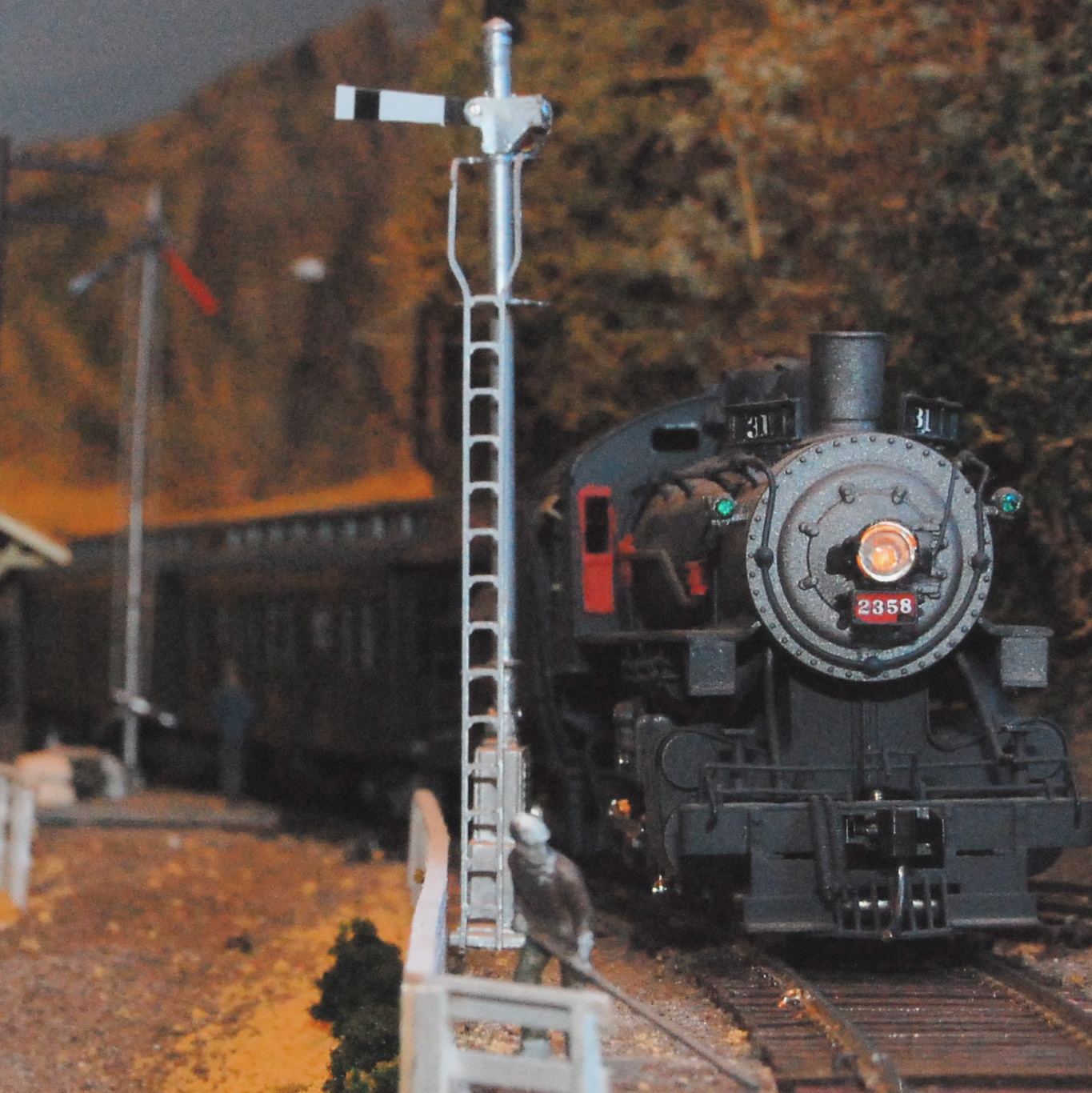
Big difference number 2: The big surprises for me was just seeing what caught their attention. I haven't seen their photos yet, but they understandably looked for interactions between trains and the world. Signals were a common tool to add some action, as were road crossings. My best guess is that model photos need the extra busy-ness and action, and really need some focal point other than the train. The Vasona Branch's semaphore signals were common places for photos. (That was also true on the prototype; one real photo that inspired me is a 1920 photo of a passenger train coming into Glenwood. That photographer, like Dan, made sure to catch the train as it "split the semaphores".

I also heard a bunch of interest about the farmhouse and orchard sitting in the blob where the tracks turn from San Jose to Campbell. This scene's always been half done and cluttered - details not glued down, ground not quite sloping correctly, the orchard too small to be realistic. I'd done a big cleanup of the scene in preparation for the photos - pulled out details, removed structures, and generally made it innocuous. But interest kept drifting back towards the farmhouse and barn. I'd started thinking about details as I was doing cleanup; I'd added a hedge to protect the farmhouse from the busier road. But the interest makes me think I should more seriously plan the scene out.

Dan and Doug also focused on the large details - freight cars and car models - rather than smaller details - not surprising because of the short time. They did spot one broken crossbuck that would have detracted from the scene; we pulled it out.

And that was pretty much it; they got ten good photos, and moved onto the next layout. I got to stare at the layout for a while; it's always fun to see the layout when it's been cleaned up for an open house or an operating session, and doubly-good when all the usual clutter in the garage has been relocated. Even though I'd crammed a bunch to get the layout in shape, I was still excited enough at seeing the layout in good shape that I finished off a couple projects that hadn't been done in time, replacing a remaining broken telephone pole, putting in some gravel around the Ainsley cannery, and fixing up the famous black walnut tree that sat at the start of Campbell Ave.

What did the photos show? I've seen the first photos, and they're great - Dan uses Helicon to combine photos taken at different focal lengths to get more depth of field. Looking at the photos, I see a few things to do differently.

  • I'm vertically challenged. In a few of the photos, it's obvious I've been less than good at making sure everything's standing up straight. They're close, but as soon as several objects are in a photo: semaphores, building, water tank, telephone poles - it's obvious each has a slightly different idea what "up" is. I'll need to work on this, both ongoing, and fixing the more obvious offenders before I next take photos.
  • Prepare for the story. I'd made sure to have cars set up in sample trains, but hadn't been good about choosing cars or trains to illustrate themes I'd want in an article about the layout. For example, large industries and lots of indistinguishable red boxcars is a big part of my layout, but I neglected to have a switcher ready at Plant 51, and also didn't make sure that the cars there were the uninteresting ones. I need to sketch out the story I want to tell beforehand, and share it with the folks doing photography.

What's next? The layout's clean and in good shape, and I'm excited to do some more building. Finishing Campbell is an obvious next step: the Hyde Cannery buildings are screaming out to be build. I'd held off on building the Campbell Theater and Ainsley Cannery because I wanted to make sure I did them right. However, my quick-and-dirty building rush seemed to work with these. Maybe I should just go build Hyde and see what happens?

The orchard scene's another obvious project.

Once both of those are done, there's obvious holes to fill. One advantage of cleaning the layout was that I got rid of all the building placed on the layout "temporarily" for lack of better space - a couple of farmhouses that never found locations, a drive-in market built for fun, a bunch of cars that needed repair. Now that the layout's opened up, I'm reminded that the area between Campbell and Vasona Junction is still completely empty. The Del Monte Plant #3 property's also still occupied only by foamcore buildings. There's also a stretch of bare plaster up on the upper deck near Alma. I'll need to take a pass on any of these scenes going forward.

If the last week's any indication, I know how to get those scenes done quickly: lock down my idea of the scene, build something that's "good enough" rather than waiting for perfection, and pull a bunch of all-nighters during a heat-wave.

Thursday, November 2, 2017

Market Street: The Train Departure Board

Short shameful confession time: I built the Market Street layout because it was easier to build than a video game.

A non-trivial bit of my inspiration for the Market Street layout came from the railway switching games made by SIAM Railway Simulations. These mostly-British prototype games provide accurate simulations either of a station or for dispatching a long set of track. The station simulations put you in the role of the tower man and switcher at anything from the end of a country branch to the busy through station at Crewe. The dispatch sections include British settings (Scottish Highland line) as well as realistic versions of Tehachapi Pass, either in the 1920’s or the 1960’s. I’ve played some samples and bought other games.

SIAM's samples page lets you get a taste of the games by downloading demonstration, reduced versions of their simulations. The samples include dispatching the Highland line and Tehachapi Pass, and handling switching in the stations at Crewe and Penzance. The Tehachapi dispatching game gave me a great appreciation for getting trains over Tehachapi Pass in the steam era.

Penzance, 1987 game from SIAM Railway Simulations

Of course, I wanted to try some more American prototypes - handling the traffic coming and going from the Oakland Pier, perhaps. Or why not the San Jose Market Street station? I got a fair way through making an iPad game so I could switch those places, but I found it difficult to control all the switch engines and car movements I wanted to include. After enough tries, I found myself asking "so what would a layout set up like one of these games look like?

So, I’ve built the layout, and I've got an answer to that question.

However, to make the layout operate like the game, I need to know what trains need to come and go. More importantly, if the layout is being exhibited, I want folks to see the names of the trains coming and going so they can understand the sheer number of trains that could be handled in the 1920’s, even if the station was a creaky old Victorian barn.

Suddenly, that way-too-large display on the Raspberry Pi has a use.

Snippet of departure board. Click here to try it out for real.

My inspiration was a European-style flip-card station sign; it’s not quite prototypical for the era, but anyone who’s been in a large train station has seen one of these, so showing a listing of trains should both inform and hint at the sheer number of trains they’re seeing.

And luckily, making such a sign is easy. One of the neat habits of programmers these days is to share programs they’ve written so others can use those programs. A friendly guy named Paul Cuthbertson liked the idea of drawing flip-style departure boards, and based on an inspiring article, went off and wrote a web page to draw one.

Now, I need more than just the departure board graphics for the Market Street layout. I need a sped-up fast clock to show the current simulated time on the railroad, for the compressed track plan means trains won’t take as long to move around as on the real thing. I’ll need a way to control the board when trains arrive and leave. I’ll need a way to manage problems - backing off accidental train departures, or stopping the clock in terms of problems.

I took Paul’s code and created this departure board for San Jose Market Street. (See this Github project for the source code itself.) Pressing a number key (1-9) causes the nth train to move to its next state; a train that’s on its way will go to “arriving” on the first press, then “arrived” on the second, then will be removed from the board on the third.

Paul’s card-flipping web page turns out to require a lot of computing horsepower to flip through all 26 characters for each change. The poor little Raspberry Pi, being the size of a credit card, couldn't keep up. Instead, I changed the program so that the board only performs 6 flips per letter, instead of flipping though the whole alphabet like the real flip board.

So now, when I set up the layout, I just need to set the box containing the DCC electronics somewhere both the audience and operator can see. The stationmaster can use a keyboard to advance the departure board as trains arrive and leave. The operators know what trains they're building; the audience gets an understanding of how easily they could commute from San Jose to San Francisco (or Salinas) in 1928.

And I get a modular layout that's inspired by a video game.


The modern practice of sharing sample code and reusable libraries is a great part of modern programming culture. Great thanks to Paul Cuthbertson for the core of the departure board code!

If the departure board idea might work for your layout, download the sources from GitHub and customize it for your own use. Drop me a note if you find it useful!

Monday, September 25, 2017

Come See the Market Street Exhibition Layout

By the way, if you're a member of the National Model Railroad Association's Pacific Coast Region, note that we're having layout tours in the San Jose area this Saturday.

I'm showing the Market Street exhibition layout as part of the tour. The layout's still new and incomplete, but if you're interested in prototype operations or portable layouts, come by and see the choices I made and what you might do the same or differently.

NMRA PCR Members can find the list of layouts on the Yahoo e-mail list for the group.

Wednesday, January 15, 2014

Seeing Local Model Railroads at "See" Level

Leo Pesce has been visiting some of our local layouts out here in the Bay Area and videotaping how things look from a train's eye view. Go check out his videos on YouTube to see some of our cool local layouts.

Rick Fortin's Valley Division Fourth District ATSF layout models a hypothetical Santa Fe branch from Chico north over the Siskyou mountains. Rick's layout is huge, requiring twenty people to operate well. One of my early operations experiences was handling the yard switcher at the west end of the yard, where I spent eight hours one Saturday just sorting boxcars. After spending a fun day in the yard, I went wandering around the layout at the end of the session and noticed some of the boxcars I switched spotted at industries up at the far end of the layout.

David Parks's Cumberland Western models the Baltimore and Ohio Railroad and the Western Maryland as they fought through the Appalachian mountains near Cumberland, West Virginia. I've been lucky enough to operate several times at David's; again, it's a large layout that shows the fun of practicing teamwork to get trains moving over the railroad.

Friday, April 12, 2013

The Best Time To Rip Up Track Is Two Weeks Before An Operating Session

Well, well! It's certainly been a while since I talked about model railroad subjects!

Let's just say it was a busy spring. I hosted an operating session for the Bay Area Layout Design and Operations meet (always the week before the Superbowl, best event on the calendar, come on over next year!). I hosted another operating session in March for our local model railroad invitational, BayRails, and hosted some very skilled operators from Santa Rosa, Arizona, Southern California, and British Columbia. I also had an open house for the Vasona Branch in early April as part of the local Iron Horse Express convention. Whew!

But that list doesn't quite tell how crazy a winter it was, and some of those stories are worth telling.

Adding some "Hurry Up and Wait" to a Model Railroad When I've heard professional railroaders talk about their jobs, I often hear about the "hurry up and wait" moments - how they'll have moments during the day when they need to rush, and other points in their jobs when all they can do is wait for long stretches of time.

I'd had a couple folks remind me that railroaders don't just show up to large industries and start switching; often they'll arrive, search around for the foreman, ask about car placements, and then start switching. Even though my switch lists already contain car doors, that idea of having to walk in and talk to the foreman seemed like a nice bit of the daily grind worth bringing into the operating session.

My low-tech solution was to take a Post-It, fold it in half to make a standing sign, and write "Contact foreman before switching plant". My crews would pull their trains out of staging, think about their moves, then start backing down the track to Plant 51 before seeing the signs. They'd come over, I'd make a couple changes to their switchlist and door spotting instructions, then turn them loose.

I liked how this worked out. The crews got a brief interruption before they started switching that got them away from thinking about the layout, and I dragged out operations a bit more (which is usually a good thing on a smaller layout). Even if their initial plans may have been thwarted, the crews seemed ok with the interruption.

The idea of "find the foreman" isn't original; Seth Neumann has blue flags made from pins and tape blocking some tracks at the Snoboy transshipment yard on his WP Milpitas Yard model railroad; I'm sure other modelers have used similar tricks. It worked well for my layout, so I'm suspecting it's time to make more permanent signs. Excitement At The Operating Sessions As usual, hosting operating sessions on a model railroad can be a bit stressful. I find my Vasona Branch requires a fair amount of prep work beforehand - cleaning track, vacuuming scenery, testing switches, tuning locomotives. I'd told the story back in January about how the prep obviously wasn't enough; on Saturday night before the operating session, cars were constatly derailing when backing into the track leading to Plant 51. Much of Saturday night and Sunday morning was spent trying to tune the cars and track so one of the busiest locations on the railroad didn't turn into a sea of derailed refrigerator cars. That repair worked and led to a good operating session on Sunday afternoon, but that track had gotten me mad.

That track at Plant 51 had been installed probably on day 3 of the model railroad. The offending section was a climbing track with a curved turnout leading to an industry, and with the turnout placed over a joint in the subroadbed. What seemed like inconsequential bumps on my first day of construction had always been trouble spots. It took the frantic effort Saturday night to convince me it was time to fix that track for good. The next week, I ripped up that entire stretch of track. I took a power sander to the roadbed to even out some bumps in the homasote, stiffened some of the joints in the plywood underneath, spackled the roadbed to get rid of any detectable unevenness, and got the track back into operation in time for BayRails. I also ripped out some of the adjoining scenery to better model the missing Los Gatos Creek bridge. Photos forthcoming as soon as I can mock up the Higgins-Hyde Packing Company plant.

The Plant 51 switch ran much better during BayRails, but I'd caught a few cars derailing during the operating session. Being conscientious, I went out the following Sunday morning determined to run the badly-behaving cars around the layout and identify trouble spots. I immediately hit two big ones - some uneven roadbed near Alma that had always been a low-grade problem, and much more frequent derailments at the Los Gatos siding that had been a constant annoyance for the last few years. After the good luck with the Plant 51 switch, I decided to rip out and replace both stretches of track... only to realize that I had two weeks to get both locations back in order before the Iron Horse Express open house. Short answer: the track got replaced, but it was a little touch-and go there.

I did learn some lessons from all these episodes. The Los Gatos Creek scene in San Jose, while unfinished, still came together remarkably fast once I'd decided to rip out and replace the track, and the new trackage makes operations a dream. I'd forgotten how fast I could build and repair when I had some hard deadlines, and the deadlines certainly contributed to getting some lingering problems fixed for good.

Going out that Sunday morning after the operating session was also a wise move, for I fixed several misbehaving cars while I could still remember where the problems had been occurring. More importantly, running a test train with only the worst cars helped me realize how badly-performing some of those cars were, and helped me zero in on bad trackage that I might not have noticed during a regular operating session. I'll certainly try to repeat this exercise after future sessions.

Guess it's time to schedule another operating session soon so I'll have a reason to rip up some track at inappropriate times.

Sunday, January 27, 2013

Open Houses: It's Like Opening Night, Repeated Over and Over

Whew, another Bay Area Layout Design and Operations meet has happened, and once again it's been a great weekend. Great talks, great conversations, and a full set of layout tours and operating sessions. Seth and Chris's description of using RFID tags to automatically make switchlists for trains showed that a long-desired bit of technology is ready for model railroading prime time. Tom Knapp described his latest Nn3 layout based on the Pacific Coast Railway in San Luis Obispo, and his lightweight modules made from 1x1 oak frames and 1" styrafoam definitely started me considering a couple module and shelf layout ideas. I missed some of the later talks as part of helping with layout design consulting, but got to talk with some fun modelers planning some neat shelf layouts and Bay Area prototypes - the advising experience was as much fun for me as I suspect it was for the designers. If you didn't make it this year, make your plans to visit San Francisco next January!

The weekend was also a bit of a whirlwind for me; I had the Vasona Branch layout open on Saturday night, and then hosted an operating session Sunday afternoon, and it was all dizzying, tiring, and fun in so many ways.

Making the layout presentable's always a struggle. There's the prep of clearing out the stuff that normally lives in the garage, the cleaning and cobweb patrol, and the effort of testing the layout to make sure it's running ok... which is a big challenge if it's been months since I last hosted. This year was a little worse than usual; although I'd been doing prep for the last few days, a bunch of gremlins must've crept in during the last few nights. A couple switches started sticking and shorting out the power supply when thrown. Well-behaved cars seemed to be derailing more often. Worst of all, one of the key switches on the layout started tossing cars off last night.

That last story is worth some detail. Normally, I'll test the layout by running a partial operating session on my own and watch for parts of the layout that misbehave. I'd done a bit of that this time, but perhaps not enough. I've also learned that it's hard to be a talkative host and run trains, so I'll usually catch an unsuspecting visitor, give him a throttle, and ask him to switch some industries while I say hello to visitors.

Last night, the poor guest took out one of the cannery jobs, and started pushing and pulling twelve cars over the spur leading to Del Monte Plant #51, the dried fruit plant in West San Jose. It seemed like every car was derailing on that switch, and each time there'd be a spark and the short circuit alarm would beep. He'd re-rail, go to do another switch, and there's be another car on the ground, another spark, and another beep. He later said he still enjoyed the job, but I was embarrassed with how badly the layout was operating - more than a few cars derailing during a session takes away any feeling of actually being a railroader.

I spent a good part of Saturday night and Sunday morning trying to diagnose what was going on. I coupled up all a good twenty cars, and ran them back and forward over that switch over and over, and cars were derailing constantly. Forward, back, derail, curse. Forward, back, derail, curse. I tried adjusting the track, I tried pulling out badly-behaving cars, I tried reasoning with the badly-behaving switch. Nothing.

Helpful hint: if you want to have a large, operating layout, it'll help if you're also willing to stand in a cold garage for hours on a wintry Saturday night running trains back and forth over a single stretch of track. Stock up on the curse words too.

With a couple hours before showtime, I was seriously considering extreme methods: pulling up the switch and replacing it with a length of flex track. I even marked the section to cut and had started curving the replacement track. Luckily, I reconsidered my odds of having a working railroad by 1:30, and decided I wasn't that brave. Instead, I pulled out the several of the worst behaving cars, replaced the trucks on a couple, and did some careful shimming, and got the failure rate down to every few trains or so. Whatever I did must have helped; the switch did decently all afternoon, and what failures it had were no worse than some of the hiccups around the layout. I'm still curious why the trucks were the problem for a couple of the cars; it looks like the springs in a couple trucks weren't keeping the sideframes level. Pitting on other wheels might have let bits of metal that could cause a wheel to climb a rail. For the rest... well, that's a mystery.

That switch (and the scenery around it) are still destined for some Serious Attention, though. I suspect a sharper-than-usual curve and slight downgrade just before the offending curved turnout is part of the problem, so some extra care at keeping vertical curves and grades gradual mught help. My current thought is to rip out the scenery and track there, do a better job of laying the track, and then redo the scenery and structures. Luckily, that switch is in front of the Abinante and Nola packing house which I learned was completely unlike the actual location. Now that I've got that 1934 photo of the J.S. Roberts packing house that I found down at the San Jose library, I've got a ton of great, photogenic detail to try to incorporate into the layout. Stay tuned for progress reports.

Even with the Mystery of the Derailing Boxcars, the weekend was still amazingly fun. The open house and operating session over the weekend brought some interesting folks by; the pictures of the operating session show their smiling (and occasionally pensive) faces. This open house also brought some folks interested in San Jose history, so I had some great conversations about about the layout. I heard about the fun of stacking cans at the Del Monte cannery, and how my Plant 51 model matched memories of taking the Daylight from San Jose to visit Grandma in San Francisco.

Thanks to all the folks who stopped by, stay tuned for maintenance progress, and I'll see the rest of you at the Layout Design and Operations meet next year!

[Photos: operating session on Sunday. I managed to shoehorn six operators onto the layout this time, including one new operator who I hope will become a regular on some of the local layouts. I also got enough questions about operating that I really need to think about getting back to regular operations...]

Monday, April 30, 2012

Shared Railroad Crossings

Me: "Where are you operating tomorrow?"

Jason: "Jim Providenza's Santa Cruz Northern."

Me: "You know you'll be running over this crossing here tomorrow, except in the opposite direction, right?"

Although hosting an operating session on my layout was my Big Event at ProRail, I also got a chance to operate on one of the other layouts - Jim Providenza's Santa Cruz Northern layout. Jim's layout is famous in model railroad circles. When interest in model railroad operations picked up in the late 1990's-about the same time that DCC control systems made running multiple trains on the same track trivial-Jim's articles in Model Railroader and other magazines about running trains with radios, dispatchers, station agents, and lots of meets got a lot of well-deserved attention and probably spurred a flock of great model railroad layouts for operations.

It didn't hurt, of course, that he's got a nicely scenicked layout with a long track run, all fit in half of a two car garage. Check out this video for a chance to see a video of the layout, though be aware the first minute focuses on the staging shelf across the garage from the best part of the layout.

The radios went away long ago, though. Now, Jim keeps trains safe via Timetable and Train Order Operation (TT&TO), the way that railroads in the first half of the 20th century kept trains from crashing into each other. Train orders, essentially, are logic puzzles that railroaders must solve before they're allowed to go home at night. All trains get a set of orders describing who wins out when two trains might occupy the same tracks. The orders are sent via telegraph to all trains (via telegraph operators at stations along the lines). The railroad crews interpret the orders (using the train orders, the rule book, and the timetable) to decide whether it's safe to move to the next siding, or if the other train might be coming at them. It's a great system when communication is challenging, but train orders required literate and sharp railroad crews to interpret the orders correctly.

Train orders also required a chain-smoking, caffeine-laden dispatcher sitting in an office somewhere with a telegraph key, papers for recording the orders sent and current location of trains, and a forceful personality to confidently hand out the orders.

Sadly, Jim didn't have one of those sorts of people, so I got to dispatch. And honestly, it was great fun; though I'd done it before, the SCN is larger and more elaborate than other layouts, so it made me think a lot more about the orders I was giving, whether I was planning ahead enough, and whether I was really writing safe orders. (Answer in at least one case: NO.)

I did poorly in one dimension: TT&TO was designed for difficult communication, so the best plan is to give out complete orders to several trains, and let them work out the details. "Train A gets to go down the hill first after 9:00; Train B can go uphill and Train C can go downhill as long as they don't get in A's way." This kind of a rule means that train B can start trying to get up the hill before 9:00 if they know there's a place to meet train A; once train A gets down the hill, then B and C rely on the rulebook to realize the train going up the hill always gets to go first without other priorities.

Assuming, of course, that all three trains realize there's a passenger train on the timetable going up the hill at 8:00, and has priority over all of them.

I instead tried to keep control and give permission only when I knew there was space - an appropriate scheme in the radio era of the 1970's, but an awful waste of paper. The cement train crew laughed about the stack of nine orders they'd needed to get their train up and back. I also ended up with three trains stuck at Fallon at the top of the hill towards the end of the session, but somehow they all got untangled just fine.

Jim's layout was a special place to visit for another reason: like me, he models the area from San Jose to Santa Cruz. He does have his own twist; Jim not only models the 1970's when he started railfanning, but he also models a personalized Santa Clara Valley where the Western Pacific had built a railroad going over the mountains. That gave him the freedom to model rough locations and the feel of the Santa Cruz Mountains without having to precisely model specific towns or the switchman's shanty next to the mainline switch at Diridon Station.

But on the edge of his Mac St. Yard in San Jose, just past the yard limits, you'll find the Southern Pacific crossing and interchange tracks. If you turn aside at the crossing and start walking up the SP tracks, you'll be on my Vasona Branch, looking at the Del Monte Cannery on one side, and Standard Oil's depot on the other. If you turn around and walk back down the unconnected WP tracks at the crossing, you'll be back here at a very busy SCN mainline looking at the Babbage Computer Company. Either way you turn, the smell of cooking tomatoes from the Del Monte cannery wins out over any other sensations.

[Photos from the SCN operating session this week are mine. First photo: SCN panorama. Second photo: after Fallon was unclogged. Third photo: SP Interchange on the SCN. If model railroad operations sounds interesting, drop me a note, or come to the Bay Area Layout Design and Operations meet, held every year the week before the Super Bowl.]

Friday, April 27, 2012

ProRail: Success!

As I've hinted over the last month or so, this week was the invite-only ProRail operating weekend, and the Vasona Branch was one of the layouts on the schedule. I hosted four attendees today for a half-day session, with participants from New York, Missouri, Nevada and California.

It was a great session - many fewer mechanical problems, and the sharp crew made it through the switching challenges with flying colors. Thanks to all the operators for a great session! Here's some action shots.

Deciding on the plan for Campbell.

Flashing brakeman signs to get the cars spotted correctly.

Two Operations Roadshow brakemen protecting the end of the Campbell Cannery Turn.

Cluttered tracks outside of Del Monte Plant #3.

Wednesday, February 1, 2012

Op Session for the South Bay's Annual LD/OPSIG Meet!

The Bay Area's annual Layout Design and Operations Weekend is now over. As usual, I had a great time - fun presentations on Saturday, invitations to operating sessions on Sunday, and layout tours throughout the weekend. Byron Henderson also arranged his layout design advice sessions for all comers, and the folks looking for advice all enjoyed getting hints about their layout designs from the experts. (If you arrange meets and conventions in your own area, consider offering the same consulting. You don't really need *experts* at layout design, just some knowledgeable folks who can listen and give good suggestions. The help seekers will be very, very grateful.)

If you didn't make it out to Mountain View this year, make sure to mark the weekend before the Super Bowl next year on your calendar, and come out and attend. It's a great event!

I'm particularly proud of the LDSIG Meet's tradition of inviting participants who may never have done serious operations to op sessions at the local layouts; my visits to Don Marenzi and Dave Adams's layouts back in 2000 and 2001 got me interested in switching, timetable and train order operations, as well as operations in general. I remember coming home from each of those operating sessions with a different view of model railroads, fired up to improve and run my own model railroad.

This year, I helped repay the favor by hosting operating sessions at the Vasona Branch for a few of the attendees. I was behind on preparing; between work, a nasty cold, and family issues, I didn't start my usual preparation til Saturday night. While I got the layout presentable and operating with around six hours of cleanup and prep, it wasn't the smoothest operating session (though it wasn't the worst either.) One of the serious problems was that I didn't check for problems detected in the last operating session in... um... October. The last thing I wanted to do the night before an operating session was try to fix balky switch machines and frogs that were intermittently losing power for fear of breaking things worse. Next time, I block out a full day for the little repairs.

But the guests seemed to all have fun; the photo shows Don and Nolan handling the Campbell Cannery Turn, with Jeff checking his timetable to figure out when the Los Gatos commute train leaves town. Brett, another guest who's a professional railroader, was impressed that my small layout could give him a realistic and busy day of switching. Note the tall shell of the Sunsweet building on the right hand side of the scene, and the new Hyde Cannery spur at the far end of town. Also note the bright blue erasers I leave around as handy brakes to keep free-rolling cars from moving.

Brett also noted that my switchlists with door assignments listed are a bit unprototypical. In the real world, the crew arrives at the industry, finds the plant's foreman, and asks where the different cars need to be spotted. They then do the necessary shuffling. The computerized switchlists with the doors chosen do add more complexity (sometimes too much), but loses that sense of "we've gotten somewhere, let's figure out what we need to do or find someone who'll tell us what to do." I'm tempted in the future to require the crew switching a big industry to stop, send a switchman over to me, wait til I stop b.s.'ing with the guests, then ask for door assignments. I can give him some specific assignments ("the Pennsy boxcar needs to go at door 5"), some random ones ("the SP cars can go in any order at doors 1, 2, or 3") and some don't cares ("why are you bothering me about those cars? You're the railroaders; just put 'em where you think they go!") I don't know if the interruption would be annoying or fun, but I'm tempted to try it next time. Model railroaders interested in auditioning for the operating session role of "cranky plant foreman" can drop a resume and head shot in the comments.

Model railroad operations and layout design are both fun, but they're more fun when shared with others. Don't forget to have some operating sessions for the new folks in the hobby. Someday, they'll be building the cool layouts you'll want to operate on!

Sunday, October 9, 2011

Train Orders on a Small Layout? Answer Hazy.

Thanks to the fortunate arrival of a coworker from out of town, I had my first operating session in months today, and it went well.  One fatality - a brakeman was brutally run over by the Santa Cruz Passenger.  Although all crews are warned to use flagmen on the broad curve between Campbell and San Jose, I need to warn folks to put the flagman far enough out so a crew in the aisle might see it.  All the trains also ran, even the San Jose Turn with its mixed freight that had twice as much to do because it didn't fully run last time.  The new track at Campbell for the Hyde Cannery and Sunsweet packing house worked well, though it would have worked better if the track didn't get filled with eight cars by session end.  (For those of you wishing that SwitchList would avoid sending cars to overflowing sidings, lets just say I feel your pain.

More importantly, I tried out my idea of simple train orders for trains going between Vasona Branch and Santa Cruz.  On the good side, I think it did encourage the crews to think a little bit about where they were going and where they'd have to meet those other trains, and it did encourage some of the typical railroader "oh, great, we're stuck at lowest priority."  I did make sure to write the orders at the last minute so no one ended up stuck on a siding for an hour because of bad planning.  On the bad side, there was still an awful lot of paper to write up, and for the crews going from San Jose to Los Gatos, the amount of interpretation they needed to go that last two feet from Vasona Junction to Los Gatos was a little annoying.

But a good time was had by all, and except for a couple balky cars, one unpowered frog, some dirty track, and a tree leaning into the right-of-way, things went well.

Saturday, May 14, 2011

Coming to Sacramento for X2011 West? Stop at the Vasona Branch!

The National Model Railroad Association's national convention is in Sacramento, California this year during the first week of July. As an added bonus for the folks travelling from around the country, the organizers have also set up a bonus "Advance Section" the weekend before so attendees can visit model railroads in the San Francisco Bay Area.

The Vasona Branch will be part of the Advance Session festivities, with operating sessions on Friday and Sunday, and I'll also have the layout open for the south bay tours on Saturday morning. If you're coming out to X2011 and want to see the Vasona Branch, plan to head out to Silicon Valley for the Advance Section before the big week in Sacramento!

Sunday, February 12, 2006

LDSIG 2006 Santa Clara Meet: First Open House

This weekend was the annual Santa Clara mini-convention on layout design and operation -- a weekend of presentations on layout design, operating sessions at nearby layouts, design critiques, and layout tours. I opened my layout for viewing on Saturday night, and probably got a good thirty or so people visiting during the evening. This was the first time I'd ever showed my layout to more than just friends, and the comments and suggestions made it all worthwhile.

It's also been a great kick-in-the-pants for the last few weeks as I put in minimal scenery, got the layout operating much better, and in general dealt with all the little niggling details that made the layout that much more viewable.

Some of the particularly helpful projects:

* A couple of stretches of empty space were replaced with flat fields of plaster. Though the area wasn't scenicked, some hastily planted buildings and fences hinted at where a farm would soon be placed.

* My lovely wife spent a good part of a weekend sewing minimal drapes to hide the underside of the layout; while the 15 yards of good fabric was a bit pricey (even on sale), the cost of the velcro to attach it to the layout was equally bad. Luckily, I now have some nice heavy denim drapes in pullman green -- a good color for the SP, and a great color to complement the scenery.

* I spent several days just cleaning track. A battery-powered Dremel tool with a wire brush did fast work of lingering dirt on wheels and track. I also found the foolproof way to test the track was set a balky 0-6-0 switcher at one end of the layout and see how far I could get before it stalled.

* A non-railroad friend kindly kept the trains running all evening as I talked with visitors. With a single-tracked mainline terminated with a pair of reverse loops, operation really requires someone observing what's going on.