Showing posts with label research. Show all posts

Wednesday, May 13, 2026

Stocking Up for the Fruit Season

Part of building a realistic model railroad is building a realistic car fleet that captures the look of the trains and industries that service the places we model.

Back when I was a teenager, my philosophy for selecting model freight cars was easy: if it looked cool, I bought it. I’d pick up a boxcar with a bright paint scheme at the hobby shop after a dentist’s appointment. I picked up a pair of covered hoppers because they looked so different from anything else I had. I built auto rack and modern boxcar kits because I found them at the hobby shop and so I could learn some new techniques or so I could do some modeling some evening.

As I started focusing on modeling prototype locations, I got more picky. I cared more about getting freight cars that would have run in the 1930s, began curating the road names so I’d get a mix of Southern Pacific and eastern railroad cars, and pushed down any interest in inappropriate cars. I sometimes broke the rules - the pink Roma Wine refrigerator car that was eye-catching but the wrong era, the early covered hopper that the Funaro and Camerlengo owner convinced me would be a neat model for my era even if it primarily was used in Florida. I built a pair of Northern Pacific stock cars from the Central Valley kits even though they were likely inappropriate for my layout. As time went on, some of these cars got given away, boxed, or merely kept far away from the layout.

The lack of the stock cars wasn’t a big deal. Although I’d initially assumed that stock movements would be a staple of western railroading, stock movements on the real Vasona Branch were rare. The Northern Pacific cars always seemed like placeholders even for the imaginary cattle movements. I’d bought some kits for SP cars at various times, but they weren’t particularly important priorities when the layout didn’t actually have any stock pens to load them.

But there were always a few rumblings that there might be better uses for the stock cars. I’d seen various photos of stock cars being used to carry fresh (“green”) fruit - photos of workers unloading fruit lugs from a stock car at the Richmond Chase cannery in the 1920’s, Ed Gibson’s find of the crushed apricots in stock cars hit by an errant Daylight passenger train in Bayshore yard in the late 1920s, stories about watermelons being shipped in stock cars well into the 1950’s.

One find, however, convinced me that stock cars might belong on the Vasona Branch. Back during the pandemic, the Campbell Museum shared a bit of Ainsley cannery letterhead summarizing the peaches received by the cannery form the Treat Ranch in the summer of 1914. Looking over the list of incoming cars, I noticed that many of the cars delivering fruit in those days were actually stock cars. That was enough for me: I knew that other canneries were receiving fruit in stock cars into at least the late 1920s, and the accounting of the Ainsley cannery receiving fruit from distant orchards suggested that bringing in fruit from distant places was reasonable for the canneries along the Vasona branch. It was time to actually build some stock cars for the fresh fruit trade.

The Cars

My SP S-40-3 cars were built from plastic kits that Ted Culotta sold via his Speedwich Media business. The parts were originally intended for highly-detailed ready-to—run plastic freight cars sold by the Red Caboose around 2013. Ted, as a passionate freight car modeler, managed to convince Red Caboose to let him sell unassembled parts from the kit separately - I’m guessing for folks who wanted to modify the kits as well as folks who wanted the pleasure of building the kits themselves. When Ted offered these in the late 2010s, I bought three on the assumption they’d be fun to build.

Like a lot of projects, the kits sat on my shelf for a long time - I never quite had a strong reason to build them, nor the inclination to spend some long weekends building the kits.

Luckily, re-reading the Treat Ranch pear accounting when prepping for a presentation on cannery history reminded me that these cars could be useful on the layout.

There’s nothing too special about building these kits - the models were mostly built according to the instructions, painted them with rattle-cans of red primer, and decaled for the SP and T&NO. (The uncommon SP subsidiaries on the Treat Ranch accounting would have been fun to model, but the SP merged all those railroads into the T&NO in the late 1920’s, so the odd reporting marks would have been unlikely to have survived into the 1930s.)

I did bit of weathering on the cars using an airbrush. Specifically, I’d had friends talking about the inexpensive airbrushes with a small pocket-sized compressor. (Here is the airbrush I got.) These airbrushes aren’t suitable for serious painting, but they do have enough airflow to make them handy for airbrushing and other detail work. I'll admit it's also freeing to put the candy-bar-sized compressor in my pocket as I search around the layout looking for things to weather - something that's hard to do with a full-sized air compressor.

The Result

The three stock cars are now on the Vasona Branch, bringing peaches and apricots to the local canneries. I’m looking forward to crews asking why they’re bringing cattle to a cannery. They'll get an earful about how railroads make some very strange choices for assigning cars during busy seasons.

Thursday, May 8, 2025

Model Railroad Sudoku II: Straight Outta SLO

And now for another game of Model Railroad Sudoku, where we leaf through a railroad employee’s time book and try to piece together what a worker's job was like. As a reminder, railroad employees used these time books - little notebooks often handed out for free by insurance men or other businesses - to record the trains they worked and the expected pay, giving them a way to double-check the railroad’s records at the end of the month. Most time books included columns for dates, where the train came from and went to, times, pay, and names of the foreman they worked for.

This time, we’ll check out a time book collected and scanned by John Signor and available by the grace of Ed Gibson, proprietor of wx4.org, also known as the Dome of Foam.

Here's the time book so you can play along, or look at some of the raw data on a Google Spreadsheet.

I’m interested in this time book in hopes of learning something about the Southern Pacific in San Jose - Ed describes the time book as the 1920’s era, and various hints made me think that the employee, Vernon Frasier, was an SP employee.

Let’s see if we can learn anything useful! For those of you playing along at home, I’ll make sure to prompt with a rough area of questioning before going into my own guesses; feel free to dive into the time book, see what you discover, and compare your observations against mine.

Question 1: Is the time book for an SP employee? When’s it from, and what area?

Now, Ed describes the time book as circa 1925 and for “Vernon Frazier” (though the scanned book doesn’t actually show a page with his name so we can’t be certain of the name spelling.) If you look in the time book, you’ll see occasional month names on the top of pages - showing that this time book was filled out in December 1928 and later months. The ads at the top are mostly for San Jose, Watsonville, and Pacific Grove businesses, seriously hinting at someone working in the local area, suggesting an SP employee. We don’t have any proof yet that he was an SP engineer, nor definitive proof of where.

Question 2: How did Mr Fraser fill in columns in the time book?

The prepared columns don’t quite match the numbers written in. Date and engine number look sane (at least for the SP), but the train number appears to have a departure time, “called for” has various numbers and X’s, “left at” isn’t close to the call time, initial delay is always a number or an X, station has just numbers, and arrived at has obvious dollar signs.

The engine number looks like SP steam engine numbers - Mr. Frazier was driving Consolidations (2727, 2670), 4-8-0s (2814), and a bunch of 4-8-2s (3650, 3638, etc). It looks like he worked on the road, and must have been an engineer or fireman. The first time (in the train number column) makes sense as a start time; let’s see if everything else makes sense.

The “called for” has various numbers -73, 1-75, 75, 77, and 71 and X - perhaps train numbers? Straight numbers like 73 likely indicate train 73 (probably a northbound Los Angeles - San Francisco passenger train), numbers with a dash indicate which section of a train run in multiple parts (1-75 is first section of train 75), and X probably indicates an “extra” train not listed in a timetable.

The “left at” column appears to have times, and most are several hours after the time in “train number”. Let’s assume this is the time he stopped work.

The “Initial delay” shows some other numbers and Xs: 76, 2-102, 330. These look very much like train numbers, especially since they look very similar to the “called for” outbound train numbers. Halfway through the time book, he stops noting these as all.

The “station no.” column is numbers, ranging from 100 (several instances) to 208. The minimum value of 100 matches the railroad rule that a road crew gets paid in 100 mile days. The 100s could represent days where Mr. Frazier didn’t travel far, and larger numbers represent longer days.

The “arrived at” column has dollar values; larger values match longer miles in the previous column, confirming that these columns are probably miles and pay.

The final column, on the second page, lists last names, and we can guess these are the foreman, engineer, or fireman.

Question 3: What’s with those train numbers?

Now, the train numbers don’t look at all familiar. 1950’s timetables don’t show appropriate trains. However, the 1920’s timetables do make sense - see Coast Division employee timetable #126 from 1927, for example.

  • Train 69/70 was the Coaster
  • Train 71/72 was the Daylight
  • Train 73/74 was the Padre, which later became the Oakland Daylight
  • Train 75/76 was the Lark
  • Train 77/78 was the Shoreline
  • Train 101/102 was the Sunset Limited - San Francisco to New Orleans.
  • Train 243/244 was the Sunset Manifest.
  • Train 330 was Freight

That’s impressive! The odd numbers are always north-bound towards San Francisco (railroad westbound), and even always south-bound towards Los Angeles (railroad eastbound.)

Here’s an excerpt of the 1928 timetable:

The times for the scheduled trains (especially the passenger trains) seem to imply Mr. Frazier is working out of San Luis Obispo - the starting times usually coincide with the departure of the first train number from San Luis Obispo, suggesting he's starting work in San Luis Obispo.

Why does he include two train numbers on all his runs? That probably means that he's going out and back. All are odd in first columns and even in second columns, suggesting he’s going west out of San Luis Obispo towards Watsonville Junction, and always returning to San Luis Obispo. Maybe he went other directions on some of the extra trips, but there’s really no sign of him going eastbound from SLO.

The X’s could indicate actual extra freights or light engine movements. Xs out of San Luis Obispo (assuming they're westbound) and are likely to be actual extra trains if only because it would be unlikely to send a helper up Cuesta without a train - that's the direction that most needs the help! There are some cases where there are Xs in both directions, again suggesting some of these are actually extra freights rather than engine movements.

Vernon’s work also changes during the year. During the winter, he operates a mix of numbered and extra trains out of San Luis Obispo always northbound, but on March 9, he starts repeatedly working the Daylight Limited (71/72). The start and end times also start matching up with times both westbound and eastbound, and with longer (230) mile days suggesting longer mainline runs.

Question 4: What more do we know if we assume he is working in San Luis Obispo?

Now that we know he was working out of San Luis Obispo, we can start checking additional sources for background on Mr. Frazier: census records (for information about him) and published railroad seniority lists (for his career and the careers of his coworkers). He might live in San Luis Obispo or in one of the other towns. Is there anyone with the name Frazier near San Luis Obispo?

With some quick searching, ancestry.com does has some information on him from census records, though with a different spelling. In the 1930 census, Vernon Fraser is 34 years old, Locomotive Engineer, born in California, married 10 years to Ruby Fraser, son Gordon and daughter Eugenia, and living at 329 Santa Barbara Ave. near the SP depot. (Full Ancestry census page here).

Railroad seniority lists are also a great source for checking on Vernon's career. These lists were important to railroaders to understand the pecking order for bidding on jobs, but they'll also give us details on when Vernon started and gives us a way to guess at those other names in the time book and confirm their particular trade and seniority level.

A 1929 seniority roster (also from the Dome of Foam) showed “Fraser, VW” (not the same spelling as Ed gave) qualified as engineer Sept. 1, 1926. So he was an engineer at this point with three years of seniority.

However, looking at the paired up names on the time book, the names all match engineers: Deffenbach and Umbertis (qualified as engineers in 1920), Nevins, McGaha, Dutcher, Fisk, etc. Either Vernon Frazier was actually working as a fireman (but doesn’t appear in the lists), or Vernon Fraser was bidding on fireman jobs even though he was qualified as an engineer, or the engineer listed in the time book might be the engineer for the train he was helping.

Question 5: Where could Vernon Frazier have been operating those trains?

If we pencil out the train schedules:

The call times mostly match up with the departure of the northbound trains, and the end times match the arrival of the southbound trains with arrival in San Luis Obispo. It looks like we’ve got the time book of an engineer operating north out of SLO. He also doesn’t appear to go all the way to Watsonville Junction which appears strange - to get back in time, he would have to part ways with the train somewhere between SLO and Watsonville Junction. Now, we know there’s a big hill - Cuesta Grade - north of SLO. Could Mr. Frazier be operating helpers?

The engine numbers hint at that - at least some of his runs on first and second class trains are on 2-8-0s, which definitely don’t seem like motive power for named trains going up Cuesta. Even when he’s on a 4-8-2, the runs are shorter, suggesting he couldn’t have made it all the way to San Ardo or Watsonville Junction and back.

(How do we know whether he was working on helpers, rather than working on mainline trains? If he was enginer for the mainline trains, I'd assume he would show mileage that better matched running halfway or all the way through a division - I'll go through that a bit more later.)

TrainSJCWatsonvilleSan ArdoSLOSurf
1017:00a5:35a3:30a12:42a11:15p
1027:30p9:00p10:56p1:25a3:08a
716:40p5:17p3:33p1:33p12:18p
728:47a10:06a11:50a1:53p3:07p
699:23a7:50a5:46a3:12a1:36a
7010:22p11:55p1:56a4:35a6:14a
737:40a6:10a4:09a1:48a12:30a
7410:07p11:26p1:10a3:25a4:43a
758:19a6:37a4:41a2:15a12:53a
769:04p10:23p12:12a2:45a4:10a
779:32p7:57p5:33p3:05p1:21p
789:05p10:40a1:06p3:40p5:18p
24311:00p4:50p9:00a11:45p8:55p
2443:15a7:20a3:33p10:15p3:08a
330-10:15a1:24p6:45p8:55p

If so, his typical day is help a train north over Cuesta Grade, cut off somewhere at Santa Margarita, and return. The miles suggest the distance he travelled (unless he did multiple round trips). 100 miles were up and back. It’s only 16 miles from SLO to Santa Margarita, so he could have made it to Paso Robles or San Miguel and back on 100 miles. But that doesn’t quite match because of the precise mileage. More importantly, Santa Margarita has the only wye north of San Luis Obispo according to the employee timetable, and there's no turntable in the area, so there would be no other place to turn an engine. Assuming a single helper run up and down does imply a lot of time waiting. For example, on December 30, 1928, Mr. Frazier starts off in San Luis Obispo at 1:13 PM, 30 minutes before the arrival of the Daylight. He took the 71 north, took the 102 south, and arrived home at 1:35 am after 182 miles - one of his longer days. Now, a 91 mile trip would only have gotten him to King City, arriving at 3:50 pm, but catching the southbound Sunset Limited at 10:30 pm. That seems like an awfully long pause in the middle of his day.

It's worth noting that the timetable only has 7-8 scheduled (non-extra) trains a day in each direction, mostly clustered in the same times. Westbound trains towards San Francisco were often passing through between 3-5 am and 3-5 pm (morning and evening departures from Los Angeles) while eastbound trains were between 10pm-1am and 10am-3pm (evening and morning departures from San Francisco). That’s awkward for crews based in San Luis Obispo where a departure at 3pm on a numbered train may mean getting stuck at Santa Margarita for several hours until the late night rush arrives eastbound.

It would be nice to know how many extra trains came through San Luis Obispo, but that's hard without dispatcher's timesheets.

I’m more willing to believe that Mr. Frazier led multiple trains, going SLO to Santa Margarita at 1:30. He could have taken the Shore Line south at 2:44 pm, or 330 freight south at 4:08 pm, arriving in San Luis Obispo between 4:00 and 6:00 pm. There’s no good scheduled trains between 6pm and midnight - maybe he could have taken an extra - but he would have needed to be in Santa Margarita at 12:15 am to catch the train back. That’s still less than 100 miles.

100 miles is the minimum mileage for a day's work, so the 100 mile days probably just didn't involve much movement.

Different days had different mileages. November 30, 1928 had up on 77, back on 102 for 182 miles, but Dec. 2 had him up on 77 and back on 102 for 151 miles. There’s other days he’s back on an extra (4 hours, 100 miles) or train 244, the Sunset Manifest.

What about the distributions in mileage? I looked at 37 days of work for Mr. Fraser. 21 of the days were 100 mile days, and all were less than 8 hours of work. The rest of the days had unique or two-occurence mileages from 112 miles to 216 miles. Mileage also correlated strongly with hours of service: a 112 mile day was 8h35m, 116 miles was 8h50m, 126 miles was 9h25m, 134 miles was 9h25m. It definitely feels less like Vernon was getting paid for the actual mileage he worked (where I would have expected a lot of repeated miles), but instead getting paid by hours worked getting converted into a mileage. $6.23 for a 100 mile day plus 6c a mile seems to be a close but not exact conversion.

Let’s try thinking through a different scenario. On December 30, 1928, Mr. Frazier gets called at 1:13 pm at SLO, acts as helper the Daylight at 1:43 pm, and takes it as far as Santa Margarita (17 miles), breaking off the helper around 2:30pm, and catching the Sunset Manifest, train 244 at 4:45 pm. He returns to SLO at 7:25 pm, catches an extra, and meets the Sunset Limited at Santa Margarita at 12:15am. He got paid $11.34 for this 12 hour and 22 minute day which got recorded as 182 miles - much less than four trips to Santa Margarita (4 x 17 miles = 68 milees).

So from just this information, I think we’ve got it figured out:

  • This is a time book for an SP engineer, Vernon Fraser.
  • It records his work between December 1928 and mid-1929.
  • He's mostly handling helpers out of San Luis Obispo.
  • He probably did short trips, and had to wait at the top of Cuesta to pair up with a train headed down, or with multiple trips that aren’t fully detailed.
  • He was working near daily, even with only a few years of seniority. If I was more curious, I'd check later censuses to see
  • He was mostly paid on hours work (converted into miles).
  • He may have done 1-2 helper runs a day, and had lots of idle tiome waiting for the next train

How does that match what you saw in the time book, and what further information would you want to examine?

Wednesday, November 6, 2024

Freight Trains in the Sky

One of the bigger changes in model railroading since the 1970’s is whether we’re modeling a completely imaginary railroad, a plausible but invented railroad, or if we’re trying to model the real world as it was at a particular time. The “imagine everything” folks might build something that’s a caricature - think John Allen’s mountain-crossing Gorre and Daphetid — or that borrows some historic reality (“bridge route in Colorado”) Owners get all the freedom to choose what they’re building out of whole cloth, create cities along the railroad from any inspiration, and avoid all the pesky research and visits to actual sites. Folks building to a plausible reality might need to understand something about the economics, architecture, and industries of a specific place and time - modeling an agricultural short line in California, or a fictitious logging railroad in Washington state. However, they’ve also got the freedom to imagine new places using whatever constraints they choose. I’m on the other side - I choose to model actual locations, and try to accurately model what’s there. I enjoy the research, I think I get a more realistic whole, and I suspect that the research helps me fill in details I couldn’t imagine on my own.

Or, more bluntly, the real world is stranger than I might imagine, so modeling a real place from photos helps me fill in those details I couldn’t possibly invent.

How strange is the real world? How about “freight trains in the sky” strange?

Report on Steam Railroads of San Jose

I was poking around in San Jose Library’s California Room, the library’s local history collection. One item caught my attention: “Report on Steam Railroads of San Jose”. This report from 1925 described the current state of the different railroads in San Jose at the time, and suggested ways to improve both the profits of the railroads while improving quality of life for San Jose residents and businesses. Considering the author was a well-known urban planner from St. Louis (Harold Bartholomew, who apparently had an entire urban planning firm specializing in railroad rethinks), I think we can imagine we’re about to hear a bunch of crazy ideas from those Back East crazy consultants. And it doesn’t disappoint, with a crazy proposal that I couldn’t have imagined.

[ Partial version of Report on Steam Railroads of San Jose here. I didn’t bother to scan the fold-out profiles for railroad elevation for the three plans. Sorry! ]

The problems of San Jose in regard to its steam railroads are similar in every respect to those in other Cities of normal and rapid growth, where the expansion of industries, commercial enterprises, and residential sections has taken place with little or no regulation. Instead of well defined and segregated industrial districts, we find in San Jose clusters of factories, warehouses, coal and lumber yards and a great number of packing establishments located close up to the railroad tracks, often main lines, as they have always existed. The industries have closed in on the railroads, so to speak, thus hindering greatly both their own expansion and that of the railroads.”

As a reminder, San Jose in 1925 was different from the railroads we know today. In the 1920’s, the College Park yard straddling the Guadalupe river was the main SP yard. The “big old barn” of an Eastlake-style wooden station on Bassett Street was San Jose’s primary railroad station. The line to Los Angeles ran down the center of Fourth Street, past office buildings and San Jose State University. The old South Pacific Coast line broke off the SP mainline at the old Lentzen Street roundhouse, past the current Shark Tank and future site of Diridon Station, and then off towards Campbell and Los Gatos. Santa Clara’s Newhall Yard hadn’t yet been built. The old freight yards were congested, lots of downtown streets got blocked by trains around the clock, and the residents complained about the 19th century feel of the railroad facilities in town. Main roads crossed the railroad at ground level, so busy streets such as First Street, Polhemus (Taylor), San Pedro Street, and the Alameda were constantly blocked by trains coming and going.

What’s Wrong with the San Jose Railroads?

It was a very different San Jose than we know. The report highlighted many of the challenges: the passenger station and yards were overwhelmed, the freight station wasn’t modern, and the city wanted the SP off Fourth Street.

There were 100 passenger trains running through San Jose each day. 70 of the trains were the commute operations - nearly as busy as today. Most of those passenger operations went to the San Jose Market Street station - a two track station that was too tiny for the service, stuck in the middle of the city, and ill-equipped to turn commute trains and send steam engines to and from the roundhouse. There were also five trains to and from Oakland and Niles, six trains to and from Los Angeles and points east, and six trains to and from Monterey and the Salinas Valley. None of these were trains to Santa Cruz - the Santa Cruz trains all stopped at the former SPC station off the Alameda.

The yards and services were still based on 1870’s San Jose. Freight switching of College Park blocked Polhemus (Taylor) Street; San Pedro Street had six to twelve tracks to cross. The consultants were particularly dismissive of the old Southern Pacific freight depot on San Pedro Street. The freight station was a fine building, 600 feet long with two tracks holding 44 freight cars each (assuming temporary bridges could be placed between adjacent cars.) However, the freight station predated automobiles. There were no loading docks for trucks on the property, the station was reached by a narrow driveway, and the only exit along San Pedro Street required crossing eight active yard tracks.

“THE FOURTH STREET PROBLEM That a problem exists as to the proper disposition of the Southern Pacific track in Fourth Street, is granted by all, including the railroad itself which some twenty years ago anticipated the situation and purchased the necessary right of way for relocating its track to by-pass the city to the South. The detour was never built, however, and in the interim the city developed a rapid suburban growth to the South and west so that the proposed route is now fairly well surrounded by residential and potential residential areas and is intersected by some 20 improved streets. Naturally, a well established community such as this resents the intrusion of the railroad into its midst. On the other hand that part of the public along and in the vicinity of Fourth Street, and those utilizing its own streets have endured the presence of the railroad for about 50 years and now feel the need of relief. It is also the sentiment that the natural expansion of the business district eastward is hampered boy the operation of trains on Fourth Street.
The railroad without a doubt would prefer to remain in Fourth Street, operating at grade for the rest of its life, as the sight loss in time due to speed reduction through the city is inconsequential and any change it may make to materially better the situation will probably cost from one to five million dollars.”

The great thing about the report is that the consultants went into detail about how the Southern Pacific and Western Pacific ran their railroads. They noted a ton of operating details about the SP.

  • San Jose yard assembled trains going to San Francisco, Oakland, Niles, Tracy, Watsonville Junction, Redwood City, and Santa Cruz.
  • 30 switch engines and crews were needed for yard and industrial switching during the fall season.
  • 30-40 freight trains a day, and 1600-1800 cars per day came through San Jose. “This is not an extraordinary great volume for the facilities at hand but the great diversity of classifications necessitates quick handling.”
  • SP had four team tracks just west of North First Street and north of passenger depot, and two additional tracks west of San Pedro Street that had a loading platform and Gantry crane.
  • For Market Street station, the two tracks under the train shed and one track north of the train shed were used for loading and unloading passengers. Five tracks north of the station were used for storing passenger equipment.
  • WP cars were only interchanged on the south side of town near Fourth Street and Alma. This was also a point of contention in the report, and the authors stressed that better and faster ways of interchange were needed.
  • The consultants were also detailed, explaining exactly how cars for the Santa Cruz branch were handled. They stated that Santa Cruz branch trains were assembled in “a small yard in Senter Street prolonged” (aka the current main line between Lenten Ave and Diridon Station). Train crews didn’t have to do any additional re-blocking or organizing there; instead, trains could sort cars at “several tracks on the Santa Cruz division in the vicinity of San Carlos Street (called the South Yard)” This is some great detail that I’m not sure how I’d get any other way. From the point of view of my Vasona Branch model railroad, it would be quite accurate for crews to sort and shuffle cars near Plant 51 either for local work or in preparation for later work further down the line. Best of all, I now know to refer to this stretch of tracks as “South Yard” - a little detail that otherwise might never have been recorded.

    So What Should We Do About It?

    The Eastern Consultants made four proposals, two that made sense and one that was batshit crazy to my modern eyes.

  • A: Bypass around San Jose to the west.
  • B: Elevated tracks along Fourth Street
  • C: Reuse the Western Pacific right of way around San Jose.
  • D: Pass around the city to the east/north, and parallel the WP on the east side of town.
  • The consultants thought the bypass around the west side of San Jose was a non-starter. Although the SP had owned the land for twenty years, suburbia now surrounded the right of way, and the neighbors were unlikely to want trains coming through their nice neighborhood. (Two years later, the Willow Glen neighborhood incorporated as a city, primarily to block the Southern Pacific from coming through. They merged back into San Jose once the SP bypass was built to their east, avoiding the neighborhood.) The consultants also noted it was going to be pricey to raise the tracks around the Alameda and through Willow Glen, build bridges at the Alameda and San Carlos, and fight the neighbors. “It is therefore recommended that this plan be definitively abandoned.”

    Plan B was their favorite - they assumed that the then-current mainline north of downtown and down Fourth Street could be raised 15 feet in the air, and the city streets in the vicinity could be dropped four feet. More importantly, they only suggest raising the through tracks to Los Angeles - the station would remain at ground level (though it would be “replaced by an efficient and modern station”), and San Francisco commute trains would continue to stop at ground level. This plan seems to assume the College Park yard must be decommissioned, for there would be no way for a train leaving the yard to reach the ramp to the elevated structure. They still note that “freight and passenger terminal reconstruction will be quite expensive as will also the elevated line of open type design” - an interesting admission when they discounted the bypass around Willow Glen because of the cost of routing and elevating the tracks there.

    To my eye, they’re being awfully optimistic about the plan:

    “The principal advantages of plan B are as follows: (1) Property values along Fourth Street will not be depressed but should be favorably affected.” Honestly, I can’t imagine freight trains rolling by at second floor level would be pleasant, either for noise, shaking, or strange stuff dropping from the train. They also admit that “certain industries particularly in the vicinity of North First Street including in the Wye… will be unfavorably affected.” I think they’re primarily talking about the Golden Gate Packing Co on Fourth Street here - apparently, its sidings couldn’t be connected after all the work to raise the line.


    The third option, Plan C, was to bypass San Jose to the west like Plan A, but avoid the challenges of forcing a new route through the Willow Glen suburbs. Bartholomew proposed having the SP move the main line to the former South Pacific line, build a new station at today’s Diridon Station, and build the necessary overpasses and underpasses along the way. When the tracks passed by the Western Pacific crossing, though, the mainline would follow the WP line through the Willow Glen neighborhood and onto open country. The consultants suggested that a jointly operated double track line could be created, or the SP could just parallel the WP immediately to the south. They claimed this approach would remove all the tracks on Fourth Street, “no important industries would be affected”, “no additional interlocking plants would be required with the WP.”, and a joint line would allow for a more convenient place for the railroads to exchange cars. They also admit that moving the SP’s passenger depot away from downtown is a drawback, “passengers will be carried through an industrial area largely and will not get a satisfactory impression of the city as a whole”, and requires acquiring a different set of land through Willow Glen.

    Paralleling the WP might not be as easy. From modern eyes, the WP’s line through Willow Glen seems to weave its own way through suburbia on a narrow right of way. I’d imagine the neighbors would have complained just as loudly as they had to the SP’s bypass proposal. The consultants proposed a joint line with the WP, or at least a parallel line, and do note that these would be much more unsafe than the existing situation if the line continued to have street level grade crossings - drivers and pedestrians were too likely to start moving when one train passed, not realizing another was coming on the parallel track.

    Plan D appeared to be a bonus proposal, provided mostly as an afterthought. Although they noted the SP could go around the east side of San Jose, they noted that the railroad would need to push a right-of-way through many blocks of existing neighborhoods, increasing the cost and the outcry.

    How’d the Consultants Do?

    All joking aside, I really love this document. Not only does it propose an alternate San Jose that I would never have imagined myself, but it also provides so many details that are helpful for my model railroad based on the real railroads they examined. I appreciate their fact gathering about the activity in San Jose: the number of trains and cars switched, the work done at the freight house and passenger depot, the switching practices, and the informal names for pieces of track. I can’t imagine anywhere else I might have learned that the tracks near the Del Monte cannery were referred to as the “South Yard”.

    I love the document, but that doesn’t mean I love that alternate San Jose they propose. I don’t know how serious this plan was, but the elevated tracks through flat San Jose doesn’t match my image of California - elevated structures like this definitely sound like something we’d find “back east”, not here. However, the fact that someone proposed this definitely highlights that this could have happened, and I could imagine someone building an interesting “what-if” layout with freight trains flying by downtown San Jose at treetop level. If I were into modeling plausible railroads, it might be interesting to build a major mainline through downtown San Jose on an elevated structure. However, I suspect it would look awkward and out-of-place. If we’re building a plausible layout, that also means we want to avoid the stuff that might be accurate but that doesn’t match our viewers’ expectations much. Just because some fancy east coast consultants thought it’s possible doesn’t mean my next guest to see the model would think so.

    I’m also not sure it would be a fun model railroad. The operational challenges - the long climb paralleling existing tracks, the new two level station at Market Street, the curve onto Fourth Street - make me wonder whether it would be good or bad as a model railroad - the elevated and ground level tracks seem like they’d remove some of the complexity and action we’d like in a model railroad.

    The whole plan, though, highlights how strange the real world is, and how folks might have suggested plans for our hometown that might seem surprising or improbable to our eyes. Apparently, someone in City Hall or the Chamber of Commerce didn’t think it was so strange, and was willing to cut Mr. Bartholomew a large check to “think outside the box” and consider freight trains in the sky.

    Bartholomew didn’t just try to rebuild San Jose’s railroads - urban planning was his business, and he did similar reports for many big cities from the 1920’s through the 1950’s. The archives of his company, Harland Bartholomew and Associates, are in Washington University’s library in St. Louis, and a listing of just some of their records show how broadly he consulted - the list shows Alameda, Oakland, San Francisco, Berkeley, and San Jose all having reports done, as well as many more cities across the U.S. If I had a couple days free in St. Louis, I’d likely stop by and check out Bartholomew’s other plans. I suspect I’ll find a bunch of “just put the freight trains on an elevated structure” ideas.

    We’ve got a lot of choice when we’re building a model railroad - whether we’re building something imaginary, plausible, or historically accurate. I’ve always aimed to model real locations and times because I think I’ll create a more believable scene than I would have if I either had to imagine a place from whole cloth, or where I wasn’t doing research on what a real place was like. The Bartholomew report on San Jose shows highlights both how strange and unpredictable the real world might be, as well as the outlandish ideas that might have been seriously considered in the real world and might be reasonable choices for a plausible layout. Either way, searching through archives and building up knowledge can be a great boon for real or plausible layouts… even if it’ll tell us we ought to put freight trains in the sky.

    Image generated by gemini.google.com, which refused to put a Daylight locomotive on the elevated structure regardless of how easy that would be.

    Sunday, January 1, 2023

    Bay Area Layout Design and Operations Meet: February 3-5, 2023

    My favorite model railroad event, the Bay Area Layout Design and Operations meet, is happening this year in Richmond, California, February 3-5, 2023. Like always, the meet's a mix of talks about design and operation, layout visits, and opportunities to try model railroad operations on layouts in the Bay Area. Friday will have a tour of the real Richmond Pacific industrial railroad. Saturday's talks will be at the Golden State Model Railroad Museum at Point Richmond. We'll get to tour layouts in the East Bay on Saturday night. Operating sessions at local model railroads will be on Sunday. Like last year, you can also attend virtually if you're not in the Bay Area or want to enjoy the presentations from your home.

    Get more information at www.bayldops.com. You must get tickets in advance at EventBrite. In-person tickets include a boxed lunch. Virtual tickets give you access to watch the presentations and ask questions via a Zoom video conference. In-person tickets also include the Zoom link in case you decide not to go up to Richmond.

    I love the Layout Design and Operations meet because it pulls together a fun group of folks: interested in modeling specific locations, railroad history, imitating the real railroads' operating practices, and just interested in understanding what the real railroads were about. It's also a great meet if you're curious about any of these topics. The invites to operate on local model railroads got me interested in model railroad operations, and helped me understand the differences between running trains on my own versus working with a dozen other people to get trains moving on a large layout. Like past years, we'll also offer layout design and operations consulting. If you're considering a new layout, or thinking about operations on an existing layout, you can sign up for time to talk with others about what you're building and what options you might consider.

    I'm planning to have the Vasona Branch open for a Sunday operating session, so if you're interested in visiting and joining in, sign up for the meet and put the Vasona Branch down as one of your choices for an ops session!

    Hope to see you there!

    Wednesday, September 23, 2020

    More Model Railroad Sudoku: Cow Cars to the Ainsley Cannery

    If we want to understand how a railroad and a cannery worked together, we need some data - preferably details about the number and types of freight cars doing to a particular industry. We’d done that in the past with Tom Campbell’s data about the grocery wholesaler’s siding in Sacramento a few years ago, but there’s always more we’d like to learn.

    
Getting information on the actual freight cars heading off to canneries is always a challenging task. Summary data often survives, either in terms of how many carloads the Santa Clara Valley sent, or canneries bragging about their canning prowess. Lawsuits might suggest the amount of traffic, such as this description of the fruit produced by several canneries. Although I’ve found occasional other facts (such as delivery notifications for freight cars at the Golden Gate cannery), the information’s spotty.

    Luckily, occasional gems turn up. The Campbell Museum shared this Ainsley Packing Co. letterhead as part of reminding us of Campbell’s cannery heritage. They were most excited about the letterhead. I was most excited about the contents.

    The letter gives the “pear account” of fruit coming to the Ainsley cannery from the Treat Ranch. It’s unclear where this ranch was. One possibility is a 160 acre ranch in Elk Grove run by the Gage family — which would explain why the fruit was arriving by rail on the Southern Pacific. There’s several other Treat Ranches that show up in searches; I’ll let someone else decide on the right one.

    We see a carload of pears arriving every couple days from late July through early September. We see multiple carloads on August 3, but otherwise there’s usually a couple days between cars. There’s a larger gap at the end of the season, with 16 days between the arrival on August 24 and September 8.

    What do we know about the freight cars? We can use the Official Railway Equipment Register (ORER) to track down what these cars were. The ORER was a frequently-published list describing each railroad's freight cars: reporting marks, size, weight, and special characteristics. Indexes in front can help us identify the owner from reporting marks. It was intended for use by shippers and others to check on the features of the cars they were assigned for loads.

    We see 14 cars listed on the Ainsley receipt. (I’ve put them in a Google Docs spreadsheet if you’d like to examine the data in detail.) All are SP or subsidiary cars, suggesting the Treat Ranch was on the SP. Many of the cars come from the Texas subsidiaries, so they may not be familiar to us West Coast SP modelers. The GHSA is Galveston, Harrisburg, and San Antonio Railway, LW is Louisiana and Western, MLT is Morgan’s Louisiana and Texas.

    They’re a mix of new and old cars; Most cars at least 15 years old, but two or three are new cars, built in the last few years. The twenty year old CS-2 ventilated fruit boxcars were common, showing up four times. Only one load is carried in a regular boxcar.

    Half the freight cars are actually stock cars. I've certainly heard of stock cars being used for carrying fruit in high season. Melons were frequently carried in stock cars as late as the 1950's. However, this is a nice reminder how prevalent use of stock cars was for tree fruit. There’s also several mentions of “boxcar/stockcar” hybrids which I don’t know much about, and couldn’t find pictures.

    The use of stockcars as a cheap ventilated boxcar is interesting, and could potentially be fun to model on the Vasona Branch. There's explicit evidence that stock cars carried fruit to canneries in the 1920's. Here's a photo showing workers unloading fruit from stock cars at the Richmond Chase cannery in San Jose. The Feb 1926 reweigh date for the nearest car indicates that apricots were still being carried in stock cars in the late 1920's. Note all the lug boxes are marked with the Richmond-Chase logo. If the cannery supplied the lug boxes, then that probably means the boxes needed to be shipped out to the farm by rail too. Doug Debs also pointed out a 1928 wreck of the Shoreline Limited passenger train at Bayshore involved the train slamming into several stock cars of apricots. The accident overturned the engine and forced some poor soul to go and recover the less-damaged apricots.

    So, 14 carloads of pears, and 150 tons of fruit just from Treat. What does that tell us about the total amount of fruit arriving at the loading dock at the Ainsley cannery? How many more cars would have been arriving during the year? We can guess that from some of the news reports about the production at the Ainsley cannery. A 1918 news article, four years after these loads, mentioned that the cannery canned 5.5 million cans of fruit during the season. They spent $300,000 on fruit alone that year. Treat’s $7500 in pears would have been 2 to 2.5% of Ainsley’s total purchase, so if Ainsley bought the same amount of fruit in 1914 (and if all the fruit had the same price), we’d expect the equivalent of 750 cars of fruit coming in during the year, or six cars a day for 120 days. Now, not all of Ainsley’s fruit would have come by train; this is the Santa Clara Valley, after all, so pears, peaches, apricots, and plums would have been arriving by wagon. But I could also imagine that Ainsley would want to lengthen their canning season as long as possible, so bringing in fruit from elsewhere would allow them to can even when the orchards in Campbell weren’t producing. (On the other hand, we’re seeing fruit from Treat Ranch from mid-July to the beginning of September - a pretty wide season already.) It’s easy to assume that we’d have a few cars of fruit a day arriving at the Ainsley cannery throughout the season.

    For my model railroad, this information gives me more details about the Ainsley Cannery, and how to make freight operations at the cannery better match what really happened in the 1930’s. First, this data suggests I should have cars coming to the cannery bringing fruit. If Ainsley was receiving fruit from elsewhere in the ‘teens, I can guess they were also receiving fruit from outside the valley in the 1930s. The use of stock cars for fruit is interesting and eye-catching, so I should should build a bunch of SP, EP&SW, and LW stock cars to bring in fruit. Finally, with so many cars coming in from Treat, I should definitely keep the Ainsley cannery busy - pushing many carloads at the industry, and also perhaps considering switching more than once a day to get realistic amounts of fruit into the cannery, and keeping my operators extra busy.

    All of the research and guessing I’m doing here can be done for your favorite railroad or industry. Keep an eye out for paper and documentation, or check photos to see if you can spot the cars being loaded or unloaded at your favorite industries. Finding information on specific cars is easier than ever; Google Books has a bunch of ORERs on line. Westerfield also used to sell CDs with scans of particular years. I use Tony Thompson’s Southern Pacific Freight Cars books for more information and photos on the car classes.


    Thanks to Ed Gibson for noticing the reweigh date on the stock car in the Richmond Chase photo, confirming that stock cars were used in the 1920's. Thanks to Doug Debs for pointing out the 1928 Bayshore wreck. Most of all, thanks to the Campbell Library for scanning and sharing the letterhead!

    Friday, May 8, 2020

    What This Layout Really Needs is a Dutch Functionalist Signal Box

    The Conundrum

    Well, if I needed proof that I’m a structure modeler, not a freight car modeler, I’ve got proof.

    I’ve talked in the past about my rules for structures: build only appropriate buildings that will fit on the layout. I’ve got a small model railroad. I don’t need bunch of models I can’t fit on the railroad, whether structures, freight cars, or locomotives. I want to model historical locations, so I don’t need models that aren’t appropriate for 1930’s San Jose. That means no generic kits, and no models inappropriate for the era or the location. I can’t always build what seems like fun. While there were lots of photogenic art deco, modernist, or mission-style buildings around San Jose, they weren’t always along the railroad tracks. My model railroad shows the back side of the old warehouses and canneries, not the attractive downtowns.

    Even with that rule, I’ve got lots of interesting structures for inspiration, all clustered in a folder labeled “Inspiration”: a 1920’s car hop restaurant in LA, that pocket gas station in Hollywood next to D.W. Griffith's movie studio, the old freight house at San Jose, a bit of the facade of Golden Gate Packing in San Jose, a moorish revival storefront. They catch my eye, they seem interesting as models, they’d fit on the layout, and they’d fit the era and the location. I keep thinking any of these would be fun; sometimes I might even pull one out as a potential project.

    No matter how earnest I sound, I’ve broken the structure rule occasionally. I built one of the classic Fine Scale Miniatures kits just to see what was special about them. The model's much-complimented instructions on weathering the building taught me some handy new tricks. A while back, I showed the 3d-printed model of that 1915 Hollywood gas station. I don’t have a place for it on the layout now, but I liked the look, and I knew it had potential to be on the layout. But other than a few examples, I don’t build inappropriate structures. Nope. If I’m building it, it better have a place on the layout.

    But hey, this hobby’s about having fun, and sometimes that means breaking our well-thought out rules to do something wacky.

    As part of entertainment during the current shelter-in-place, I’ve been following a bunch of European modelers. One, Tim Dunn, had been publicizing the Twitter Model Train Show, an online event to substitute for a cancelled model railway show in London in March. Tim’s also a broadcaster and is currently doing a TV series on railway architecture on Britain’s equivalent of the History Channel. For one episode, he mentioned the work of Sybold van Ravesteyn, a Dutch architect well-known for his modernist buildings. He shared a few photos on Twitter, including this photo of a very non-traditional switch tower / signal box:

    And just like that, I’ll toss away all my principles, and start building a model that doesn’t match my era, my location, and won’t fit on my layout. It’s a pretty sweet model, though!

    (For more on van Ravesteyn, read the detours.eu article on his projects.)

    The Prototype

    van Ravesteyn’s prototype signal box was in Utrecht in the Netherlands, between Rotterdam and Amsterdam. It's an eye-catching structure with sweeping curves, those odd round windows, and the notched roof looking a bit like Don Quixote's shaving bowl hat, all built from concrete. It's like some sort of modernist aerie that might fit well in the hills of Los Angeles, or a couple of brutalist college campuses I can think about.

    Yeah, I had to build a model of it.

    A bit of research told me more of the history. The signal box was built as part of a revamp of Utrecht’s central station in 1937 and 1938. Similar signal boxes sat on the north and south ends of the station, but the surviving photos are for the signal box on the north end, just where the Leideveer underpass dives under the railroad lines. The signal boxes were designed for electric interlocking machines, with the operators on the top floor, an equipment room in a middle level, and the bulk of the building perched on top of a 15 foot high concrete shaft. The real signal box was never actually used "because of World War II", though that doesn't say whether Utrecht was damaged, if the line didn't get enough traffic to require the interlocking, or if the building was just impractical. It appears the building was a residence for a few years, but torn down in the 1950’s. Some online photos show the tenants on the stairs up to the signal box.

    The Model

    I’d initially thought of 3d printing this model in order to reproduce the curves and the round windows. However, it’s a bit of a waste to go straight to 3d here. The switch tower would take a fair amount of resin to print - probably the equivalent of a couple freight cars, and I’d require a couple tries to print it reliably. 3d printing’s also best for a model that’s going to be made multiple times. This switch tower’s a weekend boondoggle; I don’t even need one, so 3d modeling for multiple is overkill.

    I still did a 3d model in SketchUp to figure out the measurements. I created the 3d model by studying a bunch of photos online, and estimating dimensions from the spacing between tracks, size of windows, etc.

    For most traditional buildings, figuring out how to build a model isn’t that hard: lay out the walls, cut holes for window and door castings, glue walls together, add a roof. I learned all this from kits I built in high school, and models I’ve scratch built and kit bashed ever since. The curved lines of the signal box didn’t suggest an obvious way to build. I ended up using a model airplane-like approach, with forms supporting a skin.

    I drew out the end shape on 0.060” styrene sheet (cheap and plentiful in large sheets from Tap Plastics!), cut out two pieces to match the signal box’s silhouette, and drilled holes for the round windows in the equipment room. I then added spacers with 1/8” x 1/4” styrene rod to hold the two ends out the appropriate 12 scale feet apart. (The thick styrene rod is available from Evergreen Scale Models, just like your scale 2x6 strips and clapboard siding. The bigger pieces always seem like an extravagance compared with plexiglas or wood scraps. However, the styrene rod is easy to work with - just score and snap, same as the thinner styrene - and easy to glue.) I also added 0.125” square styrene along the edges of the pieces as a gluing surface.

    Once I had the rough form, I cut out 0.020” styrene sheet for the curved walls, and carefully bent them to match the curve of the walls. A bunch of rubber bands and clamps held everything in place until the plastic glue dried. I sanded the corners so they were a bit less sharp, added filler, and primed the whole model to double-check the surface didn’t have flaws. I built the roof similarly - two sheets of 0.062” styrene for the flat roof with the concave notch, and a half-barrel roof made from half-circle forms with thin sheet over the top. One important step was gluing some 8-32 nuts into the base of the model. This is a really top-heavy model that won’t stand on its own, so I needed to secure it to a base just so I could paint it and work on it without the signal box falling over.

    Once the rough walls were formed, I added more of the structural details - the entry platform, and the horizontal table outside the observation windows, all cut from styrene sheet. I used styrene strip to frame up the observation windows, and a platform for the roof. I primed and painted the model white, and added some weathering to make the curves more obvious.

    I also made one bad move: I tried to add some texture to the walls to better look like concrete. The "pumice gel" I'd used to simulate stucco looked way too rough, and I spent a couple hours scrubbing and scraping the texture off so the model would look "cleaner".

    The steps and handrails came from Central Valley’s “Fence and Railings” and “Steps and Ladders” packs. I couldn’t reproduce the curved railings by the entrance to the signal box, so for now the model has some unfortunate straight railings. I’ll try later to do a more accurate set of railings.

    So where’s the completed model going to go? It’s not appropriate for the Vasona Branch. The WP’s West San Jose tower already has an accurate model. Even if I wanted to imagine that a modernist switch tower might have ended up at the location, economics and the unfashionable location suggested that there was no way a fancy switch tower ever would have been at the location. WP shut down the tower by the 1930’s anyway, so it's unlikely they would have spent money for a modernist jewel box out behind the Del Monte Cannery. Instead, my little Utrecht tower will probably be going to my desk at work just so I’ve got something railroad-related to be thinking about in between tasks.

    I’ve got a rule: I only build appropriate models that will fit on the layout. Except when I don’t. The Utrecht signal box was a break-the-rules, fun, more-than-a-weekend project. The signal box wasn’t appropriate for my 1930’s San Jose layout, nor does it give me a chance to explore my interest in California history. However, this little modernist signal box from half a world away does capture my interest in modern architecture, and gave me a chance to try some unusual techniques in styrene. I imagine I could have learned the same lessons in plastic by scratch building a Vanderbilt tender, or a passenger car. But I like buildings, and so if I was going to do a project just for fun, it’s pretty obvious it would have been a modernist little structure model.


    Thanks to Tim Dunn for sharing the original picture and inspiring me to build this project. Arjan den Boer's article on van Sybold van Ravesteyn gave more detail on the arrangement of the signal box, and the architect's evolution of style. Thanks to all the kit manufacturers who gave me enough model building skills so I could knock off this model in a couple of long days.

    Friday, March 20, 2020

    Rolling Back to Glenwood

    Southern Pacific train #84 rolling into Glenwood around 1913.

    A few weeks back, I finally started redoing scenery on a long-ignored part of the layout: Glenwood, on the upper deck. When I first built the Vasona Branch layout, I’d thrown in some temporary scenery... which has lasted for a good fifteen years now. Before I show off what I’ve been doing, though, let’s chat a bit about Glenwood.

    As we read in the abandonment filing, there wasn’t a lot to do in the Santa Cruz Mountains in the 1930’s: little industry, few people, and a railroad line that tended to get buried in mudslides every winter. The Los Gatos-Santa Cruz branch wasn’t a happy place for a profit-focused railroad.

    My Vasona Branch layout models the Santa Cruz Mountains on the upper deck, both for extra mileage and for my chance to model some classic California scenes. I chose to model three locations on the layout: Alma, Wrights, and Glenwood. I chose each for scenery and track arrangement reasons. Alma and Wrights were both on the uphill side of the climb to the summit, so they made sense for the slowly-rising upper deck. I chose Alma because I wanted its passing siding, and because I could find photos of the station. Wrights was an obvious place to include; the track comes up the narrow canyon, then makes a sweeping curve across Los Gatos creek to dive into the summit tunnel. The creek and bridge, toy station, tunnel, general store, and historic location made it photogenic and proper for the layout.

    But what about the Pacific side of the line? I could have modeled Felton, with its lumber mill. I could have modeled Laurel, with its tiny station sandwiched between two tunnel portals, and side-hill trestles keeping the track from sliding down into a canyon. Glenwood, however, had a tight curve at one end of town that led to the Glenwood-Laurel tunnel, just perfect for the curve on the layout, which made the model in the garage match the real-life terrain. But in the 1930’s, Glenwood was near abandoned: a main line, two weed-infested sidings, and a closed station. So why include it?

    Glenwood had been much more important in the narrow gauge days. Bruce MacGregor notes that Glenwood was nearly at the elevation of the summit tunnel; if the South Pacific Coast railroad could pull lumber and other freight to Glenwood, they could easily pull it through the tunnels and down to Los Gatos and San Jose with a single engine. As a result, Glenwood originally had multiple sidings for assembling larger trains before pulling them to the Santa Clara Valley. Glenwood also had a turntable for turning the locomotives hauling the lumber up from Boulder Creek and Felton, and a couple sidings for maintenance-of-way.

    Beyond that, Glenwood wasn’t particularly exciting. Tunnel at the west end of town to Laurel and the summit, bridge over the creek at the south end (and eventually leading to the tunnel to Zayante and Felton), the depot, a general store, a winery that looked more like a barn, and a few houses. Some resorts were scattered in the trees, but it wasn’t the most cosmopolitain of places. It made up for its meekness with stories from the early settlers, including “Mountain Charlie” McKiernan, who famously fought a bear and got a dent in his skull.

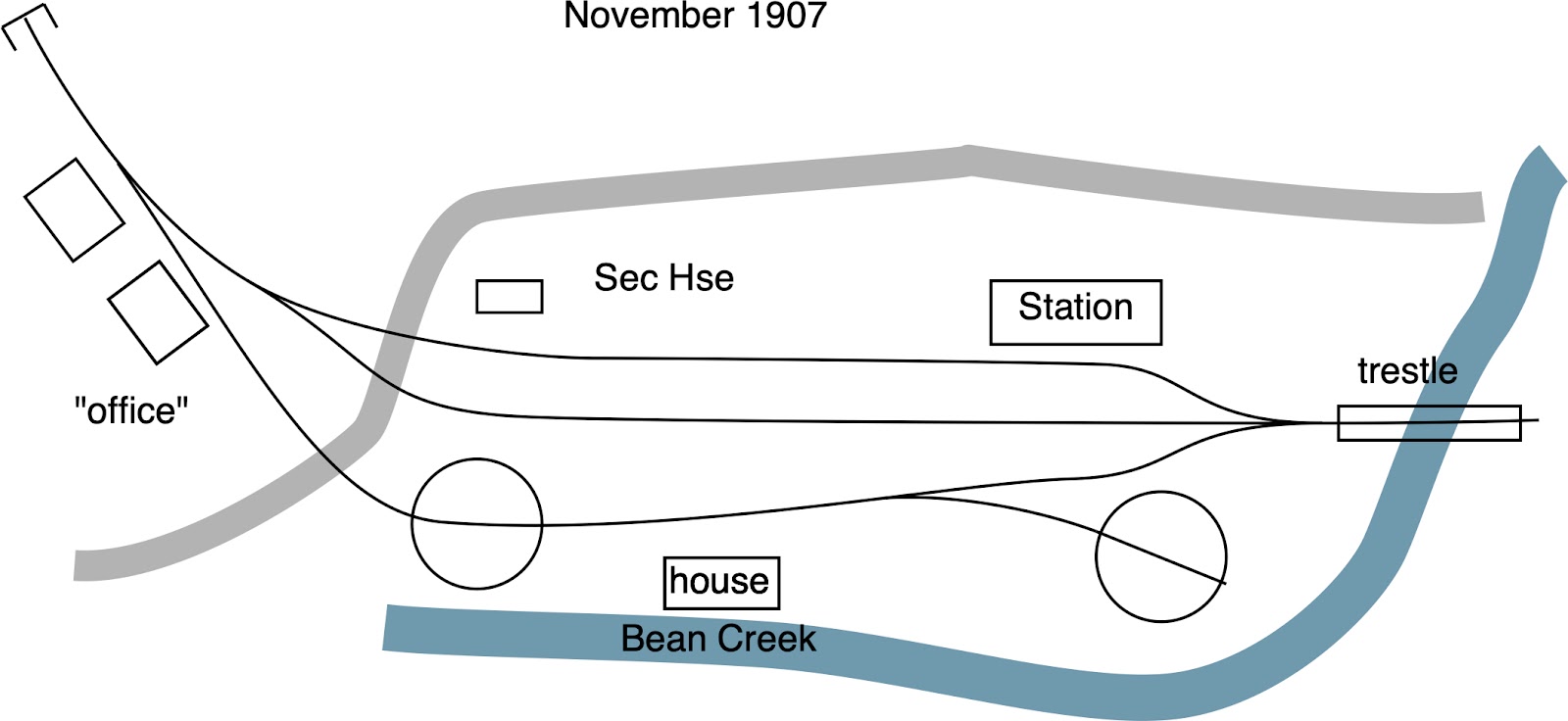
    The California State Railroad Museum has the station plan drawings for multiple years, giving us a chance to see the evolution of Glenwood from the railroad’s point of view for four times: November 1907, December 1907, 1913, and 1939.

    A November 1907 valuation map (probably while the line was still narrow gauged) shows three 700 foot sidings, a turntable on the east and west ends of town (the west one apparently filled in), a section house. Bean Creek, awfully close to the railroad tracks, shows up as a 10 foot gully stretching along the scene. The sidings ended just east of the depot where the tracks crossed to the west side of the creek. The current Glenwood Highway doesn’t yet exist; the downhill stretch is labelled “Vine Hill Road”. The road crossed the tracks just west of the station, and proceeded across the creek and up the hill on an alignment that’s no longer a public road. We see a section house (residence) and multiple structures along the tracks.

    A month later in December 1907, the SP created another map, probably showing line changes after standard gauging and reopening the line. There’s now just two sidings and the main line, with a spur in front of the depot. Bean Creek’s now been filled in with a concrete culvert.

    The 1913 map shows additional changes. This map labels the building next to the Laurel tunnel as “watchman’s house”. There’s also two spurs, probably for maintenance-of-way. There’s a couple photos from about this era showing trains passing the semaphores just before the tunnel. Those photos caught maintenance of way cars - or bunk cars - sitting on the siding. On the east end of town, longer sidings both cross the new culvert to create 1100 foot sidings for longer standard gauge tracks. The maps also show the block signals at each end of town. A private road loops over the top of the tunnel portal; this will eventually be the Glenwood Highway.

    The 1939 map shows that very little changed since 1913. The track arrangement’s similar; the only differences are in the roads. On this map, there’s now a section house, tool house, and signal maintainer’s tool house. The depot was torn down to give room for the state highway. There’s also a derail on the east end of town so runaway cars won’t roll all the way to Santa Cruz.

    So what do I want from all these sights? I’m not changing the track layout, so we’ll still have the curve into the Glenwood-Laurel tunnel. The Glenwood Highway looping over the top of the tunnel portal is a well-known design, so I’ll need to keep that. The depot’s small-ish, photogenic, and has an appropriate location so we’ll need to keep it. (I’ve got a placeholder model based on some plastic kit, but it’s time to make an accurate version.). I hadn’t known about the section house and tool house; there’s space for both next to the depot, so those deserve to be added.

    What’s already there? The old scenery has the Glenwood highway curving over the tunnel portal, but the climb out of town is jerky and doesn’t look smoothly. There’s also a house on stilts right next to the tunnel portal. It’s unprototypical; that hillside looks like it was mostly trees and bushes. It’ll need to go. I’d also cut a space for one of the abandoned turntables. Stories suggest that the turntable was filled in, but I’m willing to leave it as a hole in the ground.

    Next steps: Let’s start swinging the hammer and changing some scenery, then let’s scratch build a depot!

    Sunday, March 8, 2020

    End of the Line, From the Editorial Pages

    Eighty years ago, the last trains went along the Los Gatos-Santa Cruz line. It’s hard to remember with this bone-dry February, but January and February are usually the wet months here in California. Some of those years are wetter than average. Some years, we’ll get a couple good storms; we’ll hear about Highway 17 being closed for a day or two. Some years, storms can wash out the road to Big Sur or Half Moon Bay, and limit access for days or weeks. Some years, the rain comes down at biblical scale.

    We’ve all heard the stories about how the Los Gatos line closed. There was a big storm in late February 1940 that washed out the railroad in several places. The SP didn’t want to keep the line open. The ICC abandonment decision highlighted just how little business was on the line, and how little traffic was being carried across the Santa Cruz mountains. Away goes the railroad, away goes the route between Los Gatos and Santa Cruz, away go the tunnels and bridges. Stories in various books hint at how the summit tunnel was either blown up by the army for demolition training or to get rid of a nuisance.

    At best, those books cover the story in a paragraph or so. We don’t really know if the army blew up the tunnels to protect us against Japanese saboteurs, or Red Lectroids of Planet 10; we don’t know how bad the storm was. We don't know if the people of Santa Cruz fought the decision, and how bad the damage was. Luckily, here in the 21st century, we can rely on materials beyond what’s in the books in the hobby shop or sources at our local library. The University of California, Riverside’s California Digital Newspaper Collection now has copies of the Santa Cruz Sentinel from the 1940’s, so with a little bit of searching, we can easily learn more about what was really happened.

    Although MacGregor’s “South Pacific Coast” quotes March 4 as the day of the last train, it looks like the storm - and the last train - was actually February 27, 1940. And this wasn’t a small storm, from descriptions the next day.

    From the February 28, 1940 Santa Cruz Sentinel:

    “One of the greatest river floods in the history of Santa Cruz - and undoubtedly the most destructive - smashed its way through the San Lorenzo Valley yesterday, bearing logs, branches, dead animals, furniture, and debris from ruined summer homes and bridges. With county damage conservatively estimated at $500,000, there were at least 100 Santa Cruzans rendered temporarily homeless by the swirling yellow flood.
    “Fed by a cloudburst which brought 11.57 inches of ran to Ben Lomond in 24 hours, the muddy river first jumped its banks here at 2 a.m. and reached its peak about 6 o’clock last night…. An all-time record for high water was believed set with a 25 foot rise at Paradise Park.
    “The thundering flood swept out 100-foot River Glen Bridge at Boulder Creek, then hurtled downstream, taking out the Zayante, Cooper, and Ocean street bridges on its path to the sea. Simultaneously slides tore out telephone connections with Boulder Creek and choked the San Lorenzo drive. Severely hit were Paradise Park [the Masonic summer cabin neighborhood on the site of the former California Powder Works], a number of resorts and auto courts on the outskirts of the city, outer River Street and the entire Ocean-Barson street where some two score families were forced to flee.
    …
    Old-timers were divided as to whether or not the flood was the greatest in history. Former Mayor Fred Swanton said it outclassed the big waters of 1898 and 1907, but redoubtable Ernest Otto swore he had seen bigger floods - the time, for instance, when driftwood was carried to the very doors of Hackley Hall. He did not deny, however, that this was the most destructive because of greater business and residential development.

    …

    For most of the day Santa Cruz was virtually isolated. All Peerless stages were forced to cancel their runs over the Los Gatos highway, and the Southern Pacific routed trains by way of Watsonville Junction. The Watsonville roads by way of Chittenden and Hecker passes were closed, as was the Ocean Shore route. For a time the only road out of the city was by way of Hunter’s hill and Salinas.”

    That 11 inches of rainfall in Ben Lomond is a heck of a lot of rain; it's only been equalled forty years later on January 4, 1982. If you’re a Bay Area kid of a certain age, you probably remember the winter of 1981-1982. The San Lorenzo flooded. Brookdale Lodge’s dining room, with the creek running through it, went on a rampage in 1982, replaying the flood in 1940 that “smashed gaping holes in the rear and front of the dining room by mid-day (S.C. Sentinel, 28 Feb 1940). Ten people died near Ben Lomond when a huge section of hillside broke loose and tore through a cluster of houses in the redwoods. The same storm blocked blocked highway 101 and the Waldo Grade in Marin County for days, and flooded San Anselmo. I remember teachers living in Marin couldn’t make it to my high school for days. The 1982 storm was big enough that the USGS even wrote a report about it.

    So yeah, the horrible storm of 1982 gives us an idea how extreme 1940 would have been. Thank goodness neither year coincided with the great Santa Cruz vampire infestation of 1986, though at least there would have been plenty of material for stakes on the beach.

    Santa Cruz wasn’t the only place suffering from that storm. The February 28, 1940 issue of the Santa Cruz Sentinel also highlighted similar problems around California. The governor declared flood emergencies in the Sacramento Valley. The Napa river flooded town. “300 persons in a federal migrant camp [in Winters] were marooned after two feet of water swept through their temporary shelters.”

    The news wasn’t any better the next day. The February 29, 1940 Santa Cruz Sentinel showed photos of the damage: logs and deadwood on all the beaches and riverside, ropes and pulleys carrying groceries across the river between Lompico and Zayante. The Old San Jose road was blocked. William Turver’s 1500 hens broke loose after their chicken house was destroyed by flood waters, “found roosting on the roofs of sheds and houses yesterday.” Boulder Creek’s water supply was lost when the pipe to the main supply tank broke. 35 homes at Paradise Park summer cabins were damaged by floodwaters, with another 10 destroyed outright. A covered bridge at Paradise Park survived, but a mattress in a nearby tree hinted at the heights of the flood waters.

    There were also stories from abroad. Pescadero flooded. Marysville flooded. Shops on Hearst Ave. on Berkeley’s north side had a foot of mud dumped on their floors.

    A. L. Andrews, the Santa Cruz general traffic agent for the SP, announced it would be a week before traffic could be resumed over the mountains, with significant slides at Rincon Hill (on the Santa Cruz side) and several larger slides on the Los Gatos side. Meanwhile, Southern Pacific had other worries: Gerber and Tehama flooded, and rail traffic between California and Oregon had been halted by slides and washouts.

    Friday, March 1 leads off with “Santa Cruz Not Alone in Watery Disaster”, with pictures of flooding at Marysville. The Los Gatos road was “open but muddy”, with “delays at the bottleneck near Los Gatos were from 10 minutes to half an hour.” The railroad was still a week from opening.

    The Railroad Isn’t Coming Back

    There’s nothing else about the railroad until March 7. Below a headline about the Queen Elizabeth steamship outrunning U-boats, we find:

    “S.P. Surveys Mountain Line
    Deny Closing of Historic Run; May Rebuild Stretch
    San Francisco, March 6 (AP) - The Southern Pacific headquarters here said today railroad engineers were surveying the Los Gatos-Santa Cruz line to determine whether to make temporary repairs - as has been done previously in slide and washout areas in that sector - or to rebuild the stretch in a manner to forestall future tie-ups.
    Train service between Los Gatos and Santa Cruz was disrupted in last week’s storm. The San Jose - Los Gatos line is open, and buses now carry passengers from Los Gatos to Santa Cruz. Buses also operate the S.P.’s Watsonville Junction to Santa Cruz.
    The rail line office here said there was no indication that the Los Gatos-Santa Cruz strip would be abandoned. They said the engineers’ report probably wold be completed next week.
    TWO LOSE JOBS HERE
    Previous to the San Francisco notification above, reports were current in Santa Cruz that the mountain line might be discontinued indefinitely owing to the lack of year-around business and cost of repairs between Olympia and Los Gatos. [The precision of those endpoints makes me suspect the rumors were awfully correct.]
    An informed source said it would cost between $50,000 and $75,000 to repair trouble caused by the recent storm. Near Glenwood a large section of earth sank from beneath the tracks.
    Meantime, the two maintenance men at the local S. P. yard were notified that their jobs here had ended. They are Charles F. Berlin of 531 Mission street, employed here for some 13 years, and Malcolm Henderson of 75 1/2 Washington. Berlin is day engine watchman, and Henderson has had the night shift.
    It was also reported that the engine pits, used for maintenance, have been filled in.
    The mountain line has been closed for eight days and Greyhound buses are leaving at 7:05 am and 6:10 pm to connect with the regular train at Los Gatos. Buses take passengers from Los Gatos to Santa Cruz, arriving at 11:25 am and 6:50 pm.
    The maintenance crew left the city yesterday after repairing the mountain road as far as Olympia where some 250 cars of sand for “traction” use are taken out monthly. Freight is not affected by the temporary shutoff of the mountain service, since most of this goes by way of Watsonville Junction.
    Historic Old Line
    The historic mountain route opened as a narrow gauge railways in the late seventies and was then known as the Dumbarton road. It was then routed to San Jose, and at Santa Clara it went up the west side of the bay by way of Alviso, Newark, Alvarado, and Agnew, across on a drawbridge to Alameda, where passengers transferred to ferry for San Francisco.
    Later when the Southern Pacific took it over and widened it to broad gauge, it went up the east side of the bay and through the Mission district. In those days there were three trains daily and special additions on week-ends. They generally carried from three to eight coaches in contrast to the slight traffic of recent years. They stopped regularly at stations at Felton, Glenwood, Laurel, Wrights, Alma, and Los Gatos, Eblis, Rincon, Big Trees, Mount Hermon, Olympia, and Zayante. Most of these stations have long since vanished, although the train would stop when and if passengers requested.

    Meanwhile, the San Lorenzo Valley Chamber of Commerce, rightfully worried that the S.P. had decided to drown the line, set up its own committee to talk with the S.P.

    Everyone held their breath while waiting for the SP to make its decision. The March 19 paper quoted shippers complaining about rates: shipments from Seattle cost 30 cents per 100 lbs to San Jose, but cost 37 cents to Santa Cruz (with no details on exactly what was being shipped.) The local businessmen argued for a better rate.

    The true “beginning of the end” occurredd on March 26: “S. P. May Abandon Historic Rail Line”:

    S. P. May Abandon Historic Rail Line
    Younger Heatedly Hits Long Neglect
    Officials Reverse Recent Story; Now Say Storm Damage, Loss Each Year Is Mounting
    Santa Cruz was stunned yesterday by announcement that Southern Pacific has placed before the Interstate Commerce Commission a request to eliminate passenger train service between this city and Los Gatos.
    That this city was unprepared for the announcement may be attrabuted [sic] to the fact that the Southern Pacific officials, interviewed 10 days ago in San Francisco by an Associated Press correspondent for the Sentinel said abandonment of train service between Santa Cruz and Los Gatos was not being considered.
    F. C. Lathrop, general passenger agent, and J. J. Jordan, superintendent of the coast division, flanked by other officials, hurried down from San Francisco to explain in the wake of an early morning release from the company’s publicity department.
    On short notice the chamber of commerce called a special luncheon meeting of directors at the St. George hotel, where the railroad representatives fenced with the opposition of Donald Younger and Adriel Fried.
    Would Save $50,000
    Lathrop told the luncheon gathering of 40 that abandonment of the 15 mile branch line from Los Gatos to Olympia would save the company $50,000 a year in out-of-pocket losses, that bus service will be improved in substitution for loss of trains, that freight service will be continued between Olympia and Santa Cruz, and that the Suntan and tourist specials will be routed into Santa Cruz via Watsonville.
    Mayor C. D. Hinkle said he preferred to hear a thorough analysis of Southern Pacific’s problems “before offering any criticism.”
    Mrs. Rose Rostron, supervisor of Branciforte district, expressed the opinion that Santa Cruz would be stepping backwards by loss of the service, suggesting that most travelers preferred the train to busses.
    Donald Younger spurred debate with the charge that the Southern Pacific has reduced its service gradually through the years with a view towards eventual abandonment. “You have done everything to discourage passenger traffic over the mountains from Los Gatos,” he said. “The line into Santa Cruz has been badly mismanaged. While we have tried to provide you with more freight in exchange for promised improvement in passenger service, you have not given us your share of co-operation. You are giving us your figures and this is a stacked meeting. The chamber of commerce should appoint a committee to make a thorough investigation prior to the hearing before the railroad commission. It is the history of the Southern Pacific that you have made progress only when forced to.
    Might Save State Money
    He charged the Southern Pacific had not been fair in withholding announcement of their intentions at a time when the state was spending a huge sum to erect a viaduct above the company’s tracks between the Oaks sanitarium and Los Gatos. If it had been know that the line was to be abandoned, he claimed, the highway department could have saved the expense of the span.”
    “I think you have been a little severe in your charges,” answered Lathrop. “As far as the figures are concerned, you can get all the information you want from the railroad commission. We are seeking to adjust our operations and our service to changed transportation conditions and changed habits and demands of the public. In certain new phases of transportation we are making some notable progress in providing service that the public generally welcomes and by its patronage will make profitable to the railroad. We have been earning only 18 cents per train mile on passenger trains in and out of Santa Cruz as compared with a cost of $1.50 per train mile. On average no more than six persons have been riding each train on the Santa Cruz line. It would cost us about $50,000 to put the line into shape following damage by recent storms. Phases of railroad service that have long been unprofitable are a drag on the efforts of the railroad to provide fast enough modern freight and passenger service generally over the system.”
    He promised that the “improved bus service” to connect with Los Gatos, in substitution for the train, would save 30 minutes time between this city and San Francisco.
    Stodgy and Stuffy
    Adriel Fried criticized the company’s “stodgy” trains and “stuffy station” at Watsonville Junction where Santa Cruz passengers connect with southbound trains, and insisted that the company is being badly managed. He demanded figures on freight out of Santa Cruz. C. M. Briggs, assistant general freight agent, said he was not prepared to give those figures, but would have them available at the railroad commission hearing.
    “It is regrettable to come to a meeting of this kind and be insulted,” said J. J. Jordan, the rail company’s superintendent. “You will get all the information you want before the railroad commission.”
    
“You say we haven’t been progressive. Don’t you realize that the automobile has taken away 68% of the railroad’s business! We are trying our best to meet this transition.”
    Earl Harris maintained that the company had not lived up to its word, made two years ago, to spend money on improving the line over the mountain and bring additional Eastern tourist specials into Santa Cruz.
    Jordan replied that the company did spend $50,000 to improve the line.
    Hits Tourist Business
    James P. Leonard expressed fear that a bus connection with Santa Cruz would decrease passenger traffic to the Big Trees. “The minute a passenger agent mentions a tail-end connection by bus, you will find a strong sales resistance on the part of a prospective visitor,” Leonard said.
    Lathrop said the railroad company had borrowed $22,000,000 from the RFC, and that government would insist upon a profit on all branches. He expressed belied that Santa Cruz would not be affected “one iota” by the abandonment, “inasmuch as this community does not even use the line.”
    Drum Baikie was chairman of the lunch meeting.
    Decision as to the chamber of commerce’s attitude will be reached at a director’s meeting next Monday.
    Other Southern Pacific officials attending the luncheon were E. C. Pearce, assistant superintendent; Roy Ioas, supervisor train service; G. I. Goldsmith, assistant mail and express traffic manager; Stanley Moore, special representative passenger department; E. A. Teubner, division freight and passenger agent.
    Operating Costs High
    Both operating costs and maintenance costs of the line south of Los Gatos have been extremely heavy since it was acquired by the company in 1887 and changed from narrow to broad gauge in 1907, Southern Pacific officials stated. Operation is expensive due to the excessive curvature of the winding route through the mountains and grades which range from 2.5 to 2.9 per cent, making it necessary to use helper engines on trains carrying more than five cars northbound and seven cars southbound.
    Maintenance of the line is relatively even more costly due particularly to recurring annual storm and flood damage. Company officials stated there is an annual expense of $48,000 per year for maintenance and storm damage repair to two and one-half miles of tunnels, to other track structures, to track, and to sub-grade in the area marked for abandonment.
    The section of track which it is proposed to abandon does not include a nine-mile section from Santa Cruz to Olympia. This nine-mile section will be maintained to provide freight service from the Olympia sand pits.

    The Abandonment Hearing

    The first hearing on abandonment took place in Santa Cruz City Hall on Friday, April 26. The SP now claimed it would take precisely $46,220 to fix the line. The editorial on Sunday, April 28, 1940 quoted how it went:

    Those who attended the railroad commission hearing Friday on Southern Pacific’s petition to temporarily discontinue passenger service on the Los Gatos-Santa Cruz line may be surprised to learn that Judge Harry Bias, who represented this community, had only two days in which to prepare his case.
    He was not contacted in the manner until Wednesday afternoon, and in the brief period between that time and opening of the hearing Friday morning at 10 he studied railroad company exhibits and hurriedly assembled such information as was available through services of the chamber of commerce.
    What is more, his services were gratis.
    Ordinarily, in a hearing of this type the applicant, with its army of auditors, “experts”, and imposing array of cold figures, holds an advantage over the opposition of lay critics.
    Judge Bias, especially effective in cross-examination, disclosed not of the handicaps which are usually imposed by hurried mobilization of opposition. He turned in one of the neatest jobs we have witnessed in many years.
    Item by item, he went to the core of the subject in cross-examination of Southern Pacific representatives.
    He established these major points:
    Southern Pacific had planned abandonment of service for some years and seized the storm condition last February as an opportune time to take action.
    Revenue from freight and special trains had not been computed by the company in arriving at the reported loss on the line of $28,578 for 1939.
    Nothing of substantial nature has been done in the past 25 years to improve facilities on the regularly scheduled passenger trains operating between San Francisco and Santa Cruz.
    The company has not kept pace of competition.
    Facilities on the train coaches are below normal in comparison with modern transportation equipment.
    In concluding his remarks Judge Bias expressed the opinion that “if the railroad company had deliberately planned to discontinue its train service on this line it could not have done a better job of discouraging public patronage."
    A few of our citizens have been lulled into an attitude of non-resistance by Southern Pacific’s reported losses on this line. What we in Santa Cruz should consider of prime importance are the tremendous losses to this community as the result of what conspicuously appear to be mismanagement of an important travel artery entering this town.
    We feel that the Southern Pacific has not fulfilled the obligations of its franchise. Santa Cruz, in our opinion, has suffered huge losses due to adverse operation of passenger trains entering this community. This is the finest recreation area within short distance of the San Francisco bay area of 1,000,000 population. The trip over the mountains from Los Gatos to Santa Cruz has scenic value worthy of extensive exploration by a railroad company.
    Holding a monopoly these many years, Southern Pacific has not felt the pressure of rail competition on this line. It has provided comparative discomforts with little regard for a public attitude. Instead of improving its roadbeds and equipment to meet the competition of highways and buses, Southern Pacific has blamed the public solely for its loss of business. One can motor to San Francisco in a comfortable automobile on a comfortable highway in one-half the time required by the antiquated train. Many people, we believe, would prefer to leave their automobiles hat home and travel by train if Southern Pacific had shown the same enterprise on the Santa Cruz line that it had demonstrated elsewhere in attempting to meet competition.
    Women in long bloomer bathing suits, bewhiskered men on “gay-ninety” bikes, and horse and buggy delegations, would not look out of place in creating the arrival of one of the regularly scheduled trains at the local SP depot.
    Let us view the losses from a different perspective. This public utility, by its monopolistic operations, has denied Santa Cruz the kind of transportation facilities which are considered average in other parts of the United States. We have lost the benefits that might have come through alert, progressive management of a rail line.
    “Comfort” is something we read about in the Southern Pacific ads; also we are urged “Next Time Try the Train”.
    By schedule and type of equipment, SP has caused its Santa Cruz trains to try the public’s patience.

    The Friendly Southern Pacific attempts damage control.

    The Santa Cruz abandonment wasn’t following the path of the Boulder Creek, or Almaden, or Le Franc; the town was pissed off, and wasn’t about to roll over. The SP decided to highlight all the nice things they could do for the town. June 22, 1940, the SP argued its case. As before, they didn’t talk about closing the line, but just “closing passenger service” and replacing it with a bus. How you got to Los Gatos didn’t matter; they’d make sure the bus was attractive. The SP also attempted to assuage all the concerns. They’d continue to promote the Suntan Specials, and continue to keep the fares the same. They’d put up posters extolling Santa Cruz in stations, and highlight the destination in timetables and tourist brochures. They’d show movies of Big Trees, and make sure Santa Cruz had a central role at the SP exhibit at the 1939 World Fare in San Francisco. To comfort James Leonard, they’d continue to take tourist trains up to Big Trees. They’d lower the tariff for lumber, and wouldn’t raise rates for other commodities, and wouldn’t passenger fares. (Don’t hold your breath folks; the fares will go up in two years, regardlesss of the agreements.

    You won't have a railroad, but at least you'll be in the movies!

    Meanwhile, the old route rotted in the forest. There were reports of signals getting stolen later that summer. On October 31, the ICC decided: the line was to be abandoned.

    Tearing Up the Line

    We’ve all seen pictures of the abandonment: trains going through the canyons removing rails, bridges, and anything else salvageable. The rumors about the tunnel were less mercenary. One said the tunnels were blown up by the army to avoid saboteurs hiding in them. Another claimed the SP didn’t want the tunnels around as a nuisance. In reality, the tunnels were collapsed for the lumber. From the April 19, 1942 Santa Cruz Sentinel, courtesy of a reference in Derek Whaley’s “Santa Cruz Trains” book:


    Glenwood and Wrights Tunnels Gone
    The first two tunnels by which our erstwhile Los Gatos Railroad line bored through the hills are gone. Timbers which bolstered the mile-and-a-quarter Wrights tunnel have been taken out, the tunnel is caved in, its ends are closed. Another week will see the end of the mile-and-an-eighth Glenwood tunnel.
    H. A. Christie, professional railroad wrecker and gambler on earth formations, bought from the Southern Pacific the right to salvage what timbers he could.
    He has been trucking them down the old right-of-way to end -of-line near Felton and shipping them out.
    Rock was well broken by earthquake of 1906
    So dangerous is the work of yanking the ten-by-fourteen inch timbers out (by use of a team) and the resultant fall of rock that Mr. Christie’s premium on insurance against accident or death to his employees equals 34 percent of his payroll.
    When the fall of rock buries unsalvaged timbers he leaves them and resumes work farther along. While working in the Wrights tunnel part of his equipment was buried - and abandoned.
    The wrenching given the sand rock by the earthquake of 1906 (after which the tunnels were enlarged for the broad guage [sic] line) turned the sand rock nearly to sand.
    COUNTY WANTS TIMBERS AT SCHWANN’S LAGOON BRIDGE
    Because of the peril of the work the Southern Pacific sells the salvaging privileges and buys back what timbers it wants. Mr. Christie is under contract to sell back to the railroad 800,000 board feet of what he reclaims.
    The timbers taken from the Wrights tunnel amounted to a little more than half a million board feet. Should there be an excess over the railroad’s requirements the county is a bidder for timbers for the proposed new Schwan’s Lagoon bridge in Twin Lakes. Timbers at the salvage price will save about a thousand dollars.

    As those timbers got pulled out, the chances of the line ever opening again died completely - the Los Gatos - Santa Cruz line was no more. The storm was the last straw, but the abandonment probably would have happened any day. The salvaging and destruction of the line didn’t have saboteurs or crazy army demolition folks but a dedicated salvager with a brave team of mules. The storm also had effects beyond the route, shutting down Santa Cruz as a place for engine service. A year later, the Sentinel remarked on the boiler house being taken down to send its materials to Sacramento, and the inspection pits at the roundhouse were getting filled in. Santa Cruz would never be a big railroad town again.


    Key details to remember for the model?
    • The Olympia sand pits were shipping 250 carloads of sand a month, with the SP one of the customers.
    • Passenger trains from Los Gatos to Santa Cruz required a helper for more than 5 cars... just like my model!
    • Santa Cruz was originating trains up to 1940, and had the roundhouse and personnel up until then.
    • If the model trains ever don't run, just say "oh, the line's open" and point at a passing bus.