Showing posts with label history. Show all posts

Sunday, June 7, 2026

Figuring out more about figures

I’ve been happy enough with the cannery worker figures that I’ve continued to experiment with making figures over the last few weeks. Here’s a couple interesting observations.

Let the AI propose figures

The current workflow - I think of a description of a figure, let gemini.google.com draw a picture of a person based on that description, and I let tripo3d.ai turn the image into a 3d printer model - is pretty easy. Choosing which figures to make requires a little bit of care. What are suitable figures for my era and place? How do I describe someone in 1930’s clothing? How do I mix up my choices do I don’t have a bunch of similar figures?

As I was doing lots with the AI / large language models to create images, I realized that the generative AI systems are also good at analyzing photos too. So… we could also get the AI chatbot to propose a bunch of possible figures, and I could pick out the ones I want.

The AI chatbots work completely from text, so all I need is the right prompt. I ended up taking one of the photos of the workers at a cannery (such as the panoramic photo from California Canneries in Campbell. I dragged the photo into the chatbot at gemini.google.com, and gave it the following command:

Find the human figures in the attached photo from 1930’s California. For each person, write a four sentence physical description of the person that can serve as a prompt to generate a 3d figure of the person. Each description should start with "Create a front, side, and rear image of a human figure suitable for creating a 3d model of the person where the figure represents a person in 1930’s California. The figure is…" For each figure, the description should indicate details of body and face type: build, height, facial features, etc. inspired by the original photo The four-sentence description should also include a description of movement that would be appropriate for that person: either that the figure is walking (most figures should show some movement), perhaps carrying an item (personal item, fruit lug, tool, bag, appearing in a quarter of the figures), or indicate a reasonable pose for a normal person of the time. The description can also contain facial features or other details that might make the figure unique or animated. The output should be a sequence of description prompts that can be used later to create an image of the figure. Each description should contain a summary or label for the figure (“the lean plant mechanic”), followed by the four-sentence description in plaintext. Do not generate the images at this time.

Note that I started with a smaller prompt, but added detail and restrictions when the AI didn’t quite do what I wanted. For example, the gory detail about “show the output this way” happened because the chatbot would switch between giving textual output and just giving me a picture in a form I didn’t want. The comment about adding movement and animation was needed because otherwise the figures were all just standing with arms at their side.

Running that command on gemini.google.com quickly throws out three or four potential figure descriptions. Pasting those descriptions/prompts into Gemini generates nice images, sometimes with details or roles I hadn’t intended. I was particularly surprised when the chatbot started identifying potential roles.

Here’s a on example Gemini created:

The industrious cannery worker: Create a front, side, and rear image of a human figure suitable for creating a 3d model of the person where the figure represents a person in 1930’s California. The figure is a sturdy, broad-shouldered woman with a kind, experienced face and graying hair pulled back under a simple white head covering. She wears a long-sleeved dress covered by a practical, thick canvas apron, and she is holding a small metal fruit-sorting tool in one hand. The figure is posed standing upright with a slight forward lean, as if preparing to return to an assembly line.

and here's the image that Gemini created for that prompt. Don't ask me what the tool she's holding is.

Now, I don’t want to have figures done automatically: I still want to be choosing what kinds of figures match my era and setting, and what figures help tell the story. But automatically generating these is a neat way to get inspirations about what figures to do next, and give me options I might not have considered.

The most annoying part of AI is how the work doesn’t fit what usually keeps me focused. Each request to generate an image or generate a 3d model can take from 30 seconds to a few minutes. That’s annoying because it involves a bunch of waiting and often bumps me out of a flow state where I’m focused on work. The pauses encourage me to go off and do another task, and then by the time I come back, I’ve forgotten what stage I’m at with each image. Worse, the AI tools often do something screwy - producing images without a background, or disregarding part of the prompt, or generating an incorrect figure. Using the generating AI systems often feels like trying to get a teenager to help - sometimes it does really well, sometimes it misunderstands completely, and some times it does something stupid because it just wants to go play outside. A figure might be shown walking, but in different poses in the front and side images. Another figure may have odd details added, or might appear period-inappropriate.

Dealing with the 3d printing process ends up being in some ways easier. Taking each 3d model, adding support structures, and arranging multiple figures on the build platform is tedious work, but at least it’s constant work that keeps me engaged.

Painting

I’ve usually found painting figures taxing because it takes so long, because I’m not happy with my color choices, or because of delays waiting for paint to dry when painting a few figures.

My first big improvement was painting bigger groups of figures. I’d attach 10-20 figures to a strip of styrene, prime all the figures, then go down the line painting each color - flesh color first, then clothing, then hair (once faces had dried), then shoes, then hat.

For color choices, I started out this time writing down potential color choices for clothing, then made sure I had those colors on my pallette. Having the color ranges figured out meant that I had all my colors ready, and had ideas about variations to try ahead of time. I did one table of colors for the regular worker figures, and another for some of the unusual figures (such as management).

white, yellow
ClothingMen workersWomen workers
shoesbrown, blackbrown, black, tan
pants/dressestan, brown, black, blue, oliveyellow, white, light blue, dark blue, tan
shirts/apronswhite, blue, red check, tan
hatbrown, black, tanwhite
hairbrown, black, yellow, whitebrown, black, yellow, white
shoesbrown, blackbrown, black, tan

All this sped up figure painting so I could do a large set in an evening.

Next steps

Once we’re doing figures of random folks, the next question is obviously “can we do figures of people we know?” I’ve also been doing a few figures based on friends. I’ll share some of those results another time.

Sunday, May 17, 2026

Structures and Stories: Reproducing Industries of the Santa Clara Valley

If you've been reading this blog for a while, you've already heard how I've crossed over from building models of canneries along the tracks into some full-blown local history research. Last month, I shared that journey at the NMRA Pacific Coast Region's annual convention in Rohnert Park.

My talk - "Structures and Stories: Reproducing Industries of the Santa Clara Valley" - focused on four of the industries along the branch. For each, I gave a history of the building, talked about the business there, and showed the model I built. Then, just as on this blog, I veered off in crazy directions, talking about the deadly elevator at the Guggenhime packing house, or how Higgins-Hyde pissed off the Santa Clara valley, or about the Ainsley cannery's exports to England. The talk seemed to be well-received, though I got more compliments from wives of model railroaders who enjoyed actually hearing about the people, men and women, who helped run the fruit-related businesses in the Santa Clara valley. One listener, after hearing I was using appeals court rulings and accounting records to understand the business, asked if I'd been an investigator in a previous career, because my research seemed very similar to her past work as an IRS investigator!

If you weren't able to attend but you're curious about the presentation, slides are here. I also put together a quick handout on research tips for doing similar historic research.

And fingers crossed I encouraged some of you to similarly do some historic research on the buildings along your favorite stretch of track!

Tuesday, December 3, 2024

The Not-Pretty Side of Los Gatos

[When you’re modeling a location on a prototype railroad, part of the fun and challenge is figuring out what to model. For most places, you can’t model a location exactly because it won’t fit on a model railroad. (If you can model a place in its entirety, then perhaps you’re modeling a place that’s not quite interesting enough for a model railroad, or maybe you’ve won the lottery space-wise.) Instead, you're forced to pick and choose the interesting bits of a location that'll help you tell its story and give you a fun place to run trains.

When I started sketching out the Los Gatos scene for my model railroad, I had to make my choices of what to model. Los Gatos is a confusing location to model, with a mix of interesting operational and scenic attributes, but not enough activity to make for a great model railroad location. The city sits in an enviable location up against the Santa Cruz Mountains and at the mouth of Los Gatos Canyon. Railroad-wise, it represents the end of straight track and easy grades. It served as a key point for controlling trains entering Los Gatos canyon, a terminus for commute trains to San Francisco, and a place for steam locomotives to take on water. The downtown area along the railroad tracks is interesting architecturally, with a mix of grand storefronts and less attractive back sides of buildings. It’s less interesting for freight traffic - a freight house, the Hunts cannery, a team track, and a couple other rail-served businesses are the only source of freight traffic.

In terms of structures, I knew I wanted to model the former Hunts cannery, both as a source of traffic for the layout and to keep my focus on the fruit industry in the Santa Clara Valley. Other potential scenes included the houses along the right of way north of downtown, the team track behind the Santa Cruz Ave. shops, and finally the passenger, freight depots, and water tower on the south side of town.

Any reasonable person would have modeled the station as a destination for passenger trains, a spotting location for freight cars, and an iconic and identifiable spot for visitors from the local area. My problem was that I didn’t have space to do the depot scene justice. Because of the Vasona Branch’s focus on freight operations, sidings and industries won out over passenger facilities. Instead, I modeled (1) the cannery, (2) the houses along the tracks to remind folks of the scene of tracks running through the backyards, and (3) the track and backs of businesses to highlight the urban part of Los Gatos. I’d already filled in the first two scenes, but hadn’t yet done the team track area.

So what did the track look like around here? Historical documents hint at how the area changed over the years. It’s been easy to keep compare the changes over the years - I’ve scanned and saved away the various maps on the computer so I can consider my plan. My notebook is full of of map sketches of towns that tell me where I’d found inspiration 15 years ago, and which photos I should look at when I started building.

Los Gatos track arrangement, 1880. From Southern Pacific valuation map, California State Railroad Museum collection.

When the South Pacific Coast Railroad came through Los Gatos, Los Gatos was the point where extra power was needed to pull trains through the Santa Cruz mountains. We can see this in the track arrangement: the mainline and three sidings in front of the depot for pausing trains, a turntable for turning helper locomotives, and a spur off to Los Gatos Cannery's plant in the middle of what is now downtown. Only thre buildings are marked on the map: the Lyndon Hotel on the west side of the tracks, and the station and Wilcox House on the east side. Development hasn't yet reached Los Gatos.

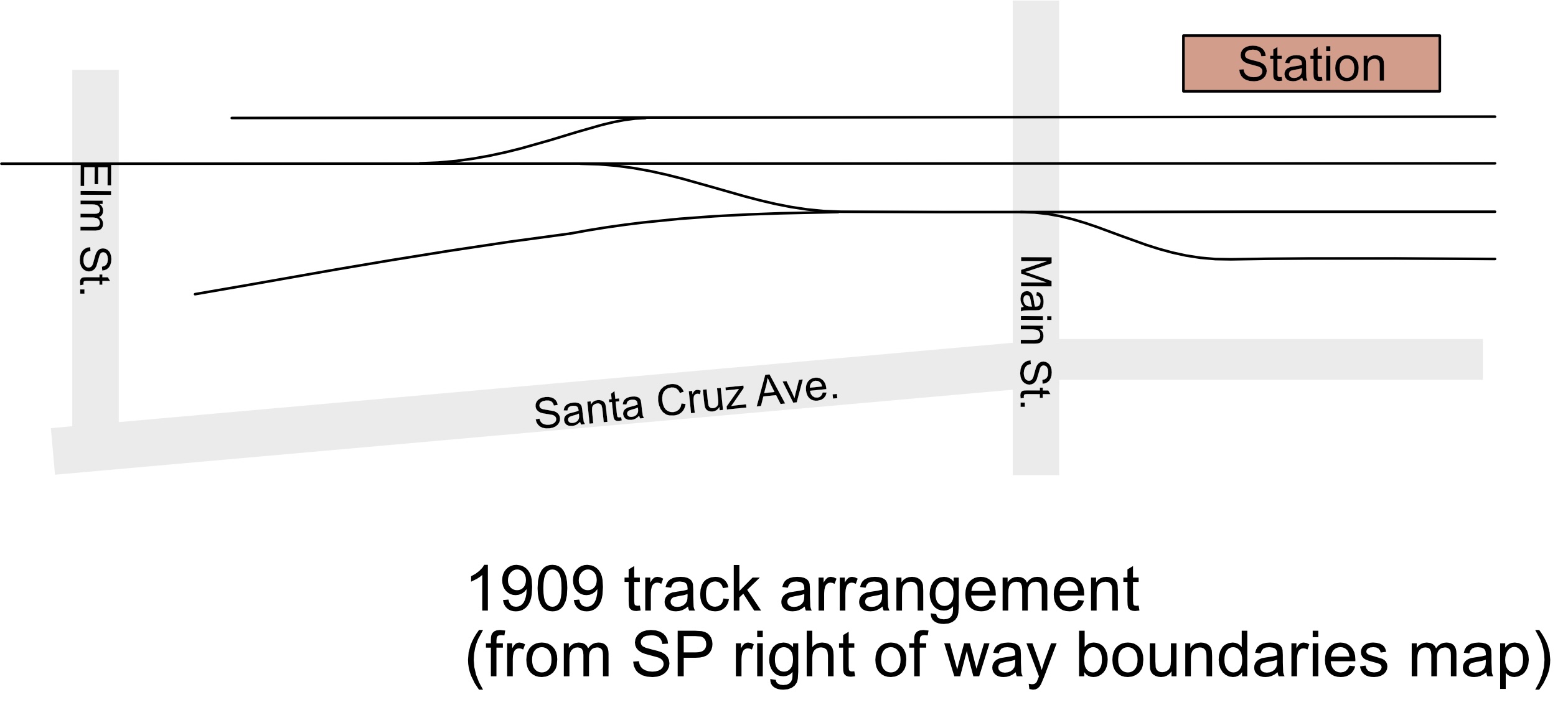
Los Gatos track arrangement, 1909. From Southern Pacific right-of-way boundaries map, California State Railroad Museum collection.

By 1909, we see that the turntable has been removed and replaced with the team track behind the storefronts on Santa Cruz Ave. Apparently, the turntable was unneeded after the end of narrow-gauge operations in the Santa Cruz Mountains. The available map was intended only for showing the right-of-way, so it doesn't show any of the buildings to help us understand how developed Los Gatos was at this time. Interestingly, the lot trackside on the other side of Elm Street has a gas tank for the former coal gas plant - this is where I've placed the ice cream factory.

Los Gatos track arrangement, 1930. From Southern Pacific valuation map, California State Railroad Museum collection.

In 1930, the team track is still present, and the valuation map shows the buildings backing on the team track. Not all the lots were built out - there was a gas station at the corner of Elm and Santa Cruz Ave, showing us Santa Cruz Ave. wasn’t yet the continuous strip of high-end retail it is today. The valuation map still shows the coal gas plant - perhaps I was hasty to put the ice cream factory there?

A final valuation map from 1946 shows a much-reduced Los Gatos. Two of the four sidings have been removed. The team track is also long-removed - a sad ending for a track that started out serving the turntable for the narrow gauge. The photo from 1953 shows the alley behind the buildings on Santa Cruz Ave., hinting at what the area around the team track looked like. It also seems to show that the third siding is still here - perhaps the SP considered it out of service and hadn't removed it.

Alley behind Bank of America, 1953. Charlie Givens photo, from Arcadia Publishing's "Railroads of Los Gatos"

The day to actually start building the Los Gatos scene finally arrived recently - the bare plywood around the team track in Los Gatos finally got on my nerves enough for me to start building. Taking a look at both my past thoughts and what I know about the location, I had a strong idea of what to build. I wanted arow of buildings backing the space behind team track, and giving a place for a detailed scene highlighting that the railroad was a bit hidden from Los Gatos’s commercial strip, but that we’re still in an urban area. The passenger station would be out of scene to the left; passenger trains stopping in Los Gatos will stop anywhere along here. I wanted to capture some of the back-alley feeling from that 1953 photo, but also wanted the area to still appear in use.

Panorama of the finished scene.

Finishing this scene required several building flats. From the 1944 Sanborn map, I see:

  • The leftmost building would be the Bank of America branch, just where the railroad tracks crossed Los Gatos’s Main Street. This was a modern building, appearing around 1928, and matching the style of many other Bank of America buildings in California. It’s a known landmark and an interesting building, and so it’s an important location to include.
  • There would be the backs of several older brick buildings along the alley paralleling the railroad. The first was a low one story building as a store. It held a liquor store in 1950’s. I haven’t been able to track down what was in this back-alley storefront in the 1930’s, but it’s still a valuable place to model - I hadn’t thought there would be storefronts along here until I saw the liquor store in an old photo. That same photo also encouraged me to make a wider alley along tracks. It’s a good building for setting the feel of being in an alley behind the main street, so I’ll make sure to model this.
  • The next was the Masonic Lodge building - two story with high ceilings. (It disappeared and the lot currently has a one story 1950’s store.) I’ll model this as well.
  • Next was another fraternal society - the International Woodsmen of the World - again multi story brick from the 19th century. Still there.) This will complete the row of buildings, and block the view of the backdrop neatly. (Probavblty the Templeman building, built 1921 from reinforced concrete?)
  • There was a series of one story buildings.
  • Finally, there was a gas station at the corner of North Santa Cruz and Elm. I won’t model this, but I will add some fencing.
  • The various brick buildings could be built using whatever scraps of buildings I’ve got in my box, but the Bank of America building deserves a bit better treatment. I'll talk more about Bank of America next time.

Wednesday, November 6, 2024

Freight Trains in the Sky

One of the bigger changes in model railroading since the 1970’s is whether we’re modeling a completely imaginary railroad, a plausible but invented railroad, or if we’re trying to model the real world as it was at a particular time. The “imagine everything” folks might build something that’s a caricature - think John Allen’s mountain-crossing Gorre and Daphetid — or that borrows some historic reality (“bridge route in Colorado”) Owners get all the freedom to choose what they’re building out of whole cloth, create cities along the railroad from any inspiration, and avoid all the pesky research and visits to actual sites. Folks building to a plausible reality might need to understand something about the economics, architecture, and industries of a specific place and time - modeling an agricultural short line in California, or a fictitious logging railroad in Washington state. However, they’ve also got the freedom to imagine new places using whatever constraints they choose. I’m on the other side - I choose to model actual locations, and try to accurately model what’s there. I enjoy the research, I think I get a more realistic whole, and I suspect that the research helps me fill in details I couldn’t imagine on my own.

Or, more bluntly, the real world is stranger than I might imagine, so modeling a real place from photos helps me fill in those details I couldn’t possibly invent.

How strange is the real world? How about “freight trains in the sky” strange?

Report on Steam Railroads of San Jose

I was poking around in San Jose Library’s California Room, the library’s local history collection. One item caught my attention: “Report on Steam Railroads of San Jose”. This report from 1925 described the current state of the different railroads in San Jose at the time, and suggested ways to improve both the profits of the railroads while improving quality of life for San Jose residents and businesses. Considering the author was a well-known urban planner from St. Louis (Harold Bartholomew, who apparently had an entire urban planning firm specializing in railroad rethinks), I think we can imagine we’re about to hear a bunch of crazy ideas from those Back East crazy consultants. And it doesn’t disappoint, with a crazy proposal that I couldn’t have imagined.

[ Partial version of Report on Steam Railroads of San Jose here. I didn’t bother to scan the fold-out profiles for railroad elevation for the three plans. Sorry! ]

The problems of San Jose in regard to its steam railroads are similar in every respect to those in other Cities of normal and rapid growth, where the expansion of industries, commercial enterprises, and residential sections has taken place with little or no regulation. Instead of well defined and segregated industrial districts, we find in San Jose clusters of factories, warehouses, coal and lumber yards and a great number of packing establishments located close up to the railroad tracks, often main lines, as they have always existed. The industries have closed in on the railroads, so to speak, thus hindering greatly both their own expansion and that of the railroads.”

As a reminder, San Jose in 1925 was different from the railroads we know today. In the 1920’s, the College Park yard straddling the Guadalupe river was the main SP yard. The “big old barn” of an Eastlake-style wooden station on Bassett Street was San Jose’s primary railroad station. The line to Los Angeles ran down the center of Fourth Street, past office buildings and San Jose State University. The old South Pacific Coast line broke off the SP mainline at the old Lentzen Street roundhouse, past the current Shark Tank and future site of Diridon Station, and then off towards Campbell and Los Gatos. Santa Clara’s Newhall Yard hadn’t yet been built. The old freight yards were congested, lots of downtown streets got blocked by trains around the clock, and the residents complained about the 19th century feel of the railroad facilities in town. Main roads crossed the railroad at ground level, so busy streets such as First Street, Polhemus (Taylor), San Pedro Street, and the Alameda were constantly blocked by trains coming and going.

What’s Wrong with the San Jose Railroads?

It was a very different San Jose than we know. The report highlighted many of the challenges: the passenger station and yards were overwhelmed, the freight station wasn’t modern, and the city wanted the SP off Fourth Street.

There were 100 passenger trains running through San Jose each day. 70 of the trains were the commute operations - nearly as busy as today. Most of those passenger operations went to the San Jose Market Street station - a two track station that was too tiny for the service, stuck in the middle of the city, and ill-equipped to turn commute trains and send steam engines to and from the roundhouse. There were also five trains to and from Oakland and Niles, six trains to and from Los Angeles and points east, and six trains to and from Monterey and the Salinas Valley. None of these were trains to Santa Cruz - the Santa Cruz trains all stopped at the former SPC station off the Alameda.

The yards and services were still based on 1870’s San Jose. Freight switching of College Park blocked Polhemus (Taylor) Street; San Pedro Street had six to twelve tracks to cross. The consultants were particularly dismissive of the old Southern Pacific freight depot on San Pedro Street. The freight station was a fine building, 600 feet long with two tracks holding 44 freight cars each (assuming temporary bridges could be placed between adjacent cars.) However, the freight station predated automobiles. There were no loading docks for trucks on the property, the station was reached by a narrow driveway, and the only exit along San Pedro Street required crossing eight active yard tracks.

“THE FOURTH STREET PROBLEM That a problem exists as to the proper disposition of the Southern Pacific track in Fourth Street, is granted by all, including the railroad itself which some twenty years ago anticipated the situation and purchased the necessary right of way for relocating its track to by-pass the city to the South. The detour was never built, however, and in the interim the city developed a rapid suburban growth to the South and west so that the proposed route is now fairly well surrounded by residential and potential residential areas and is intersected by some 20 improved streets. Naturally, a well established community such as this resents the intrusion of the railroad into its midst. On the other hand that part of the public along and in the vicinity of Fourth Street, and those utilizing its own streets have endured the presence of the railroad for about 50 years and now feel the need of relief. It is also the sentiment that the natural expansion of the business district eastward is hampered boy the operation of trains on Fourth Street.
The railroad without a doubt would prefer to remain in Fourth Street, operating at grade for the rest of its life, as the sight loss in time due to speed reduction through the city is inconsequential and any change it may make to materially better the situation will probably cost from one to five million dollars.”

The great thing about the report is that the consultants went into detail about how the Southern Pacific and Western Pacific ran their railroads. They noted a ton of operating details about the SP.

  • San Jose yard assembled trains going to San Francisco, Oakland, Niles, Tracy, Watsonville Junction, Redwood City, and Santa Cruz.
  • 30 switch engines and crews were needed for yard and industrial switching during the fall season.
  • 30-40 freight trains a day, and 1600-1800 cars per day came through San Jose. “This is not an extraordinary great volume for the facilities at hand but the great diversity of classifications necessitates quick handling.”
  • SP had four team tracks just west of North First Street and north of passenger depot, and two additional tracks west of San Pedro Street that had a loading platform and Gantry crane.
  • For Market Street station, the two tracks under the train shed and one track north of the train shed were used for loading and unloading passengers. Five tracks north of the station were used for storing passenger equipment.
  • WP cars were only interchanged on the south side of town near Fourth Street and Alma. This was also a point of contention in the report, and the authors stressed that better and faster ways of interchange were needed.
  • The consultants were also detailed, explaining exactly how cars for the Santa Cruz branch were handled. They stated that Santa Cruz branch trains were assembled in “a small yard in Senter Street prolonged” (aka the current main line between Lenten Ave and Diridon Station). Train crews didn’t have to do any additional re-blocking or organizing there; instead, trains could sort cars at “several tracks on the Santa Cruz division in the vicinity of San Carlos Street (called the South Yard)” This is some great detail that I’m not sure how I’d get any other way. From the point of view of my Vasona Branch model railroad, it would be quite accurate for crews to sort and shuffle cars near Plant 51 either for local work or in preparation for later work further down the line. Best of all, I now know to refer to this stretch of tracks as “South Yard” - a little detail that otherwise might never have been recorded.

    So What Should We Do About It?

    The Eastern Consultants made four proposals, two that made sense and one that was batshit crazy to my modern eyes.

  • A: Bypass around San Jose to the west.
  • B: Elevated tracks along Fourth Street
  • C: Reuse the Western Pacific right of way around San Jose.
  • D: Pass around the city to the east/north, and parallel the WP on the east side of town.
  • The consultants thought the bypass around the west side of San Jose was a non-starter. Although the SP had owned the land for twenty years, suburbia now surrounded the right of way, and the neighbors were unlikely to want trains coming through their nice neighborhood. (Two years later, the Willow Glen neighborhood incorporated as a city, primarily to block the Southern Pacific from coming through. They merged back into San Jose once the SP bypass was built to their east, avoiding the neighborhood.) The consultants also noted it was going to be pricey to raise the tracks around the Alameda and through Willow Glen, build bridges at the Alameda and San Carlos, and fight the neighbors. “It is therefore recommended that this plan be definitively abandoned.”

    Plan B was their favorite - they assumed that the then-current mainline north of downtown and down Fourth Street could be raised 15 feet in the air, and the city streets in the vicinity could be dropped four feet. More importantly, they only suggest raising the through tracks to Los Angeles - the station would remain at ground level (though it would be “replaced by an efficient and modern station”), and San Francisco commute trains would continue to stop at ground level. This plan seems to assume the College Park yard must be decommissioned, for there would be no way for a train leaving the yard to reach the ramp to the elevated structure. They still note that “freight and passenger terminal reconstruction will be quite expensive as will also the elevated line of open type design” - an interesting admission when they discounted the bypass around Willow Glen because of the cost of routing and elevating the tracks there.

    To my eye, they’re being awfully optimistic about the plan:

    “The principal advantages of plan B are as follows: (1) Property values along Fourth Street will not be depressed but should be favorably affected.” Honestly, I can’t imagine freight trains rolling by at second floor level would be pleasant, either for noise, shaking, or strange stuff dropping from the train. They also admit that “certain industries particularly in the vicinity of North First Street including in the Wye… will be unfavorably affected.” I think they’re primarily talking about the Golden Gate Packing Co on Fourth Street here - apparently, its sidings couldn’t be connected after all the work to raise the line.


    The third option, Plan C, was to bypass San Jose to the west like Plan A, but avoid the challenges of forcing a new route through the Willow Glen suburbs. Bartholomew proposed having the SP move the main line to the former South Pacific line, build a new station at today’s Diridon Station, and build the necessary overpasses and underpasses along the way. When the tracks passed by the Western Pacific crossing, though, the mainline would follow the WP line through the Willow Glen neighborhood and onto open country. The consultants suggested that a jointly operated double track line could be created, or the SP could just parallel the WP immediately to the south. They claimed this approach would remove all the tracks on Fourth Street, “no important industries would be affected”, “no additional interlocking plants would be required with the WP.”, and a joint line would allow for a more convenient place for the railroads to exchange cars. They also admit that moving the SP’s passenger depot away from downtown is a drawback, “passengers will be carried through an industrial area largely and will not get a satisfactory impression of the city as a whole”, and requires acquiring a different set of land through Willow Glen.

    Paralleling the WP might not be as easy. From modern eyes, the WP’s line through Willow Glen seems to weave its own way through suburbia on a narrow right of way. I’d imagine the neighbors would have complained just as loudly as they had to the SP’s bypass proposal. The consultants proposed a joint line with the WP, or at least a parallel line, and do note that these would be much more unsafe than the existing situation if the line continued to have street level grade crossings - drivers and pedestrians were too likely to start moving when one train passed, not realizing another was coming on the parallel track.

    Plan D appeared to be a bonus proposal, provided mostly as an afterthought. Although they noted the SP could go around the east side of San Jose, they noted that the railroad would need to push a right-of-way through many blocks of existing neighborhoods, increasing the cost and the outcry.

    How’d the Consultants Do?

    All joking aside, I really love this document. Not only does it propose an alternate San Jose that I would never have imagined myself, but it also provides so many details that are helpful for my model railroad based on the real railroads they examined. I appreciate their fact gathering about the activity in San Jose: the number of trains and cars switched, the work done at the freight house and passenger depot, the switching practices, and the informal names for pieces of track. I can’t imagine anywhere else I might have learned that the tracks near the Del Monte cannery were referred to as the “South Yard”.

    I love the document, but that doesn’t mean I love that alternate San Jose they propose. I don’t know how serious this plan was, but the elevated tracks through flat San Jose doesn’t match my image of California - elevated structures like this definitely sound like something we’d find “back east”, not here. However, the fact that someone proposed this definitely highlights that this could have happened, and I could imagine someone building an interesting “what-if” layout with freight trains flying by downtown San Jose at treetop level. If I were into modeling plausible railroads, it might be interesting to build a major mainline through downtown San Jose on an elevated structure. However, I suspect it would look awkward and out-of-place. If we’re building a plausible layout, that also means we want to avoid the stuff that might be accurate but that doesn’t match our viewers’ expectations much. Just because some fancy east coast consultants thought it’s possible doesn’t mean my next guest to see the model would think so.

    I’m also not sure it would be a fun model railroad. The operational challenges - the long climb paralleling existing tracks, the new two level station at Market Street, the curve onto Fourth Street - make me wonder whether it would be good or bad as a model railroad - the elevated and ground level tracks seem like they’d remove some of the complexity and action we’d like in a model railroad.

    The whole plan, though, highlights how strange the real world is, and how folks might have suggested plans for our hometown that might seem surprising or improbable to our eyes. Apparently, someone in City Hall or the Chamber of Commerce didn’t think it was so strange, and was willing to cut Mr. Bartholomew a large check to “think outside the box” and consider freight trains in the sky.

    Bartholomew didn’t just try to rebuild San Jose’s railroads - urban planning was his business, and he did similar reports for many big cities from the 1920’s through the 1950’s. The archives of his company, Harland Bartholomew and Associates, are in Washington University’s library in St. Louis, and a listing of just some of their records show how broadly he consulted - the list shows Alameda, Oakland, San Francisco, Berkeley, and San Jose all having reports done, as well as many more cities across the U.S. If I had a couple days free in St. Louis, I’d likely stop by and check out Bartholomew’s other plans. I suspect I’ll find a bunch of “just put the freight trains on an elevated structure” ideas.

    We’ve got a lot of choice when we’re building a model railroad - whether we’re building something imaginary, plausible, or historically accurate. I’ve always aimed to model real locations and times because I think I’ll create a more believable scene than I would have if I either had to imagine a place from whole cloth, or where I wasn’t doing research on what a real place was like. The Bartholomew report on San Jose shows highlights both how strange and unpredictable the real world might be, as well as the outlandish ideas that might have been seriously considered in the real world and might be reasonable choices for a plausible layout. Either way, searching through archives and building up knowledge can be a great boon for real or plausible layouts… even if it’ll tell us we ought to put freight trains in the sky.

    Image generated by gemini.google.com, which refused to put a Daylight locomotive on the elevated structure regardless of how easy that would be.

    Wednesday, July 24, 2024

    What makes a social group work?

    Pat LaTorres greets the public at a garden model railroad exhibit at Bay Area Maker Faire 2016.

    What’s it take to keep a group active over generations?

    Recently in London, I visited the Museum of Freemasonry at the London Grand Lodge. The Freemasons are one of the oldest fraternal organizations in the western world, combining fellowship, charity, and a bit of mystery together to pull men and women together. Freemasonry starred as informal clubs in the 17th century. Several related groups pulled together for unified rules and rituals around 1717. By the 1760’s, several dozen lodges were active in different pubs and coffeehouses in London.

    List of pubs hosting active freemason groups in 18th century London. From Museum of Freemasonry collection.

    The “mason” in freemasonry is based on supposed attributes of medieval stonemasons - individualists who would journey around to work on major building projects. Medieval masons created guilds for training, and secret handshakes and processes to help masons share their level of skill when working far from where they may have trained. The projects they built were the most impressive building projects in Europe, and the masons had the sense of building for the ages as they constructed cathedrals and palaces across Europe. The Freemasons borrowed the metaphors and rituals from the medieval guilds. When men are all hopped up on caffeine and focused on bettering the world with talk of democracy, bettering selves, and breaking class levels, borrowing such metaphors of secret truths seems almost required.

    As the British Empire expanded, freemasonry followed along, providing lodges that brought together all of the British expats and administrators - one of the few ways for men at different levels of society to interact. The museum highlighted an early 20th century British surveyor who knew wherever he went - Cyprus, the Middle East, New Zealand. Or London - there was always a lodge he could visit to make local acquaintances. In India, freemasonry allowed the levels of (British colonial) society to mix. The members also found it a comforting group even at the worst times - the Museum of Freemasonry included the meeting notes from Masonic gatherings at Changi prison in Singapore during the Japanese World War II occupation.

    Initiation well, Quinta da Regaleira.

    There was also all the fun ritual and secrecy as masons claimed they were passing on secrets from past ages. Some groups took this more seriously than others. One of Portugal’s elites, Carvalho Monteiro, was so dedicated to his Masonic fun that he built elaborate features in his gardens just for Masonic initiation rituals. He built caves and a deep well with a spiral staircase leading down into the depths. The lodge would send the initiates into a cave at the top end of the garden and expect them to find the correct passage to climb the well stairs "into the light." To be honest, if I had a big garden and a ton of money, I’d probably want to build a big occult fraternal society clubhouse in my backyard too.

    The London Grand Temple highlights that pride and popularity of the organization. The London art deco grand temple with its two thousand seat auditorium is a beautiful and visible symbol of the organization. San Francisco’s Scottish Rite Temple out on 19th Avenue was a similar reminder. West coast model railroaders and rail fans likely have positive impressions of the Scottish Rite temple in Stockton where the Winterrail multimedia shows were held.

    Main auditorium, Freemason's Hall, London.

    Freemasonry has declined over the intervening years in numbers and influence. All fraternal societies have fallen out of favor as trends and preferences for how folks spend their time has changed. Freemasonry’s pseudo-historical self-improvement rituals might not be as attractive in this modern age. Their philosophy and attempts to improve the spiritual nature of their members veer awfully close to 1970s cults from my uninformed point of view. Freemasonry also has a very conservative bent. At the London Grand Lodge, the dress code was quite proper and old fashioned. Men in black three piece suits carrying briefcases with their mason’s apron and regalia may not be so interesting for more informal generations. Regardless, they’re still one of the oldest fraternal societies and still have an obvious following.

    As much as friendship and gathering appeals to me, I’m likely not a good Masonic candidate - too informal, and too much of a Generation-X cynical bent. I’d pursue E Clampus Vitus, but I’m not sure I can hold my drink sufficiently to make it in.

    What’s this got to do with model railroading?

    Looking through the museum, I saw reminders of our own concerns about the hobby, especially as members age and interests change. I see the differences in how each generation wants to show their modeling skill: model contests at meets vs. RPM meets with their show-and-tell feel, focus on individual models vs the layout as a whole, layouts focused on operation against round-and-round club layouts. Each of these tensions can separate modelers, limit the size of events, and sometimes cause tension and conflict. For model railroading, I’d hope we can find ways of keeping the communities together just for a larger hobby and more folks to socialize with. I also want the community to keep attracting and encourage the next generation so we have more folks to hang out with and learn from.

    Like the fraternal societies, we worry about participation and expectations and uses of free time changes. Formal rituals - the weekly meeting on Friday nights, or expectation of the hobby as a “mens-only” operation limits who might be interested, or when folks have time available. (See also the comments about the decline of scheduled social acitivities. Church groups and bowling groups both have seen the decline. For bowling, league participation has dropped off even as bowling in general is still popular, hinting at changes at how we want to belong. Some in masonry just blame it all on the hippies and drugs which I suspect is not one of the challenges for model railroad socializing.

    The fraternal societies also remind us of the need to jump on new trends and styles. For me, it was interesting to see how model railroading changed after the introduction lion of DCC - more focus on operations and operating weekends, the new sub-hobby of electronics and command control becoming a significant part of the community, etc. Here in the Bay Area, we’ve had the DCC lunch on Fridays which started as a place for a dozen folks interested in command control to meet up and share their latest projects. That group’s quieted down after COVID thanks to an aging-out of one cohort of members, less unexplored corners, and changes in who was working close by enough to meet up.

    The masons opened their museum, I suspect, in order to be more visible to a younger generation and search for new members. It was a weird and interesting vibe - I got the sense they were proud of the museum and eager to encourage a new generation, but I also got the sense they weren’t completely ready to open themselves up to the world.

    For a model railroad group, there’s times where I think we’re hiding ourselves in similar ways. In other ways, I think we’re much more willing to talk with the visitors from outside the community, share what we’re doing, and just share our excitement. Members at club open houses are willing to talk with the public, as are the folks at our local model railroad shows. We also see how similar groups can be public and friendly at events like the Maker Faires (plug: San Francisco Bay Area Maker Faire will be in Vallejo in October!). Adam Savage’s YouTube videos sharing his personal and commercial prop-making skills also shows as an excited and modern way to share the excitement of building for building’s sake - see his video on making a carrying box for his prop gun from the Blade Runner movie.)

    Printing group, Maker Faire Bay Area, 2016.

    Burning Man illuminated art, Maker Faire 2016.

    I like model railroading. I enjoy having a hobby that lets me construct interesting things without needing to navigate city building code, market and coworker constraints at the day job, or be concerned about building things with some critical need. I like using the hobby as a chance to learn and better myself as I research local history, technology, and the scenery in the places I model. I like that the hobby lets me be social with a fun group of people and be part of informal and formal groups. I like that the hobby gives me a framework to help the community whether in restoring and operating real railroads, sharing local history, or encouraging kids to learn how to make and repair things. I like that the hobby would give me ways to work towards achievements if I wanted, but that I’m not required. We don’t have a secret handshake, but we’ve got a lot in common with the Masons. I’d just like to make sure we stay as something active, modern, and interesting for newcomers rather than something defined more by what we’ve been.

    Monday, February 13, 2023

    Movie Night XXIX: The Santa Cruz Mountains Come Down

    Winter was a hard time for the railroads of the Santa Cruz Mountains. The region can get a lot of rain, often at biblical levels. The area's unstable geology also ensures that the mountains really want to get to the beach as soon as possible. Every season will have some mudslides, washed away roads, and hillsides moving in ways that hillsides aren't supposed to move. However, in the bad years - the year of the Santa Cruz line's closure in 1940, the winter of 1982, and several other instances - the Santa Cruz Mountains won't get back to normal for months... if ever.

    This winter has been a wet winter - worse than most, but luckily not quite to the level of 1982 or 1940. The recent fires in the Santa Cruz Mountains don't help for ground or tree cover though. As a reminder of how bad this winter was, and how much the Santa Cruz Mountains don't want to continue being mountains, we can look at this "Tour de Disaster video by Larry Rairden. Larry biked around the Santa Cruz Mountains last month to check out the damage, and his photos and videos highlight last year's damage and hint at why the Los Gatos-Santa Cruz branch of the SP isn't around any more.

    When you're watched that, check out this video from a PG&E lineman watching a full sized redwood tree and hillside moving in ways neither should move.

    Read more about Larry's adventures in the San Jose Mercury News's article about his adventures.

    Monday, February 15, 2021

    A Life of Railroads

    Bill Bowdidge

    My father, Bill Bowdidge, died a few months ago.

    When my grandfather died, my father stood up at the funeral, remarked that most people there had only seem small aspects of my grandfather’s life, and proceeded to just share the full story of my grandfather - tragedy, immigration, family, work, garden - to assembled friends and family. I remember sitting in the audience and being aware that some day I’d have to do the same.

    I wasn’t able to give that eulogy for my father. COVID restrictions, elderly friends avoiding groups, and a majority of friends who have already passed away meant that we didn’t hold a funeral service for my father, and I wasn’t going to have the opportunity to share about my father’s life.

    There’s a lot of ways I could tell his story outside of a funeral - share stories of his career with friends and co-workers, recount family stories, ask friends for hiking stories. This venue, though, might appreciate the important fact is that my father was a railroader. He worked for the Western Pacific when U.S. railroads were connected to every American business. He was a model railroader. He helped me catch the same bug, getting me interested in railroads, model building, electronics, and computers. If there’s a true story most suitable for this blog, my father’s story story is it.

    The Bay Area, Orchards, and Canneries

    My father was born in the Bay Area, child of a British immigrant and a rule-breaking Irish girl from San Francisco. My grandfather had emigrated from England to New Zealand in the 1920’s, and kept going ‘round the world. He ended up in California, met my grandmother, overstayed his visa, left, returned, and settled down for good in the San Francisco Bay area where he spent his career as a newspaper printer. My father grew up in San Leandro, playing around former orchards as suburbia invaded. My father had been interested in trains from the early days; British relatives got him hooked on trains by sending railway books from the UK and teaching him about the Flying Scotsman, the Great Western Railroad, and remote branch lines. Like many young boys growing up in the 30’s and 40’s, Lionel trains were the best toys to receive. To give him a place to set them up, my grandfather bought some recycled lumber left over from the 1939 Treasure Island World’s Fair and extended the garden shed to make a train room. My father eventually moved on to HO; I’ve got his Varney F7, custom painted and lettered for the Western Pacific.

    His grandfather, on the ferry boat.

    His grandfather was a ferry captain on San Francisco Bay, sailing auto ferries for the Southern Pacific Golden Gate ferry company. Occasionally, my grandmother would take my father over to San Francisco, and they’d try to time it to be on one of Grandpa’s vessels. My father remembered trips down to the engine room with the noise and the huge machines moving about ominously.

    In the 1940’s and 1950’s, the Bay Area was still full of orchards and canneries. Bay Area kids knew that summer jobs at the cannery were always a good paying option. Dad spent multiple summers at Hunt’s and Del Monte’s canneries; his stories of those summers made me think about the cannery business as I was planning the Vasona Branch. One summer, he unloaded empty, loose cans from boxcars. He remembered using a long fork that could pick up a dozen cans at a time so they could be put on a conveyor heading into the warehouse. Another summer, he punched the piecework tickets for women filling cans with fruit. He also remembered an assignment watching an experimental automatic peach-splitting machine to make sure it would correctly center on the fold on the side of the peach. Dad also remembered the challenges of getting the popular jobs - connections and who you knew still mattered at the canneries. He’d remembered going to Del Monte and asking about jobs, only to be told he needed to be in the union. The union said they wouldn’t take him on unless he already had a job. Luckily, a neighbor who worked for Del Monte managed to get him in the door.

    Dad went off to Cal Berkeley in 1948, commuting for the first few years, then finally living in Berkeley for the last year. He’d planned to be a Chemistry major, but problems understanding the thick accent of his Chemistry 1 professor convinced him it wasn’t the right path. He also met other railroad-crazy friends, going off on railroad club adventures on the Sacramento Northern and Northwestern Pacific with friends including Dudley Wesler, a prolific Bay Area railroad photographer and railfan. He ended up graduating in business administration. When he graduated, he did a stint working for Tidewater Oil. He found the job was “just an office job” which he found boring. He started looking around for alternatives. Railroads seemed exciting, but the “Friendly” SP wasn’t interested in him. Luckily, he’d done a report for a class on the Western Pacific Railroad. He contacted a rates and legal office manager he’d talked with, Tex Wandsworth, and got an offer to “join the railroad.”

    Railroading And Two Martini Lunches

    We usually think of railroading from the operations side: engineers, brakemen, folks working in the yard. Dad was always on the business side. His first job was as a clerk in an off-line sales office in Portland, Oregon. In those days, Portland was practically a foreign country. My grandmother wasn’t sure she’d see her son again when he got the job so far away. Traveling to see family involved two days of driving US99 in the days before freeways. “Bill and Kathy’s” restaurant in Dunnigan was his usual stop when heading back in his ’48 Chevrolet. But he liked the work, made life-long friends, and loved life in Portland

    Oregon City excursion with social club.

    Although he wasn’t on the WP, the small office meant he had a lot of freedom and different tasks. He helped an older gentleman arrange railroad tickets for a fraternal order’s tour of the East Coast by train, and got a commendation letter from the customer sent to his manager. He got to interact with the other railroads in Portland when tracing WP loads in their yards. One time, the Western Pacific had an order of new boxcars sent from Seattle; the cars had the new load restraining “DF” equipment. The San Francisco head office didn’t want to bring them to California empty, and asked the Portland office to find loads for them. My father contacted canneries in the Willamette Valley who were eager to use the cars for California-bound loads.

    He also learned about railroad operations, albeit by visiting the railroads that had operations in town. From an April 1954 letter soon after he arrived:

    “Today I went out to the Union Pacific’s Albina Yard. My business card really came in handy this time. The watchman was ready to kick me out of the yard until I gave him a card. Then he took me over to the yardmaster. He seemed pretty happy that I had enough interest in my job to come out there so he spent about an hour explaining how they switch cars. He gave me his card (and I gave him mine) and told me if he could ever be of any help to me to please call him. I am going to try to get to every yard in the city. I am on my own in the office usually + I get most of my help from the fellows in the other railroads [also in the American Bank Building]. They really have been a big help. I have been taking the tariffs home at night and studying them.”

    When I was cleaning out my parents' house, I found that yardmaster's business card - he was "M.V. Newton", the general yardmaster. My father had saved that card (as well as cards for a bunch of the other clerks for other railroads clustered in the Pacific Building in Portland.

    More importantly, my father learned about railroad rates, and started serving as a rate clerk, navigating all the strange Interstate Commerce Commission rules and regulations about how much railroads could charge. In those days, freight rates needed to be approved by the ICC, and all railroads needed to hold to the same prices for the same commodities. Classifying freight the wrong way would result in nasty fines to the railroad and the shipper, so correctly interpreting the rate books was a key task.

    My dad managed to score some nice artifacts during his time in Portland. When he showed up in Portland in late 1952, there was a document in the trash describing a “manager’s tour” of the railroad to help sales agents in distant locations understand the WP infrastructure, and also the industrial parks they were hoping to develop. The local sales agent didn’t care about that document after the trip, but my dad saved it. I ended up scanning a copy when he showed it to me a few years ago.

    Eventually, though, the position in Portland wasn’t the right place for an ambitious young man. Multiple folks told my dad that he’d better go elsewhere unless he planned on staying in Portland his whole career. Being in a job “on-line” was the only way to be taken seriously on the railroad. When a rate clerk job opened up in Sacramento, my father took it and moved south, leaving some happy memories in Portland and a disappointed girlfriend.

    He arrived in Sacramento on a Friday in summer. He immediately went in to meet his manager, a curmudgeonly old railroader who warned him “Bowdidge, if you expect this to be like that sweet pension job you had in Portland, you’ve got another thing coming!” His desk, sitting in the corner of the depot looking out over the railroad tracks, was covered in amendments and insertions for the rate books; his predecessor had left three months before and the office was a mess. Dad didn’t like that; he went in Saturday morning, filed all the files, inserted the insertions, and got his desk cleared. On Monday morning, the salesmen were ecstatic - the office had been unorganized for so long. But quickly: “Bowdidge!” The rate clerk was a union job; someone had seen my father working on a weekend and filed a grievance.

    Being on-line was more exciting; he could watch the WP trains pass his office window. He could see the cars he was filling. The Western Pacific carried lots of steel coil cars from Geneva Steel in Utah to the U.S. Steel rolling mill at Pittsburg, California. My dad remembered these cars were so heavy that they would shake the depot as they rolled by. Years later, on a family vacation in Sacramento, we went to the Old Spaghetti Factory in Sacramento, located in the former WP depot. Dad pointed out the location in the bar where his desk had been.

    He also got to see the operations. WP’s dispatchers were also in the depot (or nearby). He saw their office a few times - older gentlemen chain-smoking as they avoided running trains into each other. Dad met Peter Josserand, one of the WP’s dispatchers and author of the “Rights of Trains”, the bible of dispatching practice. When I took a shift as train order operator at the La Mesa club’s Tehachapi layout, I brought my copy of “Rights of Trains” to read during the slack times and learned I could ask the dispatcher for a read back when I made extra copies of an order intended for all trains. The model dispatchers went through a lot less coffee and cigarettes than the prototype dispatchers.

    In the late 1950’s, my father transferred to the WP headquarters on Mission Street in San Francisco. He’d always point out the building when we headed to San Francisco for Christmas shopping. He’d started out as a rate clerk in San Francisco. He also upgraded his role, becoming a salesman responsible for businesses in Oakland and San Francisco. Dad spent his days visiting WP shippers, encouraging sales, keeping up relationships and solving their recent problems. Encouraging shippers to use the WP was always a challenge; the SP dominated the California market, but Del Monte and other shippers would would send a token percentage of shipments by the WP just to make sure that the Southern Pacific wouldn’t take them for granted.

    The ICC rules meant that railroads couldn’t compete on price, but instead had to work on service, so lunches at all the San Francisco restaurants - Schroeder’s, the World Trade Center, and Tadich’s Grill - was a key part of his job. Dad said he often got called on the carpet for not taking enough customers out to lunch during a month. Unlike what we might expect from Mad Men, two martini lunches weren’t common. My father remembers one shipper encouraging him for a second drink at a restaurant at Oakland’s waterfront, and my father remembered that wasn’t wasn’t a day to return to the office.

    My father remembered white-collar San Francisco business well, even after he was working in the suburbs. When I was a teenager, he took me up on a “businessman’s lunch” day to see San Francisco at work, and made a point to take me to Schroeder’s and talk about how women hadn’t been allowed in the restaurant at lunch until 1970. He assumed that the working world I’d be in would likely be downtown, and likely suit-and-tie. Instead, my working world has always been suburban and much more t-shirt and jeans.

    San Francisco’s “men-only” policy wasn’t only in the restaurants. Lela Paul was a longtime employee in the rate department at the WP. The WP didn’t normally hire women on the business side, but she’d gotten in the door during World War II and refused to leave quietly. My father remembered she got more than her usual share of abuse from her male co-workers and managers, but stayed her ground to keep her job.

    With his mother on the Denver and Rio Grande narrow gauge.

    Dad also enjoyed life as a single young businessman in San Francisco. He lived with a bunch of guys in “the bunkhouse”, an old house on Divisadero in the Richmond. He’d work late at the WP, eat at the communal table in family-style restaurants in North Beach like La Pantera. (He’d talk about how hard it was to cook at home as a single guy because all the meat markets would close at 6pm.) He hung out with a youth social group at Old St. Mary’s Church near San Francisco’s Chinatown, and went hiking and skiing with the crowd. One of the other hikers was a coffee broker who was getting frustrated with the corporate coffee business. In the mid-60’s, that fellow hiker, Al Peet, quit the broker job and opened his own coffee house in Berkeley where he roasted the beans the way he thought they should be roasted. My father remembered Al talking about growing up in Indonesia, and and life under Japanese occupation during World War II.

    Among all the customers, my father visited the Oakland Army Terminal frequently. The base handled all material going to army bases in Asia, and received a lot of freight traffic. My father would drop in on the officer in charge of rail shipments in order to hear his problems, offer solutions, and hopefully pick up some WP-routed loads in the bargain. My father figured out that if he showed up at 10:00, the office waiting room was packed with vendors hoping to talk to the officer. Instead, my father would stop by the office at 7:30. The officer was in but there was no competition, so my father would get right in and would get extra time. In 1964, that officer gave my dad a hot tip - he’d be receiving a lot more traffic soon because of troops being sent to Vietnam. “Where’s that?” my father asked - Vietnam wasn’t a household name yet. After he visited the officer, he’d head over to the WP offices. He’d show up from his early-morning sales call just as the other salesmen arrived for coffee before beginning their own calls.

    That Oakland Army Base transportation officer also encouraged my dad to take night school classes in order to get the ICC Practitioner certificate - giving him the right able to argue rate and tariff cases. It always seemed like halfway to being a lawyer for transportation rates. My dad took the classes at Golden Gate University and became an expert at rates and how to argue for exceptions. Dad was only one of maybe six people at WP with an ICC license - half were probably the company lawyers. It’s all a lost art now; all the ICC rules and tariffs disappeared during deregulation in the 1980’s.

    Dad’s rate knowledge also helped romance. When my father was courting my mother, my grandparents probably had all the usual questions of whether this young man was suitable for their daughter. However, my grandmother had spent several years as the accountant for a vegetable packer, and she’d spent a lot of time working with the railroads to route cars to vegetable brokers back east. When she found out my father worked for the railroad and knew rates, she found him quite an acceptable son-in-law.

    While Dad was in San Francisco, those steel coil cars came back into his life. He also was the salesman responsible for U.S. Steel. The steel company had an office in downtown San Francisco, and one of the staff there was the “traffic manager”, responsible for making sure the railroad cars of steel sheet arrived regularly at the Pittsburg mill. The WP had a dedicated set of short gondolas for the steel service; if there weren’t enough in Utah, then steel couldn’t be loaded. If there weren’t enough at the rolling mill, the plant would shut down, tin can production in the Bay Area would stop, and the Santa Clara Valley’s apricots wouldn’t be canned. Keeping the cars moving was essential. The U.S. Steel traffic manager in San Francisco kept tabs on all cars, and would complain to the WP if there were any hitches.

    Sacramento Northern ferry, probably with one of the Cal railroad club's excursions.

    The U.S. Steel rolling mill at Pittsburg wasn’t on the WP - it was actually on the Sacramento Northern’s trackage. The WP used to hand the cars over to the Sacramento Northern at Sacramento; they’d be pulled across the delta by the SN, and then taken by barge across the Sacramento River to Pittsburg. In 1951, though, a key Sacramento Northern trestle collapsed, severing the line from Sacramento to Oakland. The WP instead negotiated trackage rights with the Santa Fe to take WP trains on the ATSF tracks from Stockton to Pittsburg to serve the steel plant. It was a pricey move for a single shipper, but U.S. Steel was worth it.

    One day, though, there were some car delays and the Pittsburg rolling mill began running low on coil steel. The U.S. Steel traffic manager demanded a special run to carry over a few cars of steel. It wasn’t one of the days for the WP run on the Santa Fe, so scheduling a special train would be expensive and troublesome. My dad took the traffic manager out to lunch, heard the problem, and noted that the steel was certainly going to be able to arrive the next day, and asked for U.S. Steel to wait a day for the steel. U.S. Steel agreed to the one day delay. My dad submitted reimbursement for lunch; his manager called it the “$500 lunch” because it saved WP so much expense and aggravation.

    Full story here: The $500 Lunch

    Damming Conduct

    My father left the Western Pacific in 1966. The WP had its economic challenges as a small railroad. They’d had several years of potential mergers considered and dashed, first with the Santa Fe, then the Southern Pacific. The railroad was also a bit slow and stuck in its ways. He got a call looking for a traffic manager to handle rail and road shipments for Guy F. Atkinson, a large dam-and-freeway construction company, and he jumped at the offer. Many of his friends weren’t so lucky; many stayed in rate roles at either railroads or shippers; when deregulation hit, there no longer was a place for them.

    A few years back, I was at one of the NMRA meets in Sacramento when I got talking with another attendee. He’d worked for a railroad - which one? WP! Oh, where did he work? San Francisco! Oh, did you know my father ? He was in the rate department. Yes, he certainly did remember my father - they worked in the same department! “Your dad made a smart move leaving the railroad. Your father’s problem at the WP was that he was smarter than everyone else there.” What more could a son want to hear?

    Dad spent the rest of his career handling shipments of large construction equipment around the world. He sent construction equipment to build California freeways, Israeli airbases, Chilean and Canadian dams, Washington nuclear plants, and Arizona irrigation projects. He dealt with truckers carrying oversized loads, roll-on-roll-off ships hauling the largest bulldozers, and finding appropriate unloading spots for rail shipments. He also was responsible for all the personnel moves. He had a constant stream of moving company salesmen stopping by for a chat, and collected a pretty impressive collection of Allied, Mayflower, and United moving van models for his window sill. He’d constantly have a chain of frustrated spouses wondering where the moving van with their entire household was.

    The railroad knowledge paid off multiple times in his career. When Guy F. Atkinson won the bid to build New Don Pedro Dam in 1967, Dad worked with the Sierra Railroad to find convenient spurs for unloading construction equipment. As part of that relationship, he manage to score tickets for several “shippers specials” on the railroad over the years, and we headed up to Jamestown several times for a ride on the railroad. He dealt with the Canadian Pacific to get equipment to Mica Dam above Revelstoke, B.C., and had a promotional photo of the spiral tunnels at Kicking Horse Pass in his office. As a kid, my knowledge of geography tended to be much better around the location of Atkinson job sites.

    He also had some great adventures. Atkinson won a contract to build the Colbun dam in Chile, and he took multiple trips to plan sending equipment down to Chile, and bringing it back afterwards. He was particularly proud he’d practiced his Spanish enough to talk with some of the government officials to talk about importing rules, and so he was able to talk with the vendors. We’ve still got an advertising banner from one of the Chilean truckers that hung on the Atkinson loads. My father wanted to travel, but never did as much as he hoped. The multi-week trips to Chile were high points of his life. On the return from one trip, he stopped over in Peru and visited Machu Picchu, the city of the Incas high in the Andes.

    When my father returned from that trip, he had such great memories; he’d tell us about all the people he’d worked with. He visited Santiago and the walked streets named after the great liberator of Chile, Bernardo O’Higgins. He enjoyed the stay in Talca, the town closest to the job site and remembered the hair-raising drive to Talca. He remembered business lunches in the port cities of Valparaiso and Concepcion. He remembered the gruff owner of one of the trucking companies, SeƱor Gordo. He struck up a friendship with the representative of the joint project’s local company, and saw more of Chile as a result.

    He’d often tell about the great deal they’d gotten for the ship returning the construction equipment from Chile. They found a roll-on-roll-off ship that was taking cargo down to South America that was motivated to give a good deal to avoid coming back empty. Dad loaded millions of dollars worth of equipment on that random ship, though he had some nagging concerns that a random ship and a random captain might run off with the company’s bulldozers and trucks. When the ship reached the U.S., my father got a call from the import broker at the port. “I’m on the ship and sitting with the captain, but he won’t turn over the bills of lading.” The bills of lading were important; without them, the process of importing the equipment couldn’t begin. My father called the ship broker who put them in touch to understand what the hold-up was. “Mr. Bowdidge, what we have here is a lack of trust. The captain doesn’t trust that you’ll pay him, and you don’t trust him that he’ll provide the bills of lading.. I suggest you both trust each other a bit.” Both sides backed down, handed over paperwork, and the ships were unloaded without incident.

    All his stories had been really positive at the time, ten years after the military coup had deposed Allende. In recent years, I heard the other side of those stories; he remembered one lunch with some vendors where one of the men was treated more distantly by the others. It turns out that man had been part of the right wing in Chile at the time of the coup. As the rest of the table sat silently, the man proudly shared stories of torturing dissidents.

    When I asked folks from Atkinson for memories, they told me about all my father had done for the Chile project. Folks remembered the complications getting dump trailers re-imported into the U.S. The project manager for the Colbun project mentioned my father’s stories of Peru convinced them to also visit Machu Picchu. One person in the purchasing department remembered typing up my father’s yearly review. One of the questions was “what improvements could the company do to help you do your job better?” My father responded “Get out of the office more understand more about the job sites.” She was always impressed he had the courage to say that.

    My dad's favorite story, though, was the time he had to ship a horse to Venezuela on short notice. He wrote up the story, which I'll share in its entirety:

    The Day I Flew a Horse To Venezuela

    One afternoon, Ron Shumway called me and asked how much it would cost to fly a horse to Venezuela. I was puzzled, but put some numbers together and got back to him.

    A year or so later at about 4:00 pm on a Friday, [Atkinson Construction Company's president] George McCoy called and said the horse was a go. "What breed, where is he?" George says to call Sgt. Edney at the San Francisco Police Stables to get details.

    I was going to wait until Monday, but something told me to call now. The sergeant says "I've been waiting for someone to call. I'm sure glad you called! The horse "Dudley Do Right" has to be in a parade in Caracas on October 14 (about four weeks away), and worse yet various tests are required for the Vetinary Export permit required to export a horse and take weeks to incubate and have to be sent to labs in Iowa, Kansas, and Southern California."

    It seems George McCoy was on the San Francisco-Caracas Sister City Committee, who donated the horse to Caracas for crowd control. Atkinson was to pay the freight and my services were volunteered to ship the horse.

    Well, it was a real scramble, but we got the horse there for the parade. I found a good freight forwarder in Long Island who made the arrangements and consolidated several horses to fill out the pallet and share the cost of the groom. Because of the short fuse, I started the horse towards Miami with a trucker specializing in horses before we had all the veterinary permits, the export and import permits which gave the forwarder gray hairs. "You don't do anything before all the permits are in hand" they kept telling me."

    Nothing new. We always faced time constraints with Atkinson.

    Making a Model Railroader

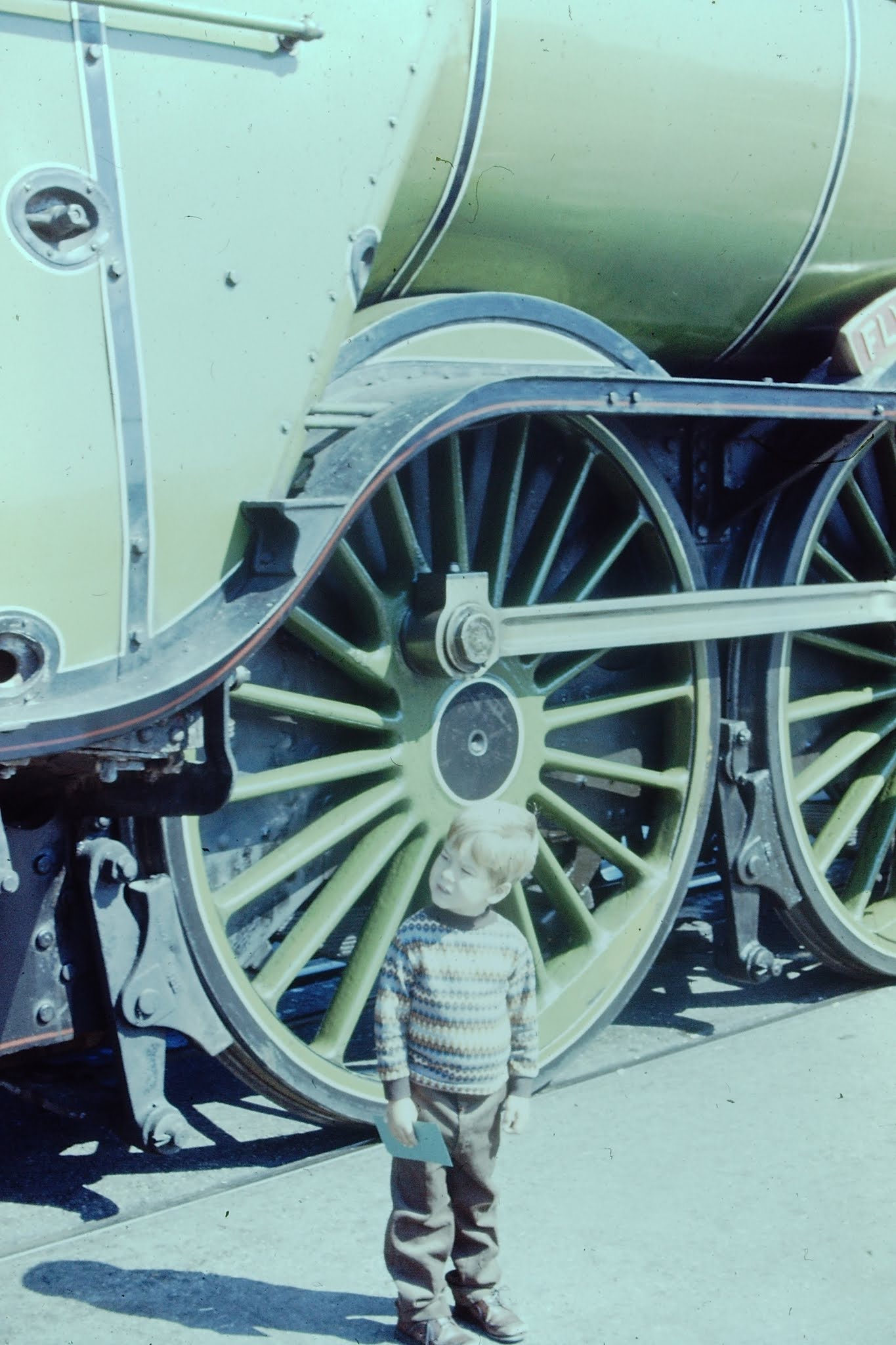
    Author, in front of Flying Scotsman locomotive, San Francisco, 1970.

    When I was growing up, I remember the train case on the wall containing the special models for my father - the Varney F7 he painted himself, his British and European trains he picked up on different visits, and the Pennsylvania GG-1 he got after an east coast trip. As soon as I was old enough for trains, he made sure I had a Lionel layout; it rolled under my bed, and I ran it incessantly. A neighbor had salvaged a former Lionel display layout from a store, and my dad saved the baseboard and restored a bunch of the signals. That got my dad hooked on trains again, and he passed it onto me.

    The Lionel trains got me interested in electricity and electronics - understanding how to power the trains, and also how to power the accessories. I scotch taped wires under the layout to light up a station. We had a Lionel crossing signal that didn’t flash; my father talked with one of the electrical engineers at work, and came back with a handful of transistors and capacitors to make a flip-flop circuit - it seemed like magic to me. He also wanted to learn how to make the signals work, so he bought a copy of Linn Wescott’s venerable “How to wire your model railroad”. I quickly usurped it, and read the whole thing cover-to-cover. I tore it to pieces, learning about switches and relays, detection circuits, block power, and strange combinations of rotary switches to allow multiple trains to be controlled automatically. Dad also had bought a couple Model Railroaders, and eight year old me wore those magazines out as I read about zip texturing and brass locomotives.

    Dad also gave me a lot of freedom. He showed me enough about tools to work safely, then turned me loose with his tools. I ended up building two model railroads, first in my bedroom, then re-using the old Lionel display layout for my larger HO layout in the garage. I made quite a mess there with scenery and wiring. After reading about the Sunset Valley’s engine terminal in Model Railroader (thanks, home town public library, for having the MR subscription!), I decide to build a 1x4 foot extension for a diesel engine terminal. My father stopped me with that attempt at usurping space, and highlighted the extension had to be removable and moved out of the way when I wasn’t operated. He regularly took me down to Trains-Nothing-But-Trains in San Mateo as soon as I was doing HO modeling. When he took me to the dentist, we always made a stop at Berkeley Hardware for a boxcar - some of those kits are still on the layout.

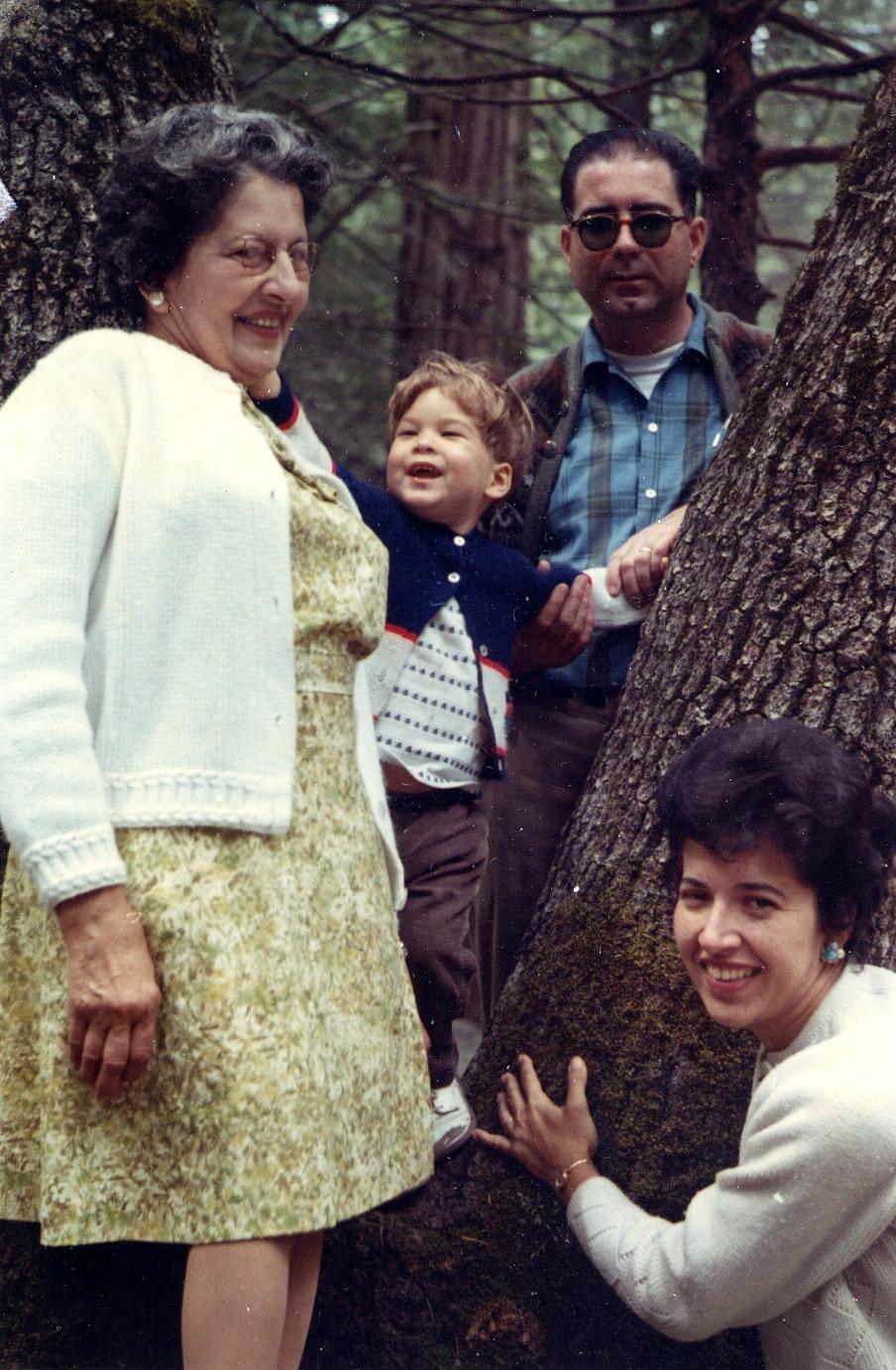
    Yosemite, with author's grandmother. My dad remembers vacation trips to Yosemite with me and my sister as highlights of his life.

    All that shaped who I was - I got interested in electricity, electronics, and digital logic. I got comfortable with tools early, and stole a bunch of my dad’s for my tool box. (Somewhere, I’ve still got side cutters I liberated years ago, as well as some jeweler’s screwdrivers from his tool box.) The model railroad electronics got me interested in taking electronics classes in high school, which taught me how to scavenge components from the junked electronics at the back of the lab.

    Dad also encouraged my interest in computers. I’d used some of the early microcomputers at school. When Dad took a computer class at the local junior college, I’d go with him to evenings in the computer lab, and would write my own programs on his account. The instructor would delete programs unrelated to the class because of disk space limitations, so I learned how to use the teletype and punch out my program listing so I could reload it the next weekend. (Meanwhile, Dad wrote his own programs to estimate costs to ship large objects via oceangoing ships.) When a friend got a TRS-80, I ended up going to visit him but would ignore him as I got caught up in programming his computer. His mother “suggested” that maybe I should have a computer of my own. My mother and father managed to get me a TRS-80. When I started learning to drive, Strawflower Electronics in Half Moon Bay was a common destination because they sold all the TRS-80 games I couldn’t get in Radio Shack stores. All that experience with early microcomputers got me into computer science, and also gave me a chance to learn about microprocessors and electronics. I’m now working for a company making computer chips - insanely complex microprocessors - but the model railroading gave me an appreciation of electronics and a decent knowledge of what’s happening down at the computer chip level to keep up with the hardware guys. The Kalmbach books on wiring the model railroad and assembling electronics is still helping me forty years later.

    A Grown-up Model Railroader

    Dad’s always been supportive and appreciative for the model railroad, though I suspect I took it much more seriously than he ever would. He liked what I was building, but his interest was still in the models he’d collected and their history - his Lionel trains from his youth, the HO models he’d built, the european models he picked up on vacation, and the occasional models he’d pick up because they caught his fancy. He occasionally passed on some of his older models to me. Somewhere, I’ve got one of his 1940’s “Crazy Crystals” refrigerator cars.

    He liked passing on stories, and indulged me when I’d push for operational details about the Western Pacific. He tended to remember more about the personalities than the day-to-day operations. He didn’t know much about how WP’s Sacramento R Street freight house handled traffic, but he still remembered the name of the guy ran the place. He didn’t necessarily know about how trains were routed, but could pull out an old rate book and explain how to argue about how to disassemble dump trailers to get a better rate.

    Mom and Dad, Vista-dome, over Donner Summit

    Back in 2006, my wife and I wanted to do something special for my parents, and found out about a private car group trip to Reno and back over Presidents’ Day weekend. The group had assembled three private cars - a streamlined dining car and a dome car, and Beebe and Clegg’s “Virginia City” observation car, all to be placed on the rear of Amtrak's California Zephyr. We picked my parents up, took them to Emeryville, jumped on the train, and crossed the Sierras. We chose a good weekend - we crossed the Sierras as a big snowstorm hit, and got to watch the snow pile up as we passed the traffic jams on I-80. It was an impressive ride, both for getting to sit in a real dome car, and getting to watch a real snowstorm crossing the Sierras.

    The Virginia City on the back of the California Zephyr.

    The trip also spurred memories from my parents. My parents got married just before my dad left the WP, and he made a point to arrange a trip by the California Zephyr to Salt Lake City and back. They may have ridden in the cars we took that trip to Reno in. We heard more stories of that trip as we sat in the bar at the Nugget casino - the Italian restaurant owner slipping them wine in Salt Lake City, newlyweds in a sleeping compartment, finding others with our rare last name in the Utah phone book. On the way back, our Amtrak train was delayed because of a broken rail somewhere out in Nevada. Our assembled group stood trackside at the Sparks station waiting for the train until the organizers managed to hire a bus to get us all to the warmth of the Reno Amtrak station. While we stood out there, snow flurries started falling - something I’d first seen during a few years living out on the east coast. My mom had never seen snow flurries before; she'd spent her life in temperate California.

    My father, by contrast, had been a skier and interested in the outdoors, so snow wasn't so unusual for him. Somewhere, he's got his record of climbing Mount Hood during his days in Portland. A few years ago, I opened one of the Southern Pacific Technical and Historical Society's magazines to find an article on the special trains that would take skiers up to Norden Summit and Sugar Bowl during the season. In the front and center, there was my dad, caught in a publicity photo. He'd also made the trip up to the 1960 Winter Olympics at Squaw Valley. In one of his few recorded cases of lawlessness, my dad paired up with friends-of-friends who managed to sneak into the US-USSR hockey match, the hottest ticket of the Olympics.

    My father's family including his not-yet-train-crazy grandson.

    Age slowed my dad down a lot over the last ten years. We’d occasionally go to train swap meets, and we’d talk a bunch about trains or about his time at the WP. When my nephew got to five years old, Dad and I pulled out our saved Lionel trains and cleaned them up for his grandson. We’re not sure he caught the train bug. My nephew wasn’t too interested a few years ago, but he set up a “sushi train” a couple weeks back in the style of a sushi boat restaurant he missed visiting. Dad heard my updates on the Vasona Branch, but hadn’t been down here for a few years because of mobility issues. As I mentioned a few months ago, the Vasona Branch got photographed for the NMRA Magazine in preparation for the NMRA National Convention in Santa Clara. The magazine issue with my layout got sent out in October. I sent Dad a copy when he was in nursing care at the end; he got to see how he’d encouraged and inspired me, and what I’d managed to build. He proudly showed it off to the caregivers.

    My father saw a lot during his life. He saw San Francisco before bridges and a city where men wore hats and women gloves. He saw the Bay Area change from industrial and agricultural to high-tech and suburban. He saw the changes in transportation with the decline of the railroads, air freight, and deregulation changes. He saw entire job categories disappear and appear. He saw early computers at Berkeley and the WP (but chose not to pursue that side of the business.) He still loved using his Macintosh to read the world’s newspapers, but the iPad was a little too newfangled for him. He saw Europe and South America, and remembered all his travel fondly. He raised a family, and saw his grandson become an energetic young man.

    He also helped his son become train-crazy, and inadvertently encouraged me in what eventually became my career.

    I’ll miss you, Dad.


    Original story extended with the "Day I Flew a Horse to Venezuela" story.