Monday, May 9, 2011

Open Source!

[Yeah, it's another article about my SwitchList software, rather than about San Jose in the 1930's. History buffs will have some interesting reading in a bit.]

Woohoo! SwitchList is now an open-source project, with source code and bug database available at code.google.com.

For those gentle readers who aren't computer geeks, what does this mean?

Open-sourcing means making the source code of a program - the actual commands the programmer types - available to others so they can use and modify the program themselves. More concretely:

  • If you're curious what it takes to make a modern Macintosh application for moving freight cars around, you can look at the computer instructions that do all that work.
  • If you don't like SwitchList as-is, you can download the source files, modify it, and make your own version to your liking. Want better ways to import your freight cars out of a spreadsheet? Download the code and change it as you want!
  • If you've got ideas about improvements that others might like, you can try changing SwitchList yourself.
  • Check out the upcoming features. Work's started on keeping track of siding and train capacity!

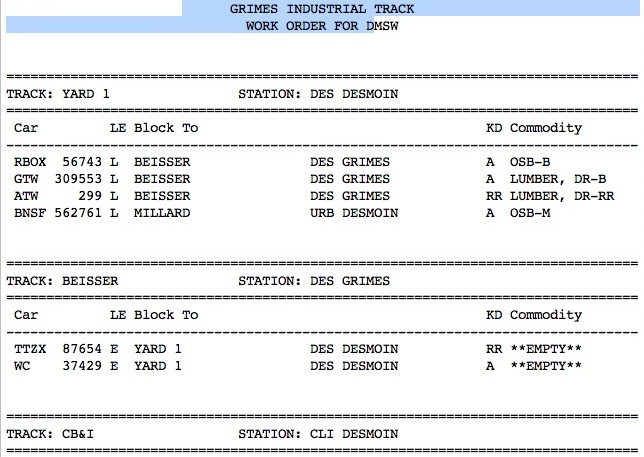
James McNab's 1980's-era PICL report feature is the first contribution to the project. Look at the sources and see what you might do with SwitchList!

Thursday, May 5, 2011

Earl Fruit Company

Even though I've been building an Earl Fruit Company packing house for my shelf layout, I still don't know that much about the company.

Earl Fruit Company seemed to be everywhere in California; all the Sanborn maps I looked at seemed to have one Earl Fruit Company plant present. Whether in a hamlet like Wrights, Walnut Grove, or Whittier, they had packing houses. I'd first thought they were a spinoff of the Southern Pacific, but then heard connections with the Armour and Di Giorgio companies. Luckily, I just saw this Bancroft Library interview with two of the Di Giorgio family about the company's origins. It's a great read both for details about how the packing house and fruit auction business worked.

Earl Fruit Company was actually started by Edwin Tobias Earl, who invented one ventilated refrigerator car. (I imagine it wasn't the first considering that the South Pacific Coast had some of his cars well before the company appeared.) Earl was involved with exporting fresh fruit east, but needed an inexpensive way to carry the fruit. At the same time, the large meat packers were shipping lots of meat in refrigerator cars to California, but were sending the cars back empty. Earl got the Armour family to buy his company, and the meat reefers started travelling back east with fruit. Armour owned the transportation, owned the packing houses, and owned the packing box makers, so they had lots of control over the prices paid to the farmers.

In 1910, the Supreme Court forced the meat packers to divest their refrigerator cars because of their monopoly power, and the railroads took over the refrigerator car business. Joseph Di Giorgio, a kid from Sicily who founded the Di Giorgio fruit brokerage business in Baltimore, realized that controlling Earl Fruit would give him access to the California fruit market. He bought the company and soon controlled the packing house and auction house ends of the fresh fruit business. Di Giorgio at first went for volume, following other fruit packers in extending credit to farmers to be repaid after the crops sold, but quickly found it less risky to primarily serve their own orchards and farms and leave the riskier deals for other packers.

Di Giorgio was huge, owning lumber mills, huge farms, the packing houses, and eventually even the S&W canned goods brand. They intended to be everywhere, and they were.

Check out the full Bancroft Library interview for lots of details about the railroad and packing industry in California; I'd learned lots about the business side, how fruit auctions worked, and how fruit labels were both expensive and important for the fruit sales.

[Fruit label cribbed from the California Digital Library and U.C. Libraries.]

Saturday, April 30, 2011

Thinking about Prototype Switchlists

I was searching around a bit to learn more about how real railroaders handle switchlists, and ran across Mark Mathu's page describing the analysis of a 1967 Green Bay and Western railroad switchlist. He and his friends not only shows the switchlist, but talks about the cars and industries being served that day.

It's interesting to see how the crews used abbreviations and shorthands for the industries they were probably serving daily. There's also no "from" field on the switchlist, nor is there any indication about what cars the crews would be picking up. I'm also surprised to see they noted the cargos on all the cars, perhaps as a double-check to make sure they had the right cars or knew where they would be dropped off.

I also like how they used every other line on the switchlist so they could write bigger; I should do that in my app.

It would be fun to do this kind of analysis for the SP in the 1930's. I might not be able to find a switchlist, but I might be able to guess from photos about the cars carried on a specific train.

Saturday, April 23, 2011

SwitchList - now with PICL Reports and the SF Belt Line's Form B-7!

There's a new version of my SwitchList program available today. Two of the big improvements in the new version are a pair of new switchlist styles to help your model railroad paperwork look more like the real thing!

The first is the computerized PICL Report, used by many modern (post-1980) railroads. PICL stands for "Perpetual Inventory of Car Locations", and the switchlist presents information in terms of the cars being picked up on tracks at each station.

James McNab created this switchlist style for his planned Iowa Interstate layout, and it'll be useful for any other modern railroader using similar paperwork.

The second switchlist style imitates the San Francisco Belt Railroad's Form B-7. Because the San Francisco Belt Railroad acted only to move cars between shippers and the railroads actually handling the freight, their switchlists were actually individual forms provided by each shipper naming the cars to pick up and drop off at that industry. SwitchList's B-7 shows all cars to be switched for a given town rather than specific industry, so for the B-7 to be prototypical, you might need to change the idea of "town" to "each large industry". Even if your own railroad wouldn't use the B-7, you might find it worth using!

Check out Bill Kaufman's article on the Belt Railroad's odd paperwork in the July 2009 issue of Railroad Model Craftsman.

The new version of SwitchList also includes "fixed rate" cargos with none of the randomness that SwitchList normally provides. If you ask for three cars a day to be filled with a given cargo, then SwitchList will give you three cars a day with that cargo.

There's other improvements to SwitchList - check out the SwitchList home page for more information.

SwitchList - now with PICL Reports and the SF Belt Line's Form B-7!

There's a new version of my SwitchList program available today. Two of the big improvements in the new version are a pair of new switchlist styles to help your model railroad paperwork look more like the real thing!

The first is the computerized PICL Report, used by modern railroads. James McNab created this switchlist style for his planned Iowa Interstate layout, and it'll be useful for any other modern railroader using similar paperwork.

Thursday, April 21, 2011

Quick link: Driving Over the Hill in 1937

The Santa Clara County branch of the California Pioneers, who had scanned the neat 1937 floods in San Jose home movies, have another interesting home movie up. This time, they're showing the drive over to Santa Cruz and shots of the Santa Cruz boardwalk. All are from 1937. The interesting bits are short, but give some hints about what Santa Cruz County looked like in the 1930's from a fast-moving car.

See the video.

For the folks modeling further north, there's also some videos of crossing the new Bay Bridge

Quick link: Driving Over the Hill in 1937

The Santa Clara County branch of the California Pioneers, who had
has another interesting home movie up, this time showing the drive over to Santa Cruz and shots of the Santa Cruz boardwalk. All are from 1937.

See the video.