Sunday, February 8, 2015

You Don't Need To Know...

As Byron might say, "You don't need to know exactly what the three required after-market modifications for Ford Model Ts were..." But if you're modeling railroads at the dawn of the automobile age, you might still want to learn.

E. B. White ("Charlotte's Web") noticed that the 1936 Sears Roebuck catalog had lost its section of Ford Model T modifications and repair parts. His goodbye note talked through what made the Model T both good and bad: the parts that everyone bought, straight off. The repairs you were sure to make. The expectation of patching tires, or learning how to crank the car.

Read the full article over at the New Yorker magazine website.

Sunday, February 1, 2015

The Dirty Secret of Printing Freight Cars

BTW, in case you're keeping track, the Hart convertible gondolas were the fourth kind of freight car I printed on the Form One. I've put together a list of all the 3d printed cars I've made, and mention some brief details about each.

With the Hart convertible gondolas, I've finally learned the dirty secret of 3d printing.

Now, if you scratch build a model, it's really easy to make one. You build it slowly; if you get stuck or if something doesn't work, you scrape off the part that isn't working and remake it. Eventually you've got a very nice model. You've also spent a fair amount of time to get to that point. You might be unwilling to make a second, or third, or fourth car because, hey, that would be boring. Making cars only as long as they're fun is fine if you only need one of a particular car, but not so good if you really need a dozen identical cars.

Now, if you were designing an injection-molded freight car, you're definitely aiming at production. You're making either thousands of models for yourself or for others. You'll put a lot of thought into the design because cutting those molds is time-consuming and expensive.

With 3d printing or resin casting, you're in the middle. You're making a small number of items, but you're having to figure out what to make. 3d printing make it easy to sketch up a first model, print it, and iterate. And as a result, you end up with a mighty large scrap box containing all the rejected pieces. Some might be fit only to give you a lesson about things not to do. Other rejected models might be great for a "wreck" at the bottom of a canyon. and some of the rejects aren't so bad...

And now you're in a race. Each time you make a test print, you've made a model that might almost be good enough to use on your layout. You've got some maximum number of models you can probably use on your layout. You've also got ideas on how to tweak each design so that it's closer to perfect and might be useful to other people. So the question is: how fast will you get to "good enough" models and lose interest in printing additional models?

I'm up to twelve or thirteen Hart gondolas at this point, and that's an awful lot for my layout that can't handle more than a hundred freight cars. I've got four cars modeling the gondolas with the bottom doors shut; they look pretty good, but the side sills are too short and won't fit the 7" lettering for reporting marks. So I'm caught - do I use these cars even though they're not quite right, or do I print another four or five cars to get perfection?

Printing a Freight Car: Hart Convertible Gondola (SP W-50-3)

In Silicon Valley, there's two kinds of semiconductor chip companies. Some companies that design their own chips, then make those chips in their "fab" -- their billion-dollar factory. Then there are companies that just make a design, and sell you the design so you can make the chips yourself. Intel is a good example of the first; ARM (the folks who make the core of iPhones) are examples of the second.

The same was true in the railroad industry. If you wanted a freight car, you could go to American Car and Foundry, and say "give me a hundred boxcars". They'd make you a hundred boxcars. Then there were other companies like Rodger Ballast Car Company. You'd call up Rodger and say "I want a hundred gondolas"; they'd hand you a set of plans and say "here's the design, go get someone else to make the cars, because we're too busy playing pinochle."

The Rodgers Ballast Car Company, as their name says, specialized in the design of freight cars for maintaining railroads - open top gondola cars for carrying the ballast rock that holds railroad track in place, or carries the rail, or carries whatever else was needed for laying down new track or repairing old track. They were particularly well known for the "Hart Convertible Gondola", the Transformer of their era. On the outside, the Hart gondola looked like a slightly odd freight car, with a strange truss frame underneath. If you wanted to carry rail or ties, you'd use it as-is. Now, imagine you've laid some railroad track, and you need to put crushed rock between the ties. You'd then open some secret hidden doors in the bed of the gondola, and it would expose a hopper that could spill rock out between the rails. You'd fill the Hart gondola with rock, send it down the track with the hopper partially open, and distribute the rock neatly. But what if you were trying to add dirt to a filled-in area along the tracks? Well, close those center doors, and instead release some side doors, and you can now spill dirt on either side of the car.

If you're feeling particularly energetic, you can set up a line of cars with a continuous line of dirt. (The cars had hinged aprons that could bridge the space between cars, and had end sections that could be removed altogether.) Now, you can put a plow that's just as wide as the inside of the car at one end of a string of cars, and stretch a cable across all the cars to a winch at the far end. Now, power up that winch and pull the plow through all that dirt, and it'll all dump out on the sides of the car as neat as can be! If you ever wanted a freight car with tons of play value, the Hart Convertible gondola is just what you need.

And if you're thinking that the Hart gondola is starting to sound like a prank, go check out the patent to see how Mr. Hart himself described it.

The Model:

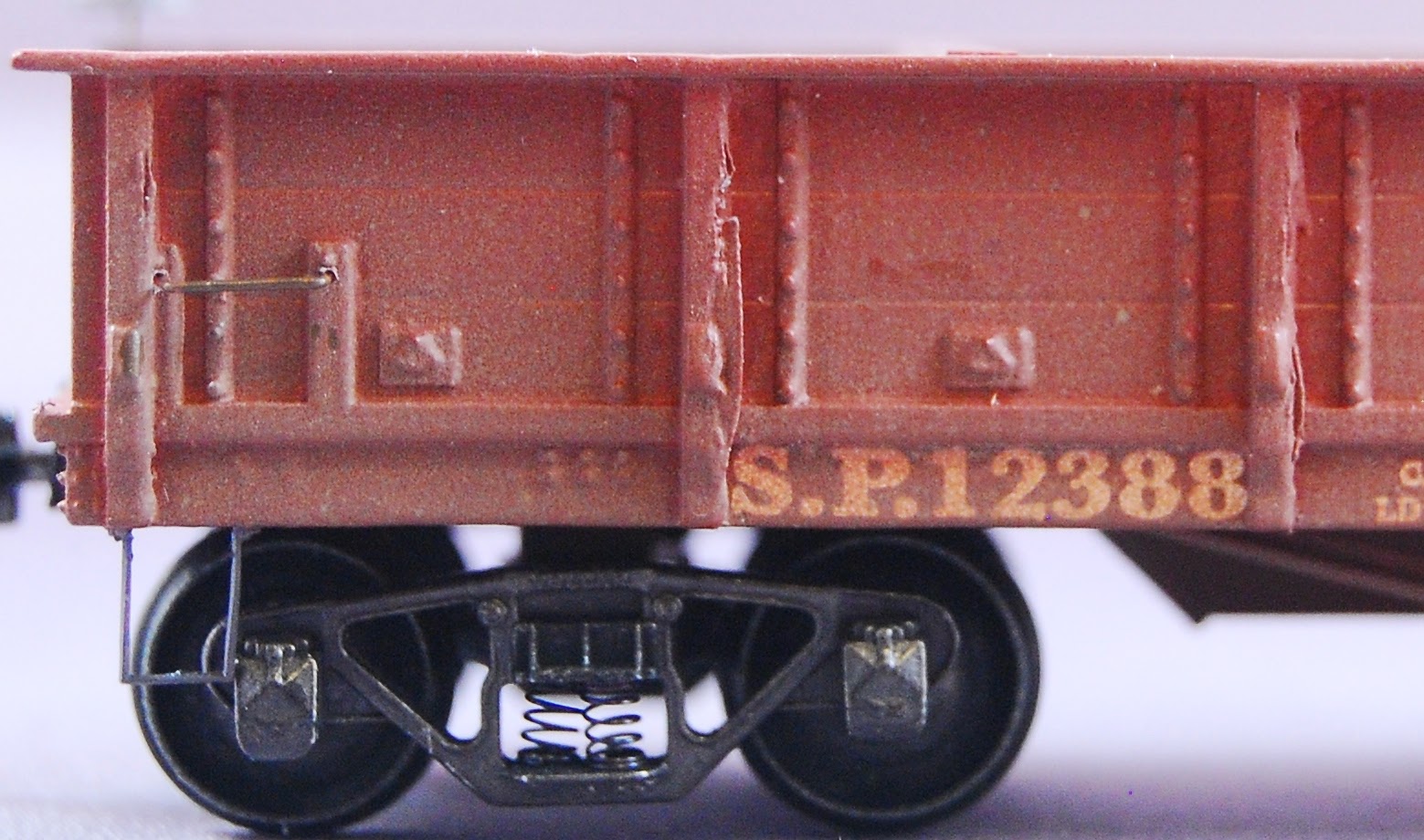
Detail of 3d printed Hart gon.

Now, the Hart convertible gondola was a popular design, with railroads across the U.S. using Rodgers' design. Unfortunately, because each railroad could tweak the plans, the designs all tend to have slight differences. They're also surprisingly rare in the model world; there were some plastic models of the Hart gondola created back in the 1960's, but few other attempts to recreate the cars.

The Southern Pacific did have around five hundred of these cars which they used for construction all across the system. These cars (with the catchy names of "W-50-1" and "W-50-3") would have been common in my 1930's era. Their pronounced underframes also mean they're eye-catching models. All the complications that make them inappropriate models for mass production. The truss, the hinged doors, and hoppers underneath would make them hard to do as injection-molded parts. However, all those complications aren't a problem for 3d printing. I also wasn't interested in scratch building one or two cars. A good work train would require several of these cars. All these requirements make 3d printing these cars the right solution.

Underframe with trusses and hopper printed in one piece.

Interior with hopper, doors, hinged aprons, and support beams in hopper bottom visible.

Like the CS-35A flat car models, I designed my Hart gondolas in SketchUp, the architectural drawing program. I started off with a simple model with only the rough underframe and shape, but left off much of the detail: grooves between board, minor fittings, and pilot holes for placing grab irons. I also left off the doors in the floor and the ends because I assumed I wanted to print these separately to make different configurations of the car. That didn't work so well; although I could print the hopper doors separately, gluing them in was messy and didn't look good. Later versions had one model with the doors up and another with the doors down - both were easy to print. I also wanted to leave off the ends so I could have models with the end walls at the end of the car, next to the hopper, or removed completely. I'd started by printing the ends separately. However, my printed versions warped, so I made new doors out of plastic sheet. The brake cylinder is unusually visible - it's attached to the outside edge of the car. Because printing the brake cylinder as part of the body would have been hard to support, I ended up gluing one on later. I'd already done a brake cylinder part for my flatcar models, so I had an unending supply of castings!

There's a bunch of tiny detail on these cars. Each each time I look at a photo of the real thing, I see more details I missed. In some cases, I added the new detail; in other cases, I've decided the model is good enough as it is. For example, I noticed early on I missed the mechanism for latching the side doors shut. In the large side photo, you'll see some sort of bracket on each post, and a square detail on each side door. This supported a bail mechanism. A piece of pipe was bent so that it went around each post and against each door. When the pipe was rotated one way, it would touch the door and the latch; rotated the other way, the bail would move away from the latch and let the door swing open. Many of the 1930's photos seem to show the mechanism gone; I left it off of my models for now. I've also noticed that the brake wheel (mounted on the end of one of the sides) had a rachet mechanism on top of the car; that deserves to be added.

The next step was to figure out how to print these cars. With the flat cars, I figured out that 36 foot cars could be printed flat on the printer's build platform. When I started printing 40 foot flat cars, I had to tip the cars at an angle to fit. With the gondola's raised sides, even tipping the car wouldn't let them fit in the build area. I tried printing some at 45 degree angle without much luck and with a lot of wasted resin for the support structure.

Five gondolas as they're removed from the 3d printer.

I finally realized that while I didn't have side-to-side space for the car, I did have vertical space - my Form One printer could print up to around a 45 foot car. So I removed some of the fine detail from one end of the car, and printed it vertically, pulling the car out of the resin tank layer by layer. Once I figured out I could do that, I also proved I could print four or five at once at a fraction of the time - printing one requires about 12 hours and $3.00 of resin, but printing five took 20 hours (4 hours a car). Woohoo!

Note flaws along posts in this model. Because the posts suddenly jut out, their initial layers are unsupported and may not adhere to later layers.

Printing the cars vertically required leaving the ends off the car. When printing vertically, anything going up and down (parallel to the sides) prints fine, but new pieces cutting across the middle either bridging the sides or sticking out from the sides work less well. (They'll work with gentle angles, but not with 90 degree projections, though there are ways to get support structures to help support the bridges.) The problems with crosswise pieces ensured I made the ends as separate pieces.

The Form One still can do some pretty amazing things - look both at the truss under frame, at the cross bracing in the truss, and at the support beam in the interior of the hopper. That's some very tiny work, and somehow the printer is able to make it cleanly!

Version with doors down

So what's been good with these cars?

  • The W-50-3 prints as a single body. Once it's printed, I just need to clean up the casting, drill and tap holes, add grab irons, and paint the finished car.
  • They're not insanely expensive. Printing these at Shapeways would have cost around $50 because of their better machines, but I could do these cars inexpensively at home - $3.00 in material, with machine time and cleanup time as biggest additional costs.
  • The 3d process makes it easy to do the variants. I could have just as easily made some with side doors swung out, or with dump doors open, or imitate the W-50-1 class's steel fishbelly sides. I've even printed an N scale car body from the design.
  • I reused the brake cylinder piece I'd already modeled and printed with the 3d printer.
  • My car's quality is close to injection molding, and certainly good enough for my purposes. There's enough detail to make me think the cars are detailed, and they stand up well against the other freight cars in my fleet. I can also print enough cars to support work train operations on my layout.

What wasn't so good?

  • I omitted some of the detail from my model - the chains that open the doors below, bars that latch the sides shut. Some of this wouldn't be a significant problem to add; in other cases (such as the chains), 3d printing might not help.
  • Because I'm printing from one end, the starting end's lacks some detail. So far it hasn't been a concern for me.
  • The clear resin I used for these models is a bit more fragile than a resin kit, and may break if dropped. The gray resin appears more flexible; I need to print a couple cars in gray.
Looks like a success. I've got five cars near ready to go, with another seven needing decals. I'm also looking forward to adding loads for some of the cars; as nice as the open hoppers look, I'd really like to fill some partially with gravel, and put rail and ties in some of the models with closed doors. More pictures as I finish the rest of the cars!

Patent image from U.S. Patent 941249. Prototype photo from Mid-Continent Railway Museum's article on a Hart gondola in their collection.

Friday, January 30, 2015

Complicating Model Railroad Operations

Here's a cute trick for complicating model railroad operations. Last year, James McNab saw a tank car appear on the Iowa Interstate, the short line railroad he models. The tank car sat around for three days, then disappeared. James figured out it was a misrouted car that wasn't supposed to come to the Iowa Interstate. It sat around for a couple days, getting in the way, until folks could figure out where to send it.

James thought this was a nice way to complicate operations on his model railroad of the same track. He now occasionally places a misrouted tank car on the layout, and warns crews either to "leave it alone" or bring it back to the yard. It's a quick and easy way to complicate operations. For folks modeling the 1970's (or perhaps even the 1930's), a siding full of idle freight cars might be another way to increase the puzzle challenge of operations.

Thursday, January 8, 2015

Hart Convertible Gondola (SP W-50-3): Another Sneak Preview

Yep, it's time for another sneak preview of my Hart convertible gondolas, printed on the Form One 3d printer.

Did I mention that I'd figured out how to print five gondolas at once?

The painted cars here are the first version of the design; the cars in back have the hopper doors closed. I've printed got a second version of this model with even more detail. It's now a race - will I have enough "good enough" cars that I won't bother to get the design perfect?

I've got an article on these models ready to go, but I'd like to do a couple good paint jobs and decal one of these models before sharing more.

Monday, December 29, 2014

Movie Night XXI: Drying Apricots at the Basuni Ranch

Just so we remember what summer's like, here's a great video from the Basuni family showing the work involved with drying apricots. Thank the California Pioneers of Santa Clara County for the work digitizing this and other videos!

Tuesday, December 23, 2014

The "Big Little Boss": Jennie Besana

Back in 1919, San Jose Evening News columnist Edith Daley spent a good part of her summer visiting the local canneries. In each, she pulled out her notebook and wrote a few facts on production, poetically described the magic she saw, and had kind words for the office staff that explained the business to her. When she visited the Contadina cannery on Race Street at Moorpark, she wrote:

F. Aiello is the owner and manager, but the office has a real “boss” in little Miss J. Besana. The way she juggles conversation about tomatoes and cans and hauling and open contracts and closed contracts is a joy! She has been with the Contadina since its opening and is a very valuable “office force.” She knows the machinery from scales to boiler, from copper coils in the big tomato puree cooker to the last can!
It is quite easy to get mixed up and call this clever secretary “the big little boss!”

("Contadina Co. Packs Many Love Apples": August 11, 1919 San Jose Evening News)

J. Besana was more than a secretary; she was a bookkeeper for the cannery, who managed the paperwork and sorted out the contracts with the growers. If you needed a reminder of how life in a cannery was awfully similar to life in a Silicon Valley startup, you only need to look at the "big little boss". Jennie Besana was just twenty-two years old at the time Edith met her, and she was already a seasoned bookkeeper who had worked for the local trolley line and a doctor in San Jose before keeping the books at Contadina. Even as she was living at home with parents, she was still holding a responsible position in the edgy and zany canning industry, which was probably as close as you can get in those days to working at Facebook or Yahoo.

Genevieve Besana was born in Novara, Italy, west of Milan. Her parents immigrated to the U.S. In 1898 when Jennie was two years old. She grew on Bishop Street, just off of Julian St. near the Alameda. (It’s now the stub end of North Morrison.) Her father, a laborer, worked at the Pratt-Low cannery in Santa Clara. Her brother, Melchior, pretty quickly went by the more American “Mickey”, and Genevieve always used her more informal “Jennie”.

Jennie went to school at St. Josephs (which I assume was associated with St. Joseph’s Basilica in downtown San Jose). Her walk to school would have taken her past Anderson Barngrover where they built all the machinery for the modern canneries. In 1915, she was in the school play as “Cora Brown, a spoiled child” in “The Rebellion of Mrs Barclay”. “Miss Besana is particularly pleasing in the scheme where she endeavors to assist Mr. Barclay in getting dinner, and succeeds only in making him go back on his principle that ___”. (That’s not my omission, but the reviewer trying not to spoil the ending. Go read one of the online copies to see how it ends.)

After high school, Jenny Besana worked as a bookkeeper, first at the Peninsular Interurban offices, then at a local doctor’s. All the while, she was living at home with her parents on Bishop St.

And some time around 1917, she heard about the new cannery being built by Italians from Back East, and joined in on the wild ride that was the tomato canning business in 1917. She worked at Contadina from its opening until the mid-1920’s, then walked across the street to the U.S. Products cannery for a similar job there.

In 1924, Jennie married Frank Maral. Frank was first-generation Portuguese; his father had bought a ranch out on White Road around 1900. Frank didn’t go into the orchard business, but was instead a millman at the Pacific Manufacturing Company in Santa Clara, and a charter member of the Alum Rock Athletic Club. Jennie and Frank moved into Frank’s house at 573 University Ave., currently located right in the middle of the Bellarmine campus.

In 1927, Jennie and Frank bought their own part of land, swapping the house for 5 acres on Blaney Ave. in Cupertino from Joseph D. Blabon. Blabon was a Cupertino rancher who had owned four hundred acres on the west side of the valley; the land he sold to Frank and Jennie had been bought from Ferdinand Blassey in 1905. Blabon still held significant acreage in prunes; a few years later in 1936, his hired help went on a rampage over low wages, “smashing windows and pulling fruit from trees”. (August 29, 1936 San Jose Mercury Herald, via Cecilia M. Tsu, “Garden of the World: Asian Immigrants and the Making of Agriculture in California”)

Frank and Jennie took a couple years to move (and perhaps to build a house), but by 1930, they were living out in the wilds of Cupertino. Jennie would have had an easy commute; just a quick walk up to Stevens Creek Road, and she could catch the interurban train all the way to Race Street.

I’d like to be able to say I’d heard more about Jennie from her grandchildren, but I can’t. She died in January 1935 at 37 years old; a cold or flu appears to have badly affected her heart thanks to a previous case of rheumatic fever. Before she died, she made Frank promise not to remarry. There were no kids. I couldn't even find a gravestone at the Santa Clara Mission Cemetery for Jennie.

January 12, 1935 San Jose Evening News: MARAL - In San Jose, Calif., January 11, 1935, Jennie Maral, beloved wife of Frank T. Maral, loving daughter of Mr. and Mrs. Joseph Besana of San Jose, sister of Melchior Besana of Cupertino and Mrs. Frances Isbeli of Berkeley Calif: daughter-in-law of Mrs. Agnes Maral of San Jose; a native of Novara, Italy, aged 36 years, 4 months, and 3 days. Funeral on Monday, January 14, 1935, at 9 a.m. thence to Holy Family Church, River and San Fernando Streets, where a requiem mass will be celebrated for the repose of her soul commencing at 9:30 a.m. thence to Santa Clara Catholic Cemetery.

Holy Family Church, at River St. and San Fernando, was a symbolic place for her funeral mass, for the church had been formed explicitly to serve the Italian immigrants of San Jose. Jennie probably attended the church as a child, and was married in that church as well. The church on River Street only lasted into the 1960's when it was torn down as part of urban renewal. The church re-formed on Pearl Ave. in South San Jose.

Frank continued to live on the property well into the 1960’s. He shared the house with his mother; his brother, Antone, lived in an apartment built into the former tank house with his wife Virginia - a small living room and kitchen on the ground floor, and bedroom above. The family raised turkeys on the ranch. In the late 50’s, Frank and Antone got out of the bird business, sold the ranch, and moved to a small adobe-style house on Stevens Creek Road. When the family moved out of that house in the 1960’s and into a modern tract house off of Wolfe, their old house became Cupertino’s Adobe Inn restaurant.

Frank lived on until 1969, and, true to his word, never remarried. He worked his entire career at Pacific Manufacturing, and lived his life in Cupertino. Frank’s relatives do remember that he was married to an Italian girl. The story of the dying wife demanding such a large promise did get passed down, but they’d forgotten that italian girl had been the “big little boss” of Contadina.

Now, Jennie wasn’t unique; my own grandmother kept the books for a vegetable packer in Hayward during the 1920’s. Like Jennie, my grandmother did the overall books, but she also handled the paperwork for outbound cars of peas with the railroad. One of the mementos my grandmother saved was her “cheat sheet” for car routing: cars for the Carbone Brothers in New York City went via the Western Pacific, Union Pacific, Chicago Burlington and Quincy, and finally Pennsylvania railroads. (Although the railroads could choose routings, shippers would often do it either for the control or to reward particular railroad salesmen.) She must have gotten a good grounding in railroad rates as well. When my dad started dating my mom, my grandmother was impressed enough by his background as a railroad rate clerk that she ignored the fact that he wasn’t Portuguese.

There’s lots of other stories about the paperwork in the offices of canneries being shuffled primarily by women who needed to understand the business, law, and human nature enough to deal with an irate farmer complaining about the prices on his contract. Other cannery visits by Edith Daley introduced Gertrude Carter as running the back office at Pyle Cannery (“Miss Carter finds this a unique season for the reason that the fruit is running almost too largely to high grade stuff. The pack is practically sold before it is canned, and this year the difficulty is in getting enough low grade fruit to fill orders.”) Filipina de Rosa and Mary Cribari were active at Bisceglia Brothers in 1919, though they had the advantage that they were also the owners. Tillie Lewis, in Stockton in the 1930’s, had the same benefit.

Edith’s articles came just after the end of World War I. The canning business had been going great guns ever since the World War started, creating both a demand for canned goods for the countries at war, and cutting off competing products from Europe. The U.S.’s entry into the war pulled men away from the cannery jobs. Edith Daley was seeing a world where women were not just working on the lines preparing fruit, but also running the canning machines at Alba Canning, and actually making the cans on the dangerous production lines at American Can. (“We haven’t lost any fingers this season.”) Edith probably had an easier time negotiating for her own by-line and column when men such as the Jack Wright, the future manager of the Evening News, was sent off to France. (Jack also wrote several “slightly fictional” columns about his wartime experience under the title "Private Prune’s Diary", which are worth a read.)

But in spite of the men being gone, all that probably didn’t mean that Jennie was going to be allowed to run the place. There were women in management at canneries. Clara Cribari could do it, but she owned Bisceglia Brothers. For other women there was a very firm glass ceiling: the women could do clerical work (and clerical in this case means both secretarial work and handling records - bookkeeping, filing, etc), but no more. I suspect management or customer-facing jobs were right out. Edith Daley’s article came at a time when the reader might have imagined times were changing… but weren’t going to change just then.

And even those clerical jobs weren’t particularly secure. Some companies wouldn’t hire married women at all, and would fire a woman who did marry. Jennie Besana’s affiliation change from Contadina’s bookkeeper to U.S. Products’ secretary happened at the same time that she took her married name.

On the other hand, if a war broke out and there weren’t men to hire, then why not hire sharp women? Twenty years later, during World War II, the June 27, 1945 San Jose News included the advertisement:

BOOKKEEPER, man or woman, for one of our clients in Gilroy, Calif. Must be competent and experienced. Steady, all-year employment. Five day week, salary $225 per month. Write giving full particulars. GIULI & GIULI, Public Accountants, Morgan Hill, Calif.

The same issue had Santa Clara Packing Co. looking for a bookkeeper as well. Jennie would have been a prime catch for either cannery.


Great thanks to Frank Maral's niece, Bonnie, for stories about the Maral family and for the stories she did have about Jennie Besana Maral. The review of "Miss Jennie Besana, "Spoiled Child" in Comedy, St. Joseph" appeared in the May 25, 1915 San Jose Mercury Herald.