


 Posts
Posts


I was searching around a bit to learn more about how real railroaders handle switchlists, and ran across Mark Mathu's page describing the analysis of a 1967 Green Bay and Western railroad switchlist. He and his friends not only shows the switchlist, but talks about the cars and industries being served that day.
It's interesting to see how the crews used abbreviations and shorthands for the industries they were probably serving daily. There's also no "from" field on the switchlist, nor is there any indication about what cars the crews would be picking up. I'm also surprised to see they noted the cargos on all the cars, perhaps as a double-check to make sure they had the right cars or knew where they would be dropped off.
I also like how they used every other line on the switchlist so they could write bigger; I should do that in my app.
It would be fun to do this kind of analysis for the SP in the 1930's. I might not be able to find a switchlist, but I might be able to guess from photos about the cars carried on a specific train.
Saturday, April 30, 2011

Saturday, April 23, 2011
SwitchList - now with PICL Reports and the SF Belt Line's Form B-7!
There's a new version of my SwitchList program available today. Two of the big improvements in the new version are a pair of new switchlist styles to help your model railroad paperwork look more like the real thing!
 The first is the computerized PICL Report, used by many modern (post-1980) railroads. PICL stands for "Perpetual Inventory of Car Locations", and the switchlist presents information in terms of the cars being picked up on tracks at each station.
James McNab created this switchlist style for his planned Iowa Interstate layout, and it'll be useful for any other modern railroader using similar paperwork.
 The second switchlist style imitates the San Francisco Belt Railroad's Form B-7. Because the San Francisco Belt Railroad acted only to move cars between shippers and the railroads actually handling the freight, their switchlists were actually individual forms provided by each shipper naming the cars to pick up and drop off at that industry. SwitchList's B-7 shows all cars to be switched for a given town rather than specific industry, so for the B-7 to be prototypical, you might need to change the idea of "town" to "each large industry". Even if your own railroad wouldn't use the B-7, you might find it worth using!
Check out Bill Kaufman's article on the Belt Railroad's odd paperwork in the July 2009 issue of Railroad Model Craftsman.
The new version of SwitchList also includes "fixed rate" cargos with none of the randomness that SwitchList normally provides. If you ask for three cars a day to be filled with a given cargo, then SwitchList will give you three cars a day with that cargo.
There's other improvements to SwitchList - check out the SwitchList home page for more information.
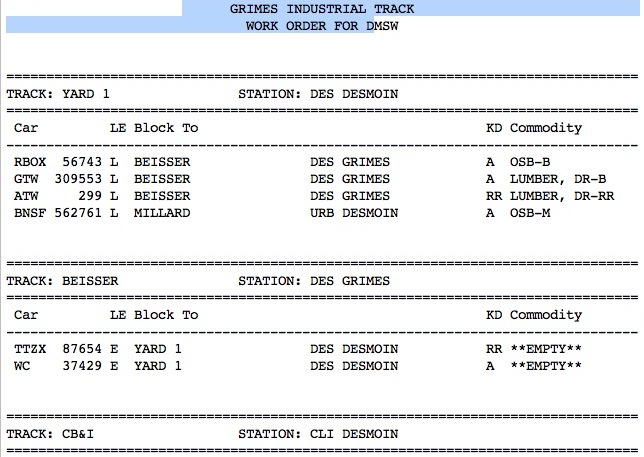
James McNab created this switchlist style for his planned Iowa Interstate layout, and it'll be useful for any other modern railroader using similar paperwork.

Check out Bill Kaufman's article on the Belt Railroad's odd paperwork in the July 2009 issue of Railroad Model Craftsman.
The new version of SwitchList also includes "fixed rate" cargos with none of the randomness that SwitchList normally provides. If you ask for three cars a day to be filled with a given cargo, then SwitchList will give you three cars a day with that cargo.
There's other improvements to SwitchList - check out the SwitchList home page for more information.
SwitchList - now with PICL Reports and the SF Belt Line's Form B-7!
There's a new version of my SwitchList program available today. Two of the big improvements in the new version are a pair of new switchlist styles to help your model railroad paperwork look more like the real thing!
The first is the computerized PICL Report, used by modern railroads. James McNab created this switchlist style for his planned Iowa Interstate layout, and it'll be useful for any other modern railroader using similar paperwork.
The first is the computerized PICL Report, used by modern railroads. James McNab created this switchlist style for his planned Iowa Interstate layout, and it'll be useful for any other modern railroader using similar paperwork.
Thursday, April 21, 2011
Quick link: Driving Over the Hill in 1937
The Santa Clara County branch of the California Pioneers, who had scanned the neat 1937 floods in San Jose home movies, have another interesting home movie up. This time, they're showing the drive over to Santa Cruz and shots of the Santa Cruz boardwalk. All are from 1937. The interesting bits are short, but give some hints about what Santa Cruz County looked like in the 1930's from a fast-moving car.
See the video.
For the folks modeling further north, there's also some videos of crossing the new Bay Bridge
See the video.
For the folks modeling further north, there's also some videos of crossing the new Bay Bridge
Quick link: Driving Over the Hill in 1937
The Santa Clara County branch of the California Pioneers, who had
has another interesting home movie up, this time showing the drive over to Santa Cruz and shots of the Santa Cruz boardwalk. All are from 1937.
See the video.
has another interesting home movie up, this time showing the drive over to Santa Cruz and shots of the Santa Cruz boardwalk. All are from 1937.
See the video.
Saturday, March 5, 2011
Progress on the Earl Fruit Packing House

Major work still to be done: make the roof look more like composition roofing by toning down the color, attach the sign permanently, paint the roof trim, attach the steps. It's not the neatest work I've ever done, but it's been fun to research and to build.

One interesting excursion involved the sign. I checked my computer for the best typeface to match the sign, and found "Bank Gothic" was first created in the 1930's, so it's actually a very appropriate font for the time. I've seen other Earl Fruit Company signs with similar block lettering - at least one in San Jose and something similar in Lodi. I suspect Bank Gothic was inspired by sign painters, rather than these signs inspired by the font, but it's still nice to know that the lettering is appropriate for the era.
Note to self: I really ought to try to recreate that prototype photo on the layout. Time to make some miniature figures that match the two poses. I wonder how I can make an accurate STOP sign for the flagman?
New Photos Appearing at Old Sites
If I ever needed a reminder to keep checking out the online collections of my favorite museums, I've got it.
 You
You
may remember this picture from a few months back showing the packing houses along Ryland St. on the north side of the San Pedro Street yards in San Jose.
 Silicon Valley Online seems to have just added this picture showing those warehouses up close, taken from just west of the San Pedro Street crossing. The near packing house is J.B. Inderridden, the far one is the three story Rosenberg Brothers packing house. Warren Dried Fruit and eventually Abinante and Nola will eventually occupy the rougher building just on the edge of the picture.
Check out those stub switches, scale shed, and see what you can glean from the track arrangements!

may remember this picture from a few months back showing the packing houses along Ryland St. on the north side of the San Pedro Street yards in San Jose.

Check out those stub switches, scale shed, and see what you can glean from the track arrangements!
Subscribe to:
Posts (Atom)