Sunday, July 24, 2011

In the Year 2001, Ray Bradbury Says...

And for a bit of California Prune and Apricot Growers (aka Sunsweet) content (and some hints about what life in the 21st century might be like), check out Ray Bradbury's Predictions for the Year 2001:

Spoiler: we still haven't gotten the wrinkles out of prunes.

Progress on Plant 51

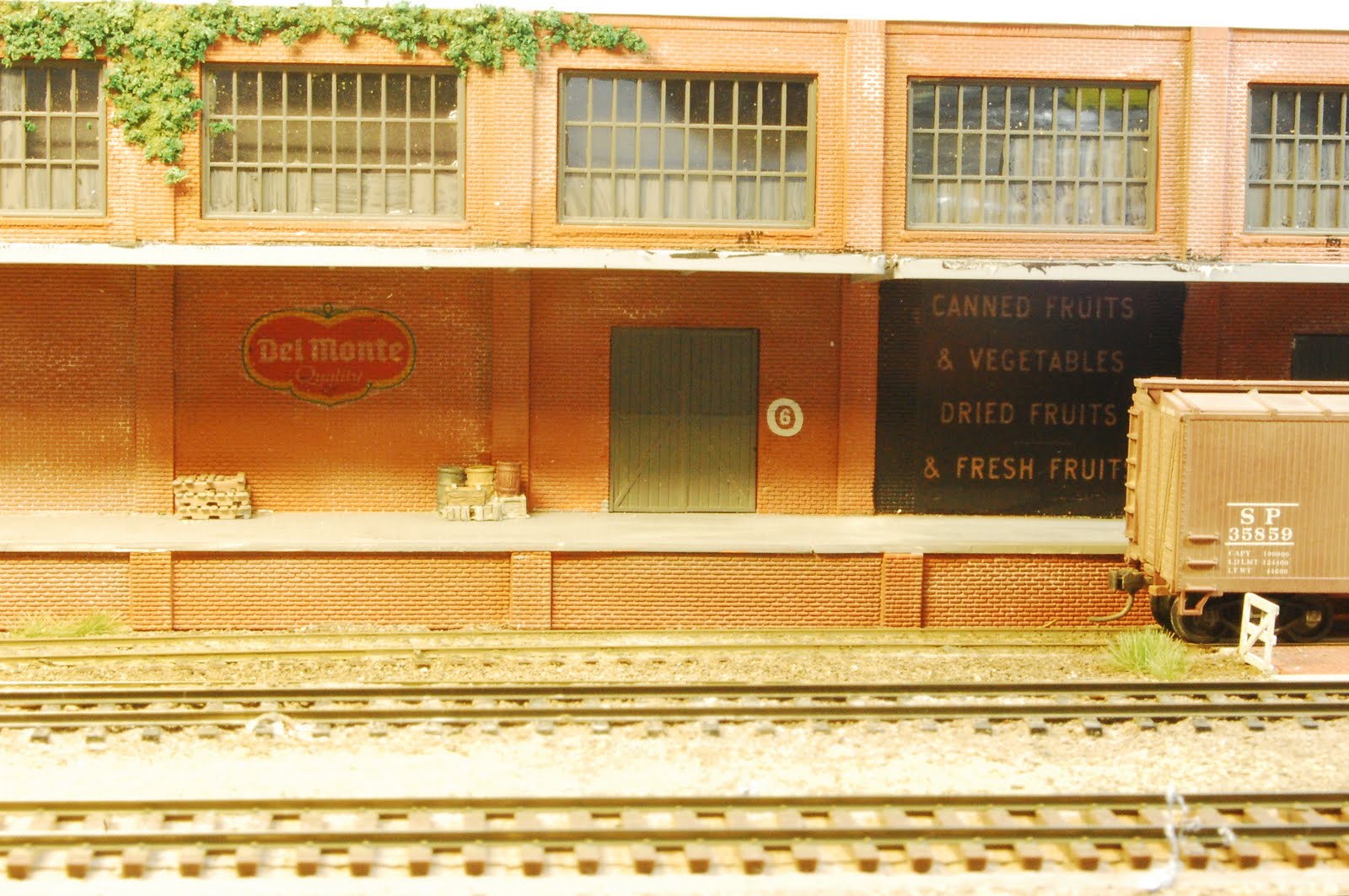
Plant 51 now has vines, the logos and other big painted signs, a roof over the platform (which still needs to be painted, as well as dirt and weeds. Next step: finish the platform roof, finish the looming building behind that had the "CALIFORNIA PACKING CORPORATION" billboard lettering, and declare Plant 51 ready for business!

Saturday, July 23, 2011

Op Session: Success!

Another operating session this weekend, this time as a thank you to the The Sacramento Central modular railroad group. They'd hosted operating sessions on the floor of the NMRA convention at the beginning of the month (which I think is very, very cool), and I was very happy to get the chance to operate on their layout on Saturday morning as the public wandered by. Tom, Dick, and Scott braved the long drive to San Jose to operate on the Vasona Branch, with the help of Special Guest Star Seth Neumann!

This was an operating session to remember for at least one reason: I finished the prep work (wiping down track, cleaning wheels, getting cars in place, etc) in around three hours which is probably a new record. Usually, I'll spend a lot longer on cleanup, vacuuming the track, and making minor repairs. Recent prep for the NMRA convention meant the layout was in decent shape, even if I'd been burying the tracks around Plant 51 in dirt from the garden in recent weeks. It also helped that this was a forgiving group; even though I hadn't managed to fix broken switch point power on a pair of infrequently-used switches, they still made it through the session with good humor. Still, it was a pretty-trouble-free session with only a few stalls and misbehavior.

One of my surprises this week was to realize the wear-and-tear of cleanup. Wiping down all the track, for example, causes the rag to catch on spikes and causes the track to move. I found today that the siding leading to Plant 51 had a dip in it that caused a locomotive to short out. A bit of folded paper raised the dip, but I suspect the dip and track misalignment came from abuse during cleaning. I need to work on ballasting track (so it stays in place better), watch for maintenace work that causes such headaches, and be more observant for rail alignment problems before a session.

I used to think that my pre-operating session cleanup bordered on the obsessive-compulsive (except for the fact that I remember how badly op sessions can go without it.) But I got confirmation I'm not alone; Jim Providenza, who models pretty much the same location in a similar garage-sized space, pointed out at a panel at the NMRA convention that track cleaning is a big deal for operations on his layout. He runs multiple track cleaner cars on his layout and religiously cleans the layout before operating sessions, but he sometimes has to clean tracks and locomotive wheels halfway through operating sessions. It's not just me...

Thursday, July 21, 2011

Random threads of research: the Woelffel Cannery

There's a surprising number of sources for historic research on the Internet, even in places you might not expect for railroad and railroad-industry facts. The Mercury News just reported that Apple, in its quest to occupy all commercial real estate in Cupertino, just leased the former Measurex campus along the Vasona Branch.

What's that got to do with canneries and railroads? Measurex is pretty modern history; it was a start-up that sold measuring tools for paper plants and other high-speed industries, starting in 1968 and going till they got bought by Honeywell in the 1990's. One reference to Measurex mentions that the land for their offices was formerly a cannery. Now that's odd, for the only cannery I know in Cupertino was the Woelffel Cannery, and that was a bit north of the Measurex campus.

Some more searching gave an answer, thanks to the University of California's Bancroft Library Oral History Project, which has been filling out its interviews of famous California businessmen and public figures with venture capitalists and founders of companies. One of those interviewed was David Bossen, one of the founders of Measurex, and he mentions:

"Anyway, she located the space, and it belonged to a nice little old lady, who I suppose has passed away now, by the name of Blanche B. Woelffel. She owned thirty-five acres in Cupertino, and she had a factory there that produced tomato paste. She had an evaporator and one big building, and she was growing tomatoes and plums on this property… Well, she had inherited it from her husband who had just died. She sold it to us, and we paid an exorbitant amount, I thought—$50,000 an acre for the first— I think we had thirteen acres originally."

Ah, so Measurex wasn't built on top of a cannery - they bought parts of the Richard Woelffel cannery. Stapleton-Spence bought the cannery itself for the machinery, or so I've read. That's how the canning industry faded from Cupertino. The cannery building lasted long enough to be photographed by the Historic American Buildings Survey in 1980, and seems to have lasted a bit longer. It's now the site of townhouses.

So there you have it - going from a news article to alumni site for a long-gone Silicon Valley startup, to historic interview from the Bancroft told me just a bit more about the life and times of the Woelffel Cannery. Key new fact for me: the Woelffel Cannery may have canned tomatoes, even if the surrounding area was all orchards!

And just to bring things back to railroads: I've always thought that would be a great building to model, and one of these days I might build it. After the NMRA convention earlier this month, I'm starting to think seriously about building a Freemo module. The Woelffel Cannery and other buildings around where Stevens Creek Boulevard crosses the railroad tracks could make a fun module!

Wednesday, July 20, 2011

Guessing at the size of Sewall Brown

Back of the envelope calculations are a favorite tool for engineers; we love them so we can quickly pronounce that something's impossible, stupid, or criminal. Or maybe it might just work...

So here's a fun bit of guesswork using back of the envelope calculations: how big would a typical packing shed - maybe that Sewall Brown apricot pit plant which I was guessing used to be a Sunsweet plant? It's not on the Sanborn maps, and there's few pictures, so I don't know the actual size of the building. Luckily, this article from the Los Gatos Weekly Times references some period news reports of the fire that burned out Sewall Brown:

"Five units responded to the fire on Sept. 20, 1955, but the 53-year-old wooden stucture that was filled with 2,000 tons of apricot pits was lost, reported the Los Gatos Times-Observer."

Ok, we now know that Sewall Brown's building was probably built in 1902, and it was big enough for *4 million pounds* of apricot pits. A random site on the internet declares that apricot pits have a density of 440.78 kg/m3. If we do some math and conversions to and from metric, that implies that Sewall Brown had about 4000 m^3, or 111,000 cubic feet of apricot pits. That's a 100 x 139 foot barn, or a 100 x 69 foot barn packed 16 feet high.

That's an awful lot of apricot kernels. It almost seems like too many apricot kernels.

The Santa Clara County Fire District historic site has some photos with little detail, but cites this about that fire:

"Apricot pit fire, 20 September 1955. A processing plant, barn and tons of apricot pits were destroyed in this fire on the Santa Clara-Los Gatos road at Vasona Junction. The pits oil was extracted for use in cosmetics and other product. 25 firefighters from the Quito, Cambrian and San Tomas stations fought the blaze under the direction of B/C Jim Ackley. The heat was so intense that two firefighters, Captain Del Coombs and FF Roger Hodgson burned their hands trying to connect a hose to a fire hydrant 100 feet from the burning building. Bulldozers were used to spread the pits to hasten extinguishing of the fire. Lower left photo shows FF Ray Lubert and Captain Walt Cunningham working hoses over the red hot pits. Photos from newspaper clippings."

That comment about bulldozing the pits makes me wonder if the pits were stored outside in the summer so that they didn't need the huge barn. I'll let someone else do the math to figure out whether the Santa Clara Valley could produce 2000 tons of apricot kernels in a single season.

Sunday, July 17, 2011

Cleanup at Plant 51

One of the great things about the model railroad hobby is that I sometimes just get distracted from the high-priority projects on my list, and can instead just dash off on some other lark for a little while.

This weekend, for example. My to-do list (both at home and on the layout) is pretty long, but I was poking around at photos I'd catalogued on Lookback Maps, and took another look at this photo of Plant 51 from the 1920's. I'd gotten a little annoyed when I first found this photo because it showed lots of details I wasn't modeling.

Here's a look at some of the detail in that photo.

Re-examining that photo got me excited about making the building more correct - modeling the ivy, roof over the docks, and larger building just behind with the large California Packing Corporation (aka Calpac, aka Del Monte) lettering. The to-do list went out the window, except for mowing the lawns. I adding all those details in: washing the building with white paint for mortar, started building the dock roof and a flat for the background building, and added ivy on the building. There were also two painted signs visible along the loading dock - a Del Monte logo, and a list of their products. After a bit of work with the printer and some do-it-yourself decal paper, I had those signs reproduced on the model. I also ballasted the track leading into Plant 51 (or, more precisely, buried it in dirt sifted from the backyard).

Here's the before-and-after photos showing the progress this weekend. I still need to finish the dock roofs, add the background building, and add some weeds around at appropriate places.


And regardless of whether I made progress on the to-do list, I'm feeling a bit better about this corner of the layout. More news on the Plant 51 changes as they develop...

Thursday, July 14, 2011

Freight Car Research: 1935 Lawsuit Hints at San Jose Freight Cars

Man, those modern railroaders have it good. If they're curious what kinds of freight cars are in trains, they go to the tracks and take photos. If they're curious about how locomotives travel around, they visit one of the tracking sites to see where UP 5623 is. They've got Street View, aerial photos, etc.

That doesn't work as well for those of us modeling the past. If we want to set a scene, we have to search dusty archives, examine the background of old photos, and dig a lot deeper for not very much information.

For example, what did the freight cars look like along the tracks in San Jose in the 1930's? Should I have a lot of Southern Pacific boxcars on my layout, or a few? Were the boxcars old, or were the new steel boxcars appearing?

Some photos (such as this photo of Del Monte's Plant 51 can hint at the question. We see lots of single sheathed boxcars, and the front two boxcars are both Texas and New Orleans (a SP subsidiary), but there's so many questions left unanswered - how fast did the cars turn over? What are those cars in the back? Where are the cars going?

Luckily, there are some other sources. Tom Campbell, who models R Street in Sacramento, was doing research on what his area looked like in the 1950's, and along the way found out about a fight whether the SP had to switch cars from the Western Pacific going to a local grocery distributor.

The California Railroad Commission case over this issue included, as evidence, a list of all the freight cars that arrived at Valley Wholesale Grocery's spur from January 1935 to June 1936. Tom and I made a spreadsheet of the cars so we could sort them by railroad, origin, delivery date, or even what kind of car it was. Check out the spreadsheet and background document.

Here's some of the surprising facts I learned from the data. What do you see? Post here, or on Tom's blog entry about Valley Wholesale Grocery.

* There were 170 cars delivered to Valley Wholesale Grocery over about a year and a half. That's a new car arriving every three days for a short spur sandwiched between two other industries. That's a reasonable rate, even for a model railroad. The majority of the cars (140/170) were SP, T&NO, and PFE, with many of the cars coming from elsewhere in Northern and Central California.

* 57 of the 170 cars are, I suspect, evaporated milk and other milk products from milk plants in Ripon, Modesto, Gustine, and Galt. I didn't know that evaporated milk was so popular in the 1930's, or that it was often used as a base for infant formula.

*31 of the 170 cars are from South Vallejo, and arrive weekly. My first guess is this is flour and other products; there had been a General Mills mill there; it burned in August 1934. Time to check out some period Sanborn maps for ideas.

* Twelve cars came from Battle Creek, Michigan, and at least one was from General Foods (aka Postum), bringing probably Post cereal, Jell-O, Maxwell House coffee, and Postum. Some of these were 50' auto boxcars with larger doors intended for carrying partially disassembled wagons and automobiles. The long cars were probably good for the light and bulky packaged foods. I've got a few 50 foot boxcars on my layout, but I only use them on team tracks. I suspect they'd also be useful at some of the dried fruit packing plants, carrying Sunsweet prunes off to an eager public!

* Two of the cars came from Palacios, Texas, on the Texas coast. Palacios was a big shrimp port, so it seems like Sacramento must have liked their canned shrimp!

* All the cars from Gustine, the location of the large Carnation Milk Products cannery, were refrigerator cars. Most of the other delivered cars were boxcars. What did Valley Wholesale get in refrigerator cars? It doesn't look like they had any kind of refrigeration in the warehouse, though there was an ice cream maker in the next building in the 1950's.

* What's that Norfolk and Western coal hopper doing in Sacramento, just arrived from Peoria? Was it a typo by the railroads or California Railroad Commission, or did they heat the building with coal at the time?

So what does all this tell me about freight cars for the Vasona Branch?
* More Southern Pacific freight cars. Valley Wholesale Grocery may not be representative of my canneries, but it suggests a lot of SP cars stayed on the SP.
* More T&NO cars. There was one T&NO car arriving for every Southern Pacific car.
* More single-sheathed, outside-braced boxcars. They're about half of the boxcar fleet seen.
* Use the 50 foot auto boxcars for the packing houses sparingly.

Time to build more cars!