


 Posts


Hope to see y'all at the X2011 convention!
Monday, June 27, 2011
Other Vasona Branch Links
For those of you visiting from the NMRA's X2011 convention website, be aware that there's more about the Vasona Branch than just this blog. To learn more about my model railroad, check out the main Vasona Branch website, the track plan (in case you're operating on the layout this weekend), and my other model railroad pages, including details on my San Jose Market Street station page.

Tuesday, June 14, 2011
It's My Own Fault
Handy Dimensions Pro Tip:

1) Make sure the distance between girders on your benchwork is wider than the length of your cordless drill.
2) Double-check that any tunnels or obstacles above benchwork are taller than your tallest rolling stock.
3) Ensure the separation between levels in a multi-deck layout is larger than the paintbrush you use for ballasting.
Sunday, June 12, 2011
The Scenery's Going In at Vasona Junction!
The Vasona Junction scene is a bear to photograph because of the low upper deck, the narrowness of the scene, the curved location, and the holes through the backdrop for the tail of the Vasona Junction wye. While I can model prototype scenes, trying to model prototype scene *locations* is near impossible because of the location of the backdrop.
At least I solved the light problem - while I was at our local Fry's Electronics, I found that they had LED light sticks intended for lighting tricked-out PC cases. For $6, I had a 12" plexiglass tube with 19 LEDs inside, ready to be powered from the same 12 volt source that powers the Tortoises. The color of the LEDs doesn't quite match the warm white fluorescent strip fixtures I normally use to light the lower deck, but there's so little room at Vasona Junction that any tiny fixture is an improvement.
Here's a few photos showing Vasona Junction:
 Winchester Road and orchards.
 Vasona Junction station sign at the Los Gatos end of the wye. The trees in the back are Woodland Scenics "Fine-leaf foilage".
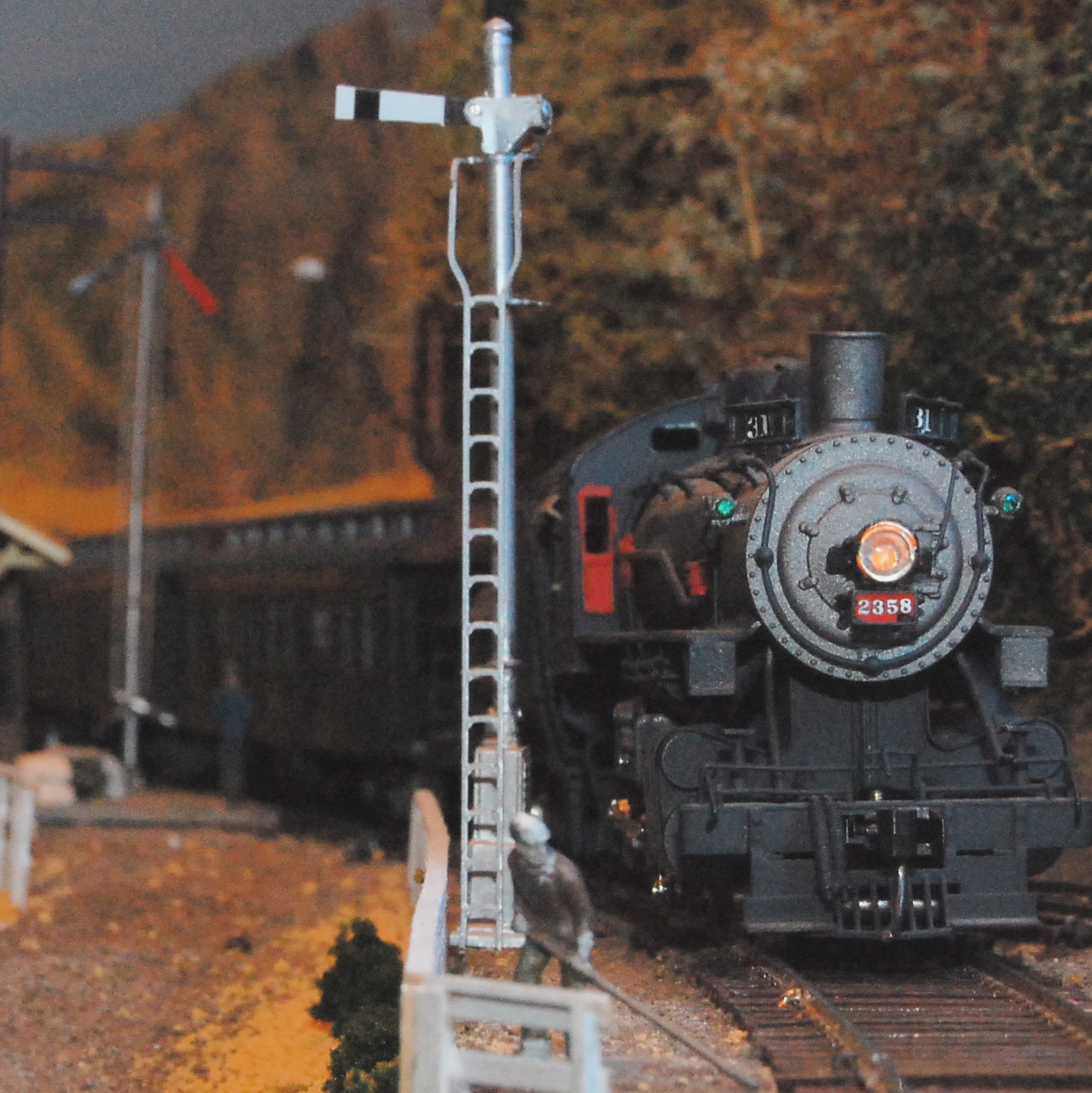
 Winchester Road, the Los Gatos - Cupertino wye leg, and the Los Gatos - Campbell leg in the foreground. The semaphore is a non-operating plastic kit because the staging tracks underneath won't permit a semaphore mechanism.
At least I solved the light problem - while I was at our local Fry's Electronics, I found that they had LED light sticks intended for lighting tricked-out PC cases. For $6, I had a 12" plexiglass tube with 19 LEDs inside, ready to be powered from the same 12 volt source that powers the Tortoises. The color of the LEDs doesn't quite match the warm white fluorescent strip fixtures I normally use to light the lower deck, but there's so little room at Vasona Junction that any tiny fixture is an improvement.
Here's a few photos showing Vasona Junction:


Monday, June 6, 2011
Long Grass: What Works, What Doesn't
Modeling California scenes without tall grass is like modeling Pittburgh without steel mills. Getting that tall grass right has been one of the challenges for me as long as I've been modeling California scenes, and I'm still not sure I can get the look right.
California didn't always look like this, of course. The original California grasslands had a mix of various native and tall grasses that didn't die off in the summer and produced lots of seeds for the animals and the original California Indians. The tall golden grasses are actually invaders that came with the Europeans, and have taken over most of the state. Each of the common grasses is well-known to any schoolkid who learned which could be stripped of seed pods when walking by, which were scratchy, and which could be thrown at other kids.
I've tried several different approaches to modeling tall grass - fine and coarse yellow ground foam (mostly AMSI's #42 ochre and #52 aspen gold, much better than Woodland Scenics' much-too-pale burnt grass), static grass (nice but sparse), fake hair to put in drilled holes, and (best so far) self-adhesive Silflor grass tufts that are great for detailing a scene.
Vasona Junction, however, is the first location where I'm trying out the Silflor grass mats. Silflor mats are static grass applied to a backing; in my case, I'm using the California Golden Grass mat which uses 6.5 mm fiber. This is one of the taller grasses in the Silflor line; they also make mats with fibers as short as 2mm and as tall as 8mm.
Yesterday, I commented that the grass and mat seemed awful high and hard to disguise; here's some close-ups of the Silflor mats (both with an undisguised edge and with 6mm Silflor grass tufts applied along the edges) compared to Silflor's static grass glued straight to the plaster.
 First, here's a photo looking down on the Silflor mat at Vasona Junction. The mat looks great, but notice the grass is close to six feet high near the figure. The grass to the left uses the Silflor grass tufts to hide the edge; the 6 mm tufts are noticeably shorter than the mat, so I took some shears to the edges to disguise the change in material. I really love the opacity of the Silflor mat; none of the ground below can be seen, and it looks like a full pasture covered in grass.
 This photo shows the same scene in side view. Again, nice and opaque, but the grasses seem awfully tall. Most of the effect of the grasses really comes at the edges where the individual grass blades are visible against the backdrop, suggesting that the edges of the grassy area are more important than the middle.
 Here's another pair of photos, this time showing the static grass I installed at Alma last year. This first photo shows the side view of the static grass with the Silflor grass tufts dressing up the area near the retaining wall. Notice that the tufts now tower over the rest of the scene, and the static grass looks a foot or two high - perhaps a bit short, but not burying the scene.
 Finally, here's a photo looking down at the scene. This starts showing the drawback of the static grasses - it looks very sparse when viewed from above. The extra yellow here comes from yellow ground foam added to the scene before the static grass was applied, and keeps the grass from disappearing against the brown soil. (That soil is sifted dirt from the worst corner of my backyard. Because my backyard is downhill from all the scenes here, the dirt color is about as realistic as can be.)
 The photos on the layout might not hint at the actual thickness of the Silflor sheets. Here's a nice photo from my shelf layout showing two pieces of Silflor. The flower bed on the left is a bit of the shorter Silflor mat from one of the Silflor sample kits; the material on the right is the 6.5 mm California Golden Grass mat. The golden grass is noticeably thicker than the shorter mat, so some of my complaints about the California Golden Grass may be specific to that particular product.
Which look do you prefer, or what's your favorite approach for modeling California dry grasses?
California didn't always look like this, of course. The original California grasslands had a mix of various native and tall grasses that didn't die off in the summer and produced lots of seeds for the animals and the original California Indians. The tall golden grasses are actually invaders that came with the Europeans, and have taken over most of the state. Each of the common grasses is well-known to any schoolkid who learned which could be stripped of seed pods when walking by, which were scratchy, and which could be thrown at other kids.
I've tried several different approaches to modeling tall grass - fine and coarse yellow ground foam (mostly AMSI's #42 ochre and #52 aspen gold, much better than Woodland Scenics' much-too-pale burnt grass), static grass (nice but sparse), fake hair to put in drilled holes, and (best so far) self-adhesive Silflor grass tufts that are great for detailing a scene.
Vasona Junction, however, is the first location where I'm trying out the Silflor grass mats. Silflor mats are static grass applied to a backing; in my case, I'm using the California Golden Grass mat which uses 6.5 mm fiber. This is one of the taller grasses in the Silflor line; they also make mats with fibers as short as 2mm and as tall as 8mm.
Yesterday, I commented that the grass and mat seemed awful high and hard to disguise; here's some close-ups of the Silflor mats (both with an undisguised edge and with 6mm Silflor grass tufts applied along the edges) compared to Silflor's static grass glued straight to the plaster.


Which look do you prefer, or what's your favorite approach for modeling California dry grasses?
Sunday, June 5, 2011
Progress on Vasona Junction
Back in January, I made my to-do list of big, risky, time-consuming projects I hoped to do this year.
Some haven't gotten anywhere, such as building Ainsley Cannery.
Others have only gotten to the planning stages, with the revamped sidings in Campbell only getting as far as buying new switches, and the Moody Gulch oil wells only getting as far as research. It's been good research, though. Early California Oil gave me a few details on Moody Gulch, and gave me a much better understanding of the oil boom in Coalinga, Bakersfield, Los Angeles, and Long Beach; I don't think I realized how big a deal each of these oil booms were, and just how much they changed each area. Crude Politics, which I'm only partly through, highlights how the style of the boom was affected by land issues. While Coalinga and the Elk Hills fields were methodically pumped out, the multiple owners of oil in Los Angeles and Long Beach meant that every residential lot dweller dug a well and started pumping as fast as possible in order to get their share of the oil wealth, resulting in poorer fields and worse prices as the fields were overpumped and glutted the market.
Luckily, some of the projects have had real progress. I spent this weekend wiring two new light fixtures for the garage, and the scenery in Vasona Junction is starting to take shape.
First, the light fixtures: I knew the garage was dark, so adding new lights and repositioning others was primarily to improve visibility for operators. I was a bit worried about pulling down the 1960's era large fluorescent fixtures and getting new fixtures up without crushing the layout, but had no mishaps at all. (Whew!). The new lights also make the garage more homey for me. My biggest problem is that I tended to build scenery in the past where the light was good, and now that the light has shifted, attention tends to aim at different spots… with inferior scenery. Time to build out some ignored locations.
 Vasona Junction is making good progress; the backdrop is in, along with rough scenery, dirt, signal equipment, and the beginnings of an orchard. To decorate the scene with the obvious signal hardware, I'm using American Limited Models semaphore kits. These don't move, but they look nice, and I unfortunately don't have space under Vasona Junction for the mechanisms. A pair of their wig-wag grade crossing signals protects Winchester Road, and assorted signal equipment castings from Tomar/Alexander Scale Models provide battery boxes and a remote signal indicator on the Campbell - Cupertino branch of the wye ensures maintenance crews only move their speeder when the track is unoccupied.
I'm also trying the Silflor sheets of tall grass. I'd already used their static grass in the past, but found that while the rolled sheets look denser and better from above, the sheets are much thicker than the static grass, and I'm having trouble hiding the edges. I'm currently using some of the grass tufts, but the height difference is still annoying. I'm still plugging along, though; I'm hoping it'll all start pulling together as a scene more as it gets closer to completion.
Some haven't gotten anywhere, such as building Ainsley Cannery.
Others have only gotten to the planning stages, with the revamped sidings in Campbell only getting as far as buying new switches, and the Moody Gulch oil wells only getting as far as research. It's been good research, though. Early California Oil gave me a few details on Moody Gulch, and gave me a much better understanding of the oil boom in Coalinga, Bakersfield, Los Angeles, and Long Beach; I don't think I realized how big a deal each of these oil booms were, and just how much they changed each area. Crude Politics, which I'm only partly through, highlights how the style of the boom was affected by land issues. While Coalinga and the Elk Hills fields were methodically pumped out, the multiple owners of oil in Los Angeles and Long Beach meant that every residential lot dweller dug a well and started pumping as fast as possible in order to get their share of the oil wealth, resulting in poorer fields and worse prices as the fields were overpumped and glutted the market.
Luckily, some of the projects have had real progress. I spent this weekend wiring two new light fixtures for the garage, and the scenery in Vasona Junction is starting to take shape.
First, the light fixtures: I knew the garage was dark, so adding new lights and repositioning others was primarily to improve visibility for operators. I was a bit worried about pulling down the 1960's era large fluorescent fixtures and getting new fixtures up without crushing the layout, but had no mishaps at all. (Whew!). The new lights also make the garage more homey for me. My biggest problem is that I tended to build scenery in the past where the light was good, and now that the light has shifted, attention tends to aim at different spots… with inferior scenery. Time to build out some ignored locations.

I'm also trying the Silflor sheets of tall grass. I'd already used their static grass in the past, but found that while the rolled sheets look denser and better from above, the sheets are much thicker than the static grass, and I'm having trouble hiding the edges. I'm currently using some of the grass tufts, but the height difference is still annoying. I'm still plugging along, though; I'm hoping it'll all start pulling together as a scene more as it gets closer to completion.
Monday, May 16, 2011
Places I Won't Model: Sewall Brown Co.
[Title borrowed from Derek Lowe's "Things I Won't Work With" series from his "In the Pipeline" blog. Worth reading, especially to hint at why you might not want to be a chemist.]
 I knew when I started building my Vasona Branch layout that I can't fit every possible scene on the San Jose-Santa Cruz branch into the available space. Sometimes that meant hard decisions about leaving out representative scenes, and sometimes it meant having no problem taking the mental pruning shears to my ideas.
The Sewall Brown Co. was one of those easy-to-prune ideas. [Horrible pun completely unintended, I swear.] Sewall Brown collected apricot kernels from the local farmers, drying yards, and canneries; they were processed and sent to Europe for sweets and baking. Others were in the same game; even Del Monte Plant #3 had a portion of the plant to handle this valuable by-product. Brown's warehouse was on the Winchester Road just north of Vasona Junction - about where Highway 85 and the Netflix offices are now located. One of the Vasona Junction photos in Railroads of Los Gatos shows the buildings in the far distance.
 It's also a well-known location because of some photos of trains serving the site, and because of the attached painting which I've seen in a few places. It's an interesting industry, both because it's located in an otherwise empty stretch of track, has the huge billboard sign on the wall, and is an unusual industry that modern-day audiences may never have thought possible.
From a model railroad standpoint, it's less of a draw. The industry location was in a stretch between towns, so it either needs to take the conceptual space of a full town, or needs to be shoehorned in between Campbell and Vasona Junction, and removes some of the distance and emptiness along the route. Sewall Brown is also probably a low-traffic industry; I can imagine it having a hard time filling one car a month, let alone one car a day. For an operating model railroad, an empty spur is at best scenery, and wasting a few feet of layout on that scenery might not always be appropriate. (I find it interesting the painting shows two cars being retrieved on a rainy winter day - would that have ever really happened?)
So Sewall Brown was struck from the layout. Every now and then, I think about adding it back into the area around Vasona Junction, but that stretch from Campbell to Los Gatos really needs to be wall-to-wall orchards, so the apricot pit processor loses.
I was doing some searches on Sewall Brown tonight hoping to find some photos of the Vasona Junction area, and found Mr. Brown's biography transcribed online. One of the interesting facts in that article is the tidbit:
list of Sunsweet packers in 1920 I presented back in December showed that there was a Los Gatos/Vasona packing house at that time.
I'd bet that the Sewall Brown Co. warehouse at Vasona Junction was actually the Sunsweet packing house, and Mr. Brown took over the property when Sunsweet realized that having two packing plants within a couple miles of each other was inefficient. I can't find any mention of the Vasona packing house in The Sunsweet Story, so proving that Sewall Brown had been yet-another-Sunsweet packing house will require a bit of rummaging in city directories.
Off to ancestry.com and the San Jose Library to poke through musty city directories!
(Additional note: The Santa Clara County Fire Department collection of historical photos says that the Sewall Brown plant burned down in September, 1955.)
[Both images from History Los Gatos. I think the painting was done by Michael Kotowski, and appears in Bruce MacGregor's "South Pacific Coast: A Centennial", and I seem to remember seeing it in an Orchard Supply catalog at least a decade ago as well.]

The Sewall Brown Co. was one of those easy-to-prune ideas. [Horrible pun completely unintended, I swear.] Sewall Brown collected apricot kernels from the local farmers, drying yards, and canneries; they were processed and sent to Europe for sweets and baking. Others were in the same game; even Del Monte Plant #3 had a portion of the plant to handle this valuable by-product. Brown's warehouse was on the Winchester Road just north of Vasona Junction - about where Highway 85 and the Netflix offices are now located. One of the Vasona Junction photos in Railroads of Los Gatos shows the buildings in the far distance.

From a model railroad standpoint, it's less of a draw. The industry location was in a stretch between towns, so it either needs to take the conceptual space of a full town, or needs to be shoehorned in between Campbell and Vasona Junction, and removes some of the distance and emptiness along the route. Sewall Brown is also probably a low-traffic industry; I can imagine it having a hard time filling one car a month, let alone one car a day. For an operating model railroad, an empty spur is at best scenery, and wasting a few feet of layout on that scenery might not always be appropriate. (I find it interesting the painting shows two cars being retrieved on a rainy winter day - would that have ever really happened?)
So Sewall Brown was struck from the layout. Every now and then, I think about adding it back into the area around Vasona Junction, but that stretch from Campbell to Los Gatos really needs to be wall-to-wall orchards, so the apricot pit processor loses.
I was doing some searches on Sewall Brown tonight hoping to find some photos of the Vasona Junction area, and found Mr. Brown's biography transcribed online. One of the interesting facts in that article is the tidbit:
Sewall S. Brown attended the grammar and high schools of San Jose and afterward became a student at Stanford University. After completing his education he became connected with the San Jose Water Works and then secured a position as field representative with the California Seed Growers' Association, with which he remained until June 1, 1921, when he came to Los Gatos as superintendent of plant No. 7 of the California Prune & Apricot Growers' Association. He has a comprehensive understanding of the work in which he is engaged and is seeking in every way possible to advance the interests of his employers, who thoroughly appreciate his services.California Prune and Apricot Growers' Association is better known to you frequent readers of the blog as Sunsweet, which also had operations in downtown Campbell, on Lincoln Avenue in San Jose, and elsewhere in the Valley. I hadn't heard of a Sunsweet packing house in Los Gatos, but the
list of Sunsweet packers in 1920 I presented back in December showed that there was a Los Gatos/Vasona packing house at that time.
I'd bet that the Sewall Brown Co. warehouse at Vasona Junction was actually the Sunsweet packing house, and Mr. Brown took over the property when Sunsweet realized that having two packing plants within a couple miles of each other was inefficient. I can't find any mention of the Vasona packing house in The Sunsweet Story, so proving that Sewall Brown had been yet-another-Sunsweet packing house will require a bit of rummaging in city directories.
Off to ancestry.com and the San Jose Library to poke through musty city directories!
(Additional note: The Santa Clara County Fire Department collection of historical photos says that the Sewall Brown plant burned down in September, 1955.)
[Both images from History Los Gatos. I think the painting was done by Michael Kotowski, and appears in Bruce MacGregor's "South Pacific Coast: A Centennial", and I seem to remember seeing it in an Orchard Supply catalog at least a decade ago as well.]
Saturday, May 14, 2011
Coming to Sacramento for X2011 West? Stop at the Vasona Branch!
The Vasona Branch will be part of the Advance Session festivities, with operating sessions on Friday and Sunday, and I'll also have the layout open for the south bay tours on Saturday morning. If you're coming out to X2011 and want to see the Vasona Branch, plan to head out to Silicon Valley for the Advance Section before the big week in Sacramento!
Subscribe to:
Posts (Atom)